EUR/USD surrenders intraday gains after upbeat US ISM Services PMI
- EUR/USD is off from the day's high above 1.1100 but still holds little gains on firm Fed rate cut bets.
- The major trigger for the US Dollar will be the August US NFP report on Friday.
- The ECB is almost certain to cut interest rates this month.

EUR/USD surrenders the majority of its intraday gains after facing selling pressure above the round-level resistance of 1.1100 in Thursday’s North American session. The major currency pair gives up gains as surprisingly upbeat United States (US) ISM Services Purchasing Managers Index (PMI) data for August has offered significant support to the US Dollar (USD). The US Dollar Index (DXY), which tracks the Greenback’s value against six major currencies, recovers the majority of its intraday losses after discovering buying interest near the day's low around 101.00.
The ISM Services PMI report showed that activity in the services sector expanded at a slightly faster pace to 51.5 from July's reading of 51.4. Economists projected the Services PMI to have grown at a slower pace to 51.1.
However, the broader outlook of the US Dollar is still downbeat as weak US ADP Employment Change data has deepened fears about deteriorating labor demand. The agency reported that 99K fresh payrolls were hired in the private sector in August, while investors anticipated new addition of 145K job-seekers, higher than July’s reading of 111K, downwardly revised from 122K.
Weak US private employment data has boosted market expectations for the Federal Reserve (Fed) to begin the long-awaited policy-easing cycle aggressively. A sharp increase in market speculation for the Fed’s large interest rate cut this month weighed heavily on the US Dollar (USD).
For meaningful updates on current labor market conditions, investors await the US Nonfarm Payrolls (NFP) data for August, which will be published on Friday.
Daily digest market movers: EUR/USD holds slight gains amid firm Euro
- EUR/USD tests territory above 1.1100, with investors focusing on a slew of US economic data. The Euro (EUR) is performing strongly against its major peers even though annual Eurozone Retail Sales surprisingly declined by 0.1% in July. The Retail Sales data, a key measure of consumer spending, was expected to have grown at a similar pace. Meanwhile, monthly Retail Sales rose expectedly by 0.1%.
- Weak households' spending would prompt market speculation that the European Central Bank (ECB) will resume its policy-easing cycle this month, which started in June, after pausing in July.
- The ECB is widely anticipated to cut interest rates this month as officials have remained worried about poor growth prospects, with confidence that inflationary pressures continue to ease consistently. ECB Governing Council member François Villeroy de Galhau said in an interview with Bloomberg last week, “There are good reasons for the central bank to consider cutting its key interest rates in September.” Villeroy added, "Unfortunately, our growth remains too weak.” He further added, “The balance of risks still needs to be monitored in Europe."
- Meanwhile, Eurozone growth concerns have deepened further as the final estimate HCOB PMI report showed that the overall economic activity expanded at a slower pace of 51.0 from the flash reading of 51.2. The Composite PMI expanded moderately due to slower growth in the service sector and a continuous contraction in the manufacturing sector.
Technical Analysis: EUR/USD faces selling pressure above 1.1100
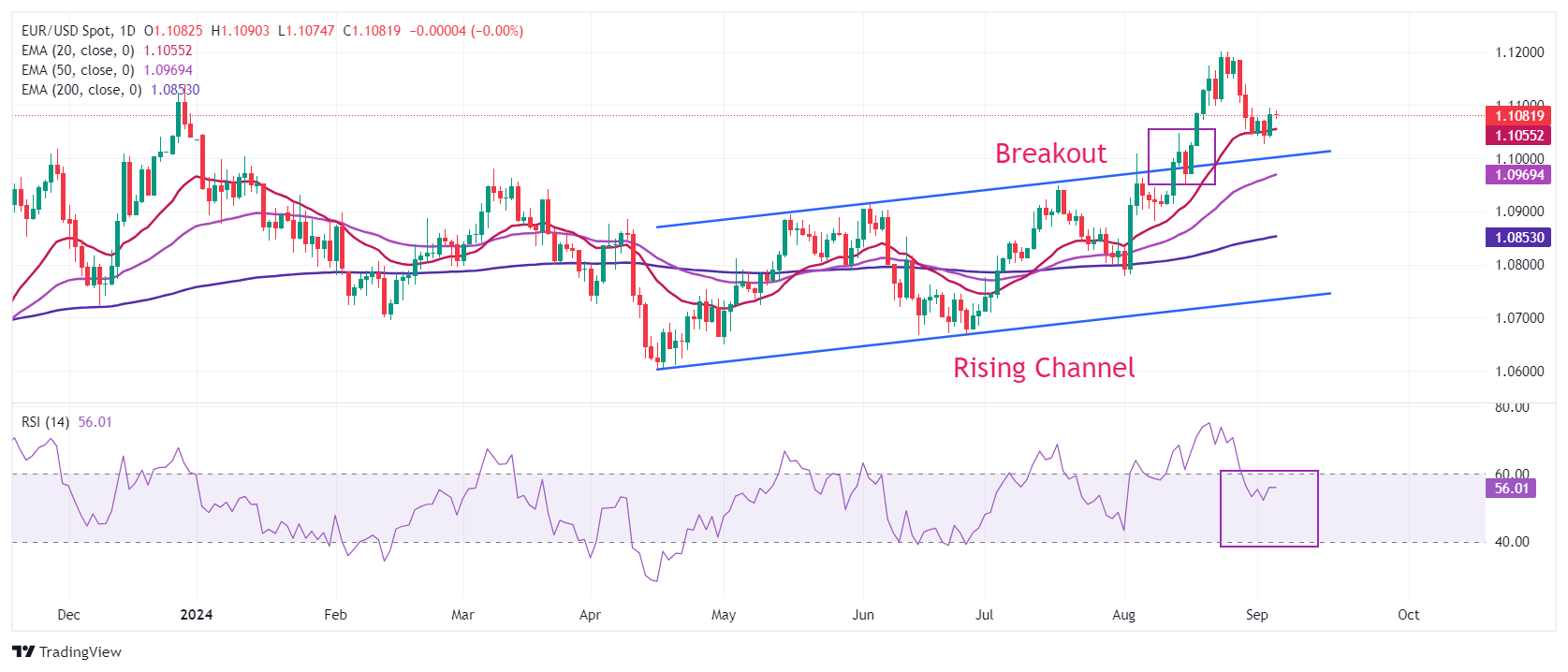
EUR/USD comes down from the day high above 1.1100 in Thursday's New York session. The near-term outlook of the major currency pair remains firm as it manages to gain firm footing near the 20-day Exponential Moving Average (EMA) around 1.1055.
The longer-term outlook is also bullish as the 50-day and 200-day EMAs at 1.0970 and 1.0865, respectively, are sloping higher. Also, the shared currency pair holds the Rising Channel breakout on a daily time frame.
The 14-day Relative Strength Index (RSI) has declined below 60.00 after turning overbought near 75.00.
On the upside, the recent high of 1.1200 and the July 2023 high at 1.1275 will be the next stop for the Euro bulls. Meanwhile, the downside is expected to remain cushioned near the psychological support of 1.1000.
Author

Sagar Dua
FXStreet
Sagar Dua is associated with the financial markets from his college days. Along with pursuing post-graduation in Commerce in 2014, he started his markets training with chart analysis.