EUR/USD refreshes weekly high as US Dollar plummets, US PCE inflation in focus
- EUR/USD rises as the US Dollar posts a fresh weekly low ahead of a slew of US economic data.
- The optimism over Bessent maintaining fiscal discipline keeps the US Dollar under pressure.
- ECB’s Centeno warned about the risk of price pressures remaining below the bank’s target.


EUR/USD posts a fresh weekly high to near 1.0560 in Wednesday’s North American session. The major currency pair strengthens as the US Dollar (USD) extends its downside after the release of a string of United States (US) economic data such as Durable Goods Orders for October, revised Q3 Gross Domestic Product (GDP) growth estimates, and Initial Jobless Claims data for the week ending November 22.
First estimates of Q3 GDP growth show that the US economy expanded by 2.8%, in line with preliminary estimates. Fresh orders for Durable Goods grew at a slower-than-expected pace. Durable Goods Orders rose by 0.2%, slower than estimates of 0.5%. In September, the economic data contracted by 0.4%. Meanwhile, individuals claiming jobless benefits for the first time surprisingly came in lower at 213K than the former release of 215K. Economists expected the Initial Jobless Claims to arrive at 217K.
The US Dollar Index (DXY), which gauges the Greenback’s value against six major currencies, posts a fresh weekly low near 106.00. The Greenback was already in a correction mode after posting a fresh two-year high at around 108.00 on Friday. The correction was triggered after Scott Bessent, a veteran hedge fund manager, said that the objective of enacting tariffs will be “layered in gradually and the budget deficit will be reduced to 3% of Gross Domestic Product (GDP) by slashing spending,” a move that won’t result in high inflation than feared. The comments from Bessent came after US President-elect Donald Trump nominated him for Treasury Secretary.
Going forward, investors will pay close attention to the US Personal Consumption Expenditure Price Index (PCE) data for October, which will be published at 15:00 GMT. The PCE inflation data is the Federal Reserve’s (Fed) preferred inflation measure for decision-making on policy rates. The PCE report is expected to show that the headline inflation accelerated to 2.3% year-over-year in October from 2.1% a month earlier.
In the same period, the core PCE – which excludes volatile food and energy prices – is estimated to have risen by 2.8%, stronger than the former release of 2.7%. The month-on-month headline and core PCE are expected to have grown steadily by 0.2% and 0.3%, respectively.
The US PCE inflation data will influence Fed interest rate cut prospects for the December meeting. On Monday, Minneapolis Fed Bank President Neel Kashkari said it is reasonable to consider another interest rate reduction in the December meeting. His viewpoint of an interest rate cut next month was backed by expectations that inflation is gently trending down and the labor market remains strong right now.
US Dollar PRICE Today
The table below shows the percentage change of US Dollar (USD) against listed major currencies today. US Dollar was the strongest against the Canadian Dollar.
| USD | EUR | GBP | JPY | CAD | AUD | NZD | CHF | |
|---|---|---|---|---|---|---|---|---|
| USD | -0.83% | -0.85% | -1.15% | -0.09% | -0.50% | -1.28% | -0.57% | |
| EUR | 0.83% | -0.03% | -0.32% | 0.74% | 0.33% | -0.46% | 0.26% | |
| GBP | 0.85% | 0.03% | -0.33% | 0.78% | 0.36% | -0.42% | 0.29% | |
| JPY | 1.15% | 0.32% | 0.33% | 1.07% | 0.65% | -0.13% | 0.58% | |
| CAD | 0.09% | -0.74% | -0.78% | -1.07% | -0.42% | -1.20% | -0.48% | |
| AUD | 0.50% | -0.33% | -0.36% | -0.65% | 0.42% | -0.78% | -0.08% | |
| NZD | 1.28% | 0.46% | 0.42% | 0.13% | 1.20% | 0.78% | 0.71% | |
| CHF | 0.57% | -0.26% | -0.29% | -0.58% | 0.48% | 0.08% | -0.71% |
The heat map shows percentage changes of major currencies against each other. The base currency is picked from the left column, while the quote currency is picked from the top row. For example, if you pick the US Dollar from the left column and move along the horizontal line to the Japanese Yen, the percentage change displayed in the box will represent USD (base)/JPY (quote).
Daily digest market movers: EUR/USD extends its upside despite growing Eurozone growth risks
- EUR/USD gains at the US Dollar’s expense on Wednesday. However, the outlook of the Euro (EUR) is downbeat as European Central Bank (ECB) policymakers have grown nervous over the Eurozone’s current and forward economic growth.
- On Tuesday, ECB policymaker and Portuguese central bank chief Mario Centeno warned that the economy was stagnating and "risks are accumulating downwards," with tariffs threatened by Trump a further downside risk. When asked about his outlook on the monetary policy, Centeno warned about the risk of inflation undershooting the bank's target and advised not to leave rate cuts too late.
- On the contrary, ECB member of the executive board Isabel Schnabel ruled out risks of inflation undershooting the bank's target and warned about high inflation in the services sector in her comments during an interview with Bloomberg on Wednesday. On the interest rate outlook, Schnabel commented, "Given the inflation outlook, I think we can gradually move toward neutral if the incoming data continue to confirm our baseline."
- An interest rate reduction from the ECB is almost certain in the December meeting, however, market participants are mixed about the likely rate cut size. “The view here remains there is no fiscal calvary coming in the eurozone and that the only way to address the current malaise is for the European Central Bank to cut rates more quickly than usual. The market now prices 37bp of a 50bp ECB cut in December and short-dated US; eurozone spreads remain very wide at 190bp,” analysts at ING said in a note.
- For fresh guidance on the interest rate path, investors will focus on the flash November Harmonized Index of Consumer Prices (HICP) data for the Eurozone and its major economies, which will be published on Thursday and Friday.
Technical Analysis: EUR/USD jumps above 1.0550
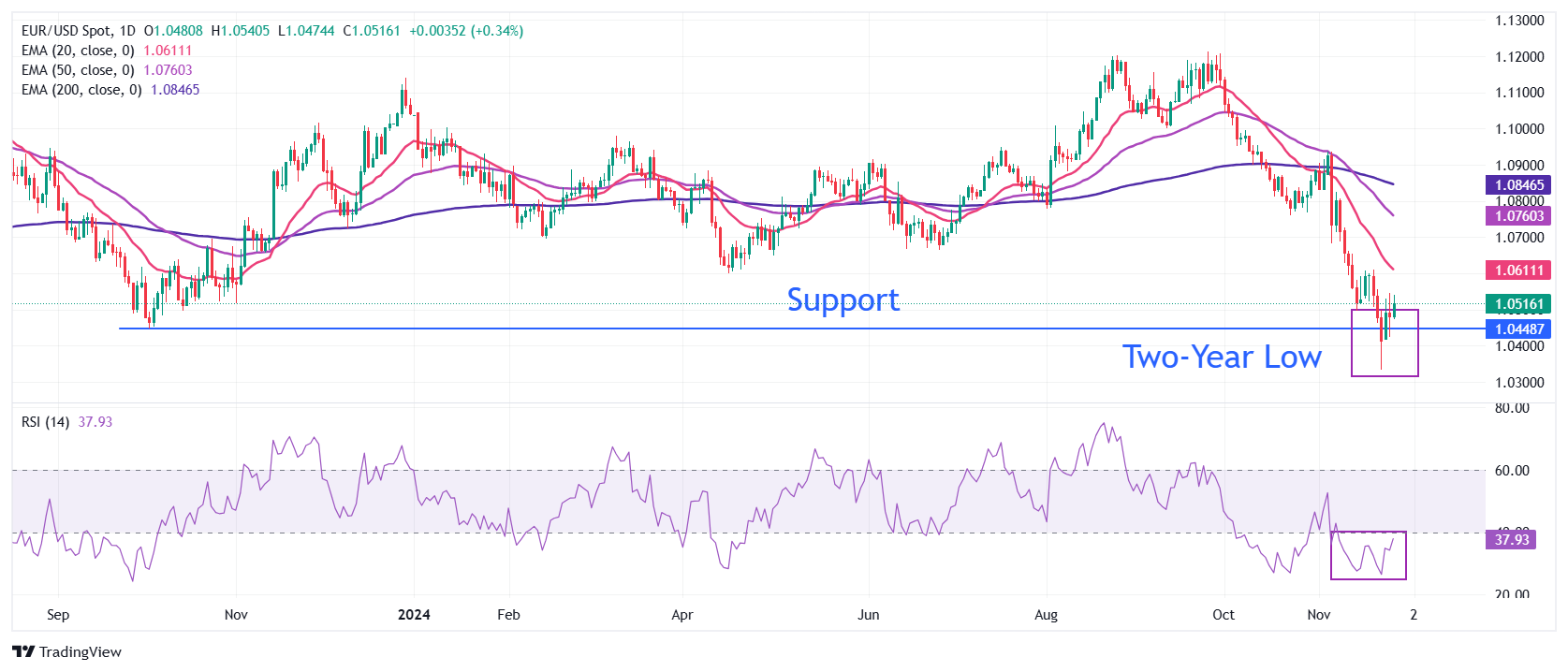
EUR/USD jumps above the psychological figure of 1.0500 in North American trading hours on Wednesday. The major currency pair continues to hold the near-term low of 1.0330. However, the outlook remains bearish as all short-to-long-term day Exponential Moving Averages (EMAs) in the daily chart are declining, pointing to a downside trend.
The 14-day Relative Strength Index (RSI) rebounded after conditions turned oversold. However, the oscillator has cooled down, which could allow bears to take charge again.
Looking down, the November 22 low of 1.0330 will be a key support for Euro bulls. On the flip side, the November 20 high round 1.0600 will be the key barrier.
Economic Indicator
Core Personal Consumption Expenditures - Price Index (YoY)
The Core Personal Consumption Expenditures (PCE), released by the US Bureau of Economic Analysis on a monthly basis, measures the changes in the prices of goods and services purchased by consumers in the United States (US). The PCE Price Index is also the Federal Reserve’s (Fed) preferred gauge of inflation. The YoY reading compares the prices of goods in the reference month to the same month a year earlier. The core reading excludes the so-called more volatile food and energy components to give a more accurate measurement of price pressures." Generally, a high reading is bullish for the US Dollar (USD), while a low reading is bearish.
Read more.Next release: Wed Nov 27, 2024 15:00
Frequency: Monthly
Consensus: 2.8%
Previous: 2.7%
Source: US Bureau of Economic Analysis
After publishing the GDP report, the US Bureau of Economic Analysis releases the Personal Consumption Expenditures (PCE) Price Index data alongside the monthly changes in Personal Spending and Personal Income. FOMC policymakers use the annual Core PCE Price Index, which excludes volatile food and energy prices, as their primary gauge of inflation. A stronger-than-expected reading could help the USD outperform its rivals as it would hint at a possible hawkish shift in the Fed’s forward guidance and vice versa.
Author
Sagar Dua
FXStreet
Sagar Dua is associated with the financial markets from his college days. Along with pursuing post-graduation in Commerce in 2014, he started his markets training with chart analysis.