EUR/USD remains firm as Trump raises tariffs cautiously
- EUR/USD remains firm above 1.0400 as US President Donald Trump has announced lower-than-anticipated tariffs on China.
- ECB’s Lagarde warned that the Euro bloc should be prepared for US tariffs.
- ECB’s Stournaras commented that the policy-easing pace could accelerate if the US imposes tariffs on the Eurozone.
EUR/USD clings to gains above the key support of 1.0400 in Wednesday’s North American session. The major currency pair holds gains while investors gauge explicit United States (US) tariff plans to build fresh positions. The US Dollar Index (DXY), which tracks the Greenback’s value against six major currencies, recovers intraday losses after posting a fresh two-week low near 107.75.
United States (US) President Donald Trump is poised to raise 25% tariffs on Mexico and Canada and 10% on China, which will come into effect on February 1. Trump has also threatened to fix trade imbalances with the Eurozone but has not yet provided clear details. On Monday, Trump said he would remedy the trade imbalance either by “raising tariffs or Europe buying more US oil and gas”. These tariff calls appear less fearful than what market participants had anticipated from Trump’s election campaign comments, diminishing the US Dollar’s (USD) safe-haven demand.
Trump's lower tariff hikes than fears might force traders to pare bets supporting the Federal Reserve (Fed) to keep interest rates at their current levels for longer. Currently, market participants expect the Fed to keep borrowing rates in the range of 4.25%-4.50% in the next three policy meetings.
Daily digest market movers: EUR/USD trades firmly at the cost of US Dollar
- EUR/USD has significantly recovered in the past few trading days. However, its outlook remains uncertain, as President Trump has threatened to impose tariffs on the Eurozone. Additionally, the European Central Bank (ECB) is expected to unwind its policy restrictiveness further and move toward the neutral target of 2%.
- In response to Trump’s threat of tariff hikes, European Union (EU) ministers have commented that they should improve the bloc’s competitiveness and developing capital markets rather than retaliate. ECB’s President Christine Lagarde said in an interview with CNBC on the sidelines of the World Economic Forum (WEF) on Wednesday that Europe must be “prepared for any US tariffs”. Lagarde added that tariffs would be more “selective.”
- EU-US trade relations have also worsened because of Trump’s withdrawal of American membership from the Paris Climate Agreement, which directs members to establish their own targets for reducing greenhouse gas emissions.
- On the monetary policy front, traders price in four 25 basis points (bps) interest rate cuts by the ECB coming consecutively in the next four meetings. ECB policymaker and the Governor of the Bank of Greece Yannis Stournaras said that interest rate cuts should be at the order of “25 bps each time to get close to 2% by the end of 2025”. Stournaras warned that possible US tariffs would “speed up interest rate cuts” in the Eurozone.
Euro PRICE Today
The table below shows the percentage change of Euro (EUR) against listed major currencies today. Euro was the strongest against the Japanese Yen.
| USD | EUR | GBP | JPY | CAD | AUD | NZD | CHF | |
|---|---|---|---|---|---|---|---|---|
| USD | -0.15% | -0.08% | 0.25% | 0.07% | -0.15% | -0.01% | -0.09% | |
| EUR | 0.15% | 0.07% | 0.41% | 0.21% | -0.01% | 0.13% | 0.05% | |
| GBP | 0.08% | -0.07% | 0.33% | 0.15% | -0.07% | 0.06% | -0.01% | |
| JPY | -0.25% | -0.41% | -0.33% | -0.18% | -0.41% | -0.28% | -0.35% | |
| CAD | -0.07% | -0.21% | -0.15% | 0.18% | -0.22% | -0.09% | -0.17% | |
| AUD | 0.15% | 0.00% | 0.07% | 0.41% | 0.22% | 0.13% | 0.06% | |
| NZD | 0.01% | -0.13% | -0.06% | 0.28% | 0.09% | -0.13% | -0.08% | |
| CHF | 0.09% | -0.05% | 0.01% | 0.35% | 0.17% | -0.06% | 0.08% |
The heat map shows percentage changes of major currencies against each other. The base currency is picked from the left column, while the quote currency is picked from the top row. For example, if you pick the Euro from the left column and move along the horizontal line to the US Dollar, the percentage change displayed in the box will represent EUR (base)/USD (quote).
Technical Analysis: EUR/USD refreshes three-week high near 1.0460
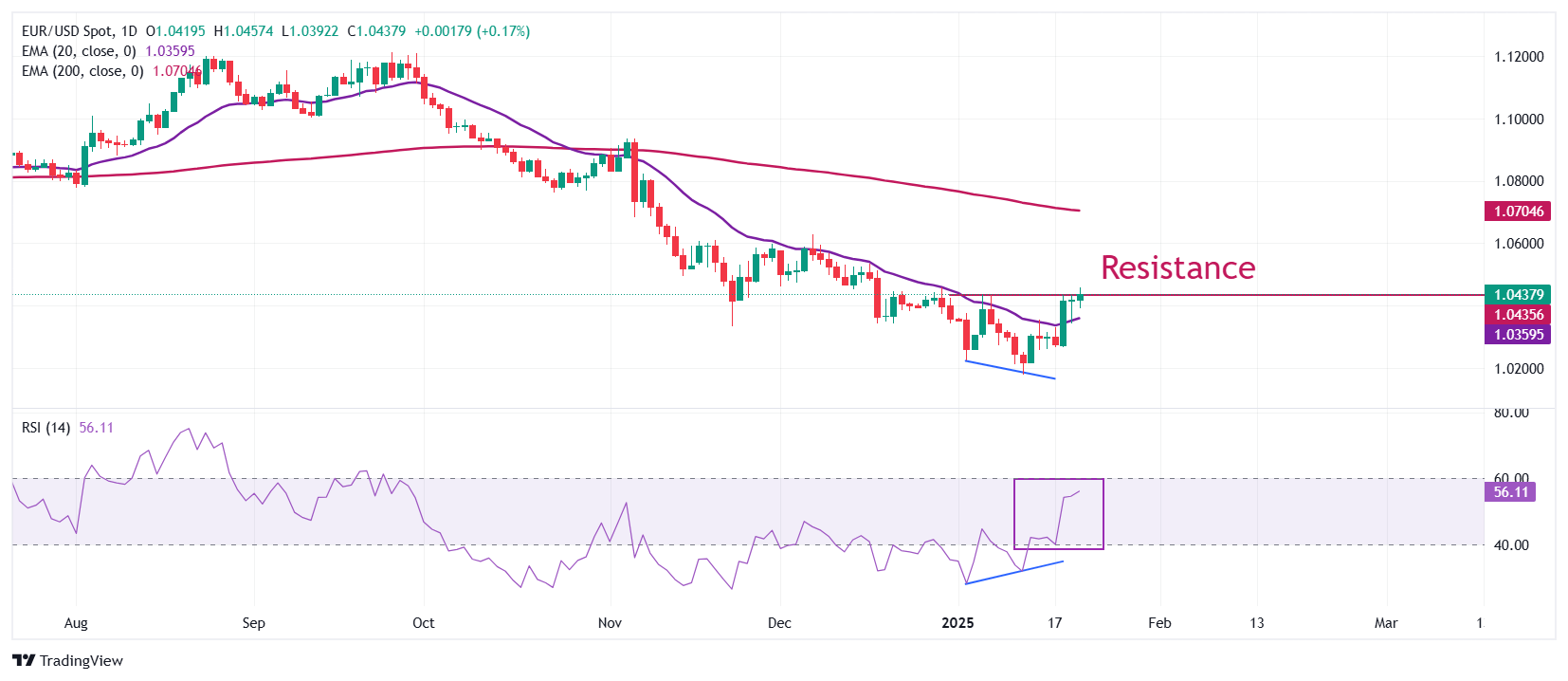
EUR/USD posts a fresh three-week high of 1.0460 in Wednesday’s North American trading hours. The major currency pair recovered after a divergence in momentum and price action. The 14-day Relative Strength Index (RSI) formed a higher low, while the pair made lower lows. The negative divergence would be confirmed if the pair manages to sustain above the immediate support of 1.0450
The near-term outlook of the shared currency pair has improved as it has climbed above the 20-day Exponential Moving Average (EMA), which trades around 1.0358. Meanwhile, the longer-term outlook is still bearish as the 200-day EMA at 1.0700 is sloping downwards.
Looking down, the January 13 low of 1.0175 will be the key support zone for the pair. Conversely, the psychological resistance of 1.0500 will be the key barrier for the Euro bulls.
US Dollar FAQs
The US Dollar (USD) is the official currency of the United States of America, and the ‘de facto’ currency of a significant number of other countries where it is found in circulation alongside local notes. It is the most heavily traded currency in the world, accounting for over 88% of all global foreign exchange turnover, or an average of $6.6 trillion in transactions per day, according to data from 2022. Following the second world war, the USD took over from the British Pound as the world’s reserve currency. For most of its history, the US Dollar was backed by Gold, until the Bretton Woods Agreement in 1971 when the Gold Standard went away.
The most important single factor impacting on the value of the US Dollar is monetary policy, which is shaped by the Federal Reserve (Fed). The Fed has two mandates: to achieve price stability (control inflation) and foster full employment. Its primary tool to achieve these two goals is by adjusting interest rates. When prices are rising too quickly and inflation is above the Fed’s 2% target, the Fed will raise rates, which helps the USD value. When inflation falls below 2% or the Unemployment Rate is too high, the Fed may lower interest rates, which weighs on the Greenback.
In extreme situations, the Federal Reserve can also print more Dollars and enact quantitative easing (QE). QE is the process by which the Fed substantially increases the flow of credit in a stuck financial system. It is a non-standard policy measure used when credit has dried up because banks will not lend to each other (out of the fear of counterparty default). It is a last resort when simply lowering interest rates is unlikely to achieve the necessary result. It was the Fed’s weapon of choice to combat the credit crunch that occurred during the Great Financial Crisis in 2008. It involves the Fed printing more Dollars and using them to buy US government bonds predominantly from financial institutions. QE usually leads to a weaker US Dollar.
Quantitative tightening (QT) is the reverse process whereby the Federal Reserve stops buying bonds from financial institutions and does not reinvest the principal from the bonds it holds maturing in new purchases. It is usually positive for the US Dollar.
Author

Sagar Dua
FXStreet
Sagar Dua is associated with the financial markets from his college days. Along with pursuing post-graduation in Commerce in 2014, he started his markets training with chart analysis.

















