EUR/USD breaks below 1.03 while European sentiment shrinks
- EUR/USD sells off on Wednesday after being rejected above 1.0400 this week.
- Earlier this Wednesday German factory orders sank lower while Eurozone sentiment numbers shrunk further.
- President-elect Donald Trump is mulling to issue an economic state of emergency to issue universal tariffs.

The EUR/USD pair is saying goodbye to for now 1.0300 after being rejected above 1.0400 earlier in the week. The pair erases most of the initial weekly gains after German factory orders data for November came out. The heavily industrialized core European country saw Factory Orders shrink by 5.4% in November, compared to a 1.5% decline in October. The data could not have come at a worse time, given the political campaigning ahead of the German snap elections on February 23.
Meanwhile, markets are on edge over President-elect Donald Trump, who is further shaking up the geopolitical scene. In a statement held at Mar-a-Lago on Tuesday, Trump reiterated his desire to incorporate Greenland, the Panama Canal, and Canada into the United States. Trump also mentioned again that he will address the US rates, which are too high at the moment and need to come down substantially, Bloomberg reports.
Daily digest market movers: Economic emergency
- President-elect Donald Trump is looking into the possibility of issuing universal tariffs under a state of economic emergency. This would implement Trump's tariff plans quite quickly after declearing first a state of emergency which needs swift action, CNN reports.
- German Factory Orders sank in November, contracting by 5.4% on the month compared to the 0% expected. On a yearly basis, factory orders fell by 1.7%, compared to the rise of 5.7% last seen in October.
- German Retail Sales decreased by 0.6% in November, missing the positive 0.5% expectation. At least the actual number is better than the -1.5% seen in October.
- December’s French Consumer Confidence came in at 89, a touch lower than the 90 from November.
- Eurozone Consumer Confidence for December remains unchanged at -14.5, while Industrial Confidence misses its estimate and falls to -14.1, lower than the -11.7 expected and below the revised -11.4 from November.
- November Producer Price Index data for the Eurozone sees a 1.6% uptick against the previous 0.4% increase, and beating the 1.5% consensus view.
- German Bunds ticked up further to hit a near-fresh six-month high of 2.517%, which is no longer far off from the 2.642% high seen in July last year.
- European equities are mildly positive, beating the negative tone seen in Asia, where equities across the region are set to close in red numbers on Wednesday.
Technical Analysis: It could move quickly now
The EUR/USD revival at the beginning of this week looks dead and buried. With a firm correction during the US trading session on Tuesday, it looks like US Dollar (USD) bulls are dominating again. With the resurgence to 1.0440, a window of opportunity was offered for US Dollar bulls that had missed the earlier entry at the end of December.
For the EUR/USD recovery to continue, the first big level to break is 1.0448, the low of October 3, 2023. Once through that level, the 55-day Simple Moving Average (SMA) at 1.0549 comes into play. Another catalyst will be needed for this kind of move, as it could squeeze the Dollar bulls.
On the downside, ahead of the current two-year low of 1.0224, the 1.0294 level is now acting as the new first line of defence. It was a pivotal point on Monday, offering room for buyers in EUR/USD to get involved and push price action higher. Further down, the round level at 1.02 would mean a fresh two-year low. Breaking below that level would open up the room to head to parity, with 1.0100 as the last man standing before that magical 1.00 level.
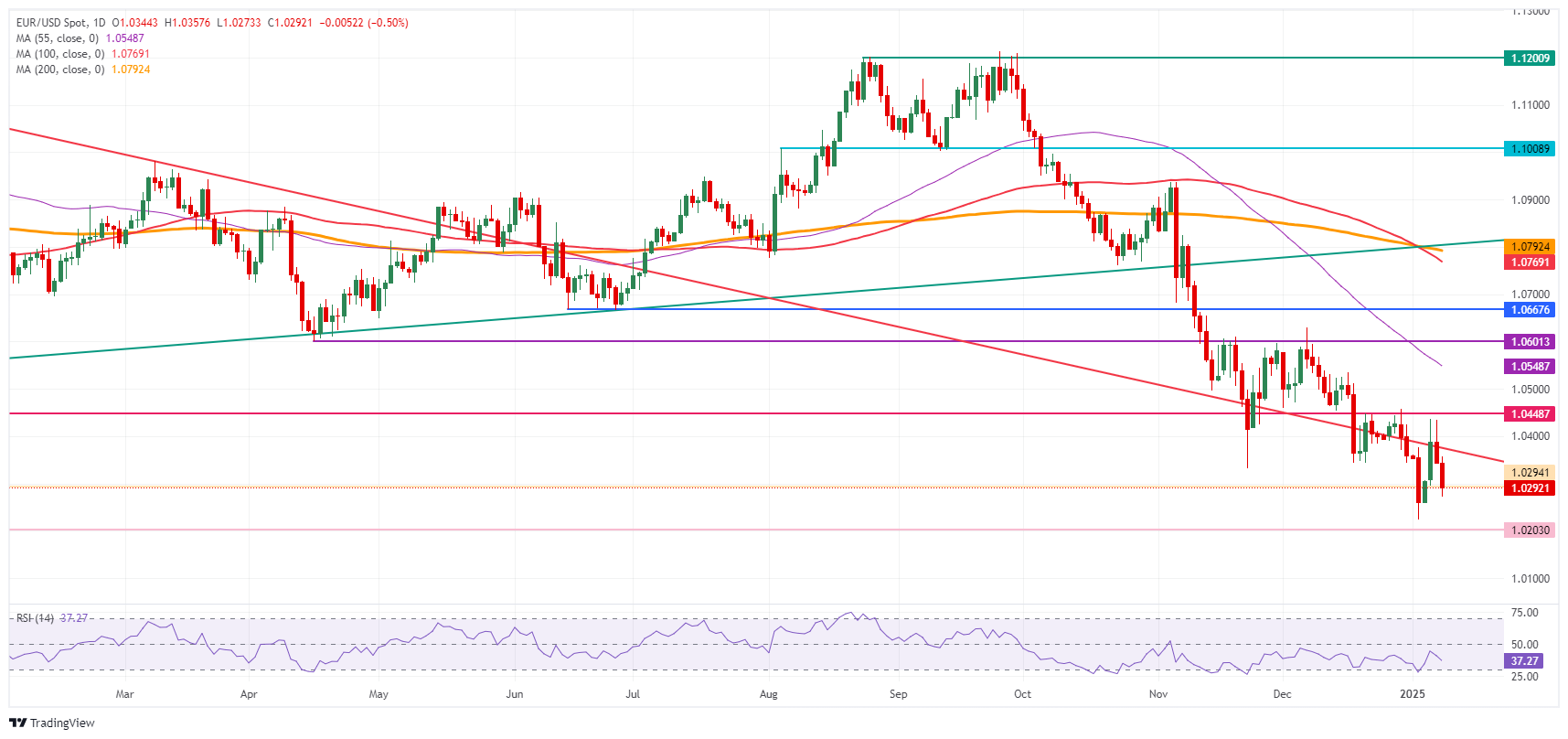
EUR/USD: Daily Chart
German economy FAQs
The German economy has a significant impact on the Euro due to its status as the largest economy within the Eurozone. Germany's economic performance, its GDP, employment, and inflation, can greatly influence the overall stability and confidence in the Euro. As Germany's economy strengthens, it can bolster the Euro's value, while the opposite is true if it weakens. Overall, the German economy plays a crucial role in shaping the Euro's strength and perception in global markets.
Germany is the largest economy in the Eurozone and therefore an influential actor in the region. During the Eurozone sovereign debt crisis in 2009-12, Germany was pivotal in setting up various stability funds to bail out debtor countries. It took a leadership role in the implementation of the 'Fiscal Compact' following the crisis – a set of more stringent rules to manage member states’ finances and punish ‘debt sinners’. Germany spearheaded a culture of ‘Financial Stability’ and the German economic model has been widely used as a blueprint for economic growth by fellow Eurozone members.
Bunds are bonds issued by the German government. Like all bonds they pay holders a regular interest payment, or coupon, followed by the full value of the loan, or principal, at maturity. Because Germany has the largest economy in the Eurozone, Bunds are used as a benchmark for other European government bonds. Long-term Bunds are viewed as a solid, risk-free investment as they are backed by the full faith and credit of the German nation. For this reason they are treated as a safe-haven by investors – gaining in value in times of crisis, whilst falling during periods of prosperity.
German Bund Yields measure the annual return an investor can expect from holding German government bonds, or Bunds. Like other bonds, Bunds pay holders interest at regular intervals, called the ‘coupon’, followed by the full value of the bond at maturity. Whilst the coupon is fixed, the Yield varies as it takes into account changes in the bond's price, and it is therefore considered a more accurate reflection of return. A decline in the bund's price raises the coupon as a percentage of the loan, resulting in a higher Yield and vice versa for a rise. This explains why Bund Yields move inversely to prices.
The Bundesbank is the central bank of Germany. It plays a key role in implementing monetary policy within Germany, and central banks in the region more broadly. Its goal is price stability, or keeping inflation low and predictable. It is responsible for ensuring the smooth operation of payment systems in Germany and participates in the oversight of financial institutions. The Bundesbank has a reputation for being conservative, prioritizing the fight against inflation over economic growth. It has been influential in the setup and policy of the European Central Bank (ECB).
Author

Filip Lagaart
FXStreet
Filip Lagaart is a former sales/trader with over 15 years of financial markets expertise under its belt.