EUR/USD struggles near 1.1000 as ECB Nagel supports more rate cuts
- EUR/USD stays under pressure as the US Dollar sees more upside, with US CPI coming under the spotlight.
- The Fed is expected to cut interest rates by 25 bps in November.
- A majority of ECB policymakers are open to more rate cuts.

EUR/USD remains under pressure as the outlook of the Euro (EUR) remains fragile, with a majority of European Central Bank (ECB) officials continuing to emphasize the need to reduce interest rates further due to a sharp deceleration in Eurozone price pressures and poor economic growth.
In an interview with Table Media, ECB policymaker and Bundesbank President Joachim Nagel said, "I am certainly open to considering whether we could possibly make another interest rate cut.” Nagel has also agreed with the revision of the Eurozone’s Gross Domestic Product (GDP) forecast for 2024 to a 0.2% contraction against a prior projection of 0.3% growth.
However, the German Industrial Production for August has come in better than expected. On a monthly basis, Industrial Production grew at a robust pace of 2.9%, compared to estimates of 0.8% after contracting by 2.4% in July.
Meanwhile, ECB policymaker and Austrian central bank Governor Robert Holzmann advised to proceed with caution on further interest rate cuts as inflation has yet not been defeated, in his comments while interviewing with Sueddeutsche Zeitung published on Monday. In September, the Eurozone flash Harmonized Index of Consumer Prices (HICP) decelerated to 1.8% year-on-year.
Daily digest market movers: EUR/USD trades cautiously as US Dollar holds gains
- EUR/USD remains on backfoot below the psychological resistance of 1.1000 in Tuesday’s North American session. The major currency pair faces pressure as the US Dollar clings to gains, with investors shifting focus to the United States (US) Consumer Price Index (CPI) data for September, which will be published on Thursday.
- The inflation data is expected to show that the annual core CPI – which excludes volatile food and energy prices – has grown at a steady pace of 3.2% year-over-year (YoY). The headline inflation is estimated to have decelerated to 2.3% YoY from 2.5% in August.
- The impact of the inflation data is expected to be lower on the Federal Reserve’s (Fed) interest rate outlook as policymakers are more focused on reviving economic growth and consumer spending. The comments from Fed Governor Adriana Kugler in Tuesday’s European session suggested that the policymaker sees more rate cuts as appropriate if price pressures continue to decline as expected.
- The outlook of the US Dollar remains firm as financial market participants expect the Fed to cut interest rates again in November, but the rate-cut size is expected to be 25 basis points (bps), according to the CME FedWatch tool. Lately, market speculation for a Fed 50 bps rate cut waned after the US job report for September, which showed that labor demand remained robust and wage growth was stronger than expected.
Technical Analysis: EUR/USD struggles for firm footing above 1.0950
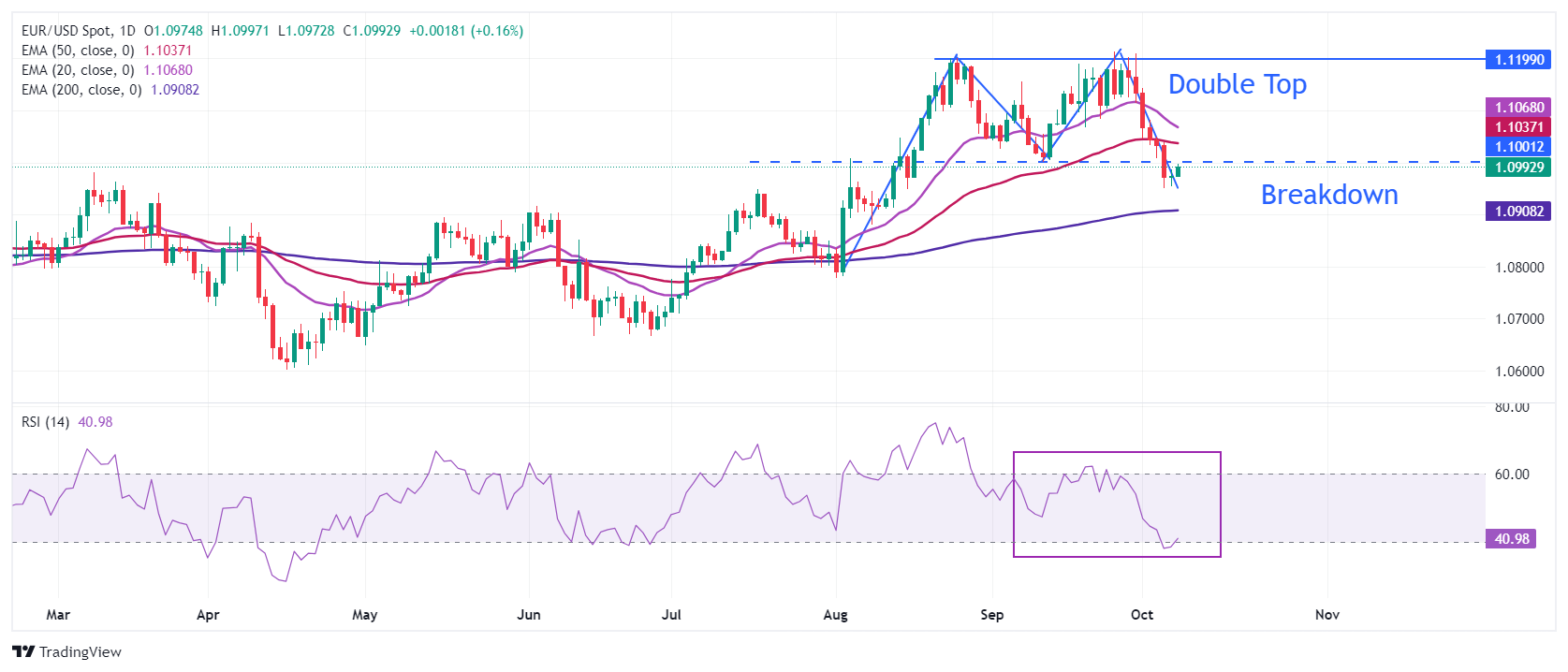
EUR/USD gathers strength to gain ground near the immediate support of 1.0950. The major currency pair is broadly under pressure as it has delivered a breakdown of a Double Top chart pattern formation on a daily timeframe. The above-mentioned chart pattern was triggered after the shared currency pair broke below the September 11 low of 1.1000.
The 14-day Relative Strength Index (RSI) slides below 40.00. A bearish momentum would trigger if the RSI sustains below the same.
Looking down, the pair is expected to find support near the 200-day Exponential Moving Average (EMA) around 1.0900. On the upside, the 20-day EMA at 1.1070 and the September high around 1.1200 will be major resistance zones.
ECB FAQs
The European Central Bank (ECB) in Frankfurt, Germany, is the reserve bank for the Eurozone. The ECB sets interest rates and manages monetary policy for the region. The ECB primary mandate is to maintain price stability, which means keeping inflation at around 2%. Its primary tool for achieving this is by raising or lowering interest rates. Relatively high interest rates will usually result in a stronger Euro and vice versa. The ECB Governing Council makes monetary policy decisions at meetings held eight times a year. Decisions are made by heads of the Eurozone national banks and six permanent members, including the President of the ECB, Christine Lagarde.
In extreme situations, the European Central Bank can enact a policy tool called Quantitative Easing. QE is the process by which the ECB prints Euros and uses them to buy assets – usually government or corporate bonds – from banks and other financial institutions. QE usually results in a weaker Euro. QE is a last resort when simply lowering interest rates is unlikely to achieve the objective of price stability. The ECB used it during the Great Financial Crisis in 2009-11, in 2015 when inflation remained stubbornly low, as well as during the covid pandemic.
Quantitative tightening (QT) is the reverse of QE. It is undertaken after QE when an economic recovery is underway and inflation starts rising. Whilst in QE the European Central Bank (ECB) purchases government and corporate bonds from financial institutions to provide them with liquidity, in QT the ECB stops buying more bonds, and stops reinvesting the principal maturing on the bonds it already holds. It is usually positive (or bullish) for the Euro.
Author

Sagar Dua
FXStreet
Sagar Dua is associated with the financial markets from his college days. Along with pursuing post-graduation in Commerce in 2014, he started his markets training with chart analysis.