EUR/USD cycles familiar levels as NFP jobs dump looms ahead
- EUR/USD spun in place on Wednesday after Fed met expectations.
- The Fed continues to wait for signs of easing inflation, but looking hopeful.
- Friday’s US NFP to have extra weight after Fed flags labor data as key to rate cuts.

EUR/USD churned near key technical levels on Wednesday after the Federal Reserve (Fed) held rates steady for one last meeting as markets had broadly anticipated. The slow race to September’s Fed rate call kicks off on Friday with the latest print of US Nonfarm Payrolls (NFP) for July.
Read more: Jerome Powell speaks on rate outlook after keeping policy settings unchanged
EU data remains limited for the back half of the trading week, leaving investors to focus squarely on upcoming US NFP figures. Median market forecasts are hoping for a continued easing in the US jobs market, calling for net job additions of 175K in July, down from the previous print of 206K.
Federal Reserve Chairman Jerome Powell outlined the specific conditions required for the Fed to implement a rate cut in September. These include ongoing improvements in inflation trends and the US labor market remaining stable or showing further weakening. This provides the markets with a clear benchmark for the upcoming important US economic data releases. The upcoming US Nonfarm Payrolls report, expected to be released on Friday, is anticipated to meet at least one of the Fed's criteria, as it is projected to show a further decrease in job additions for July.
EUR/USD technical outlook
Fiber bids are hung up on the 50-day Exponential Moving Average (EMA) at 1.0818, and middling price action has EUR/USD grinding into a fresh technical middle just north of the 200-day EMA at 1.0796.
The pair is still down from the last swing high that fell just short of 1.0950, but downside momentum is getting squeezed out by a price floor from long-term technical averages. Bidders are set for another attempt to push Fiber back into the high end as a choppy descending channel keeps bullish momentum crimped.
EUR/USD daily chart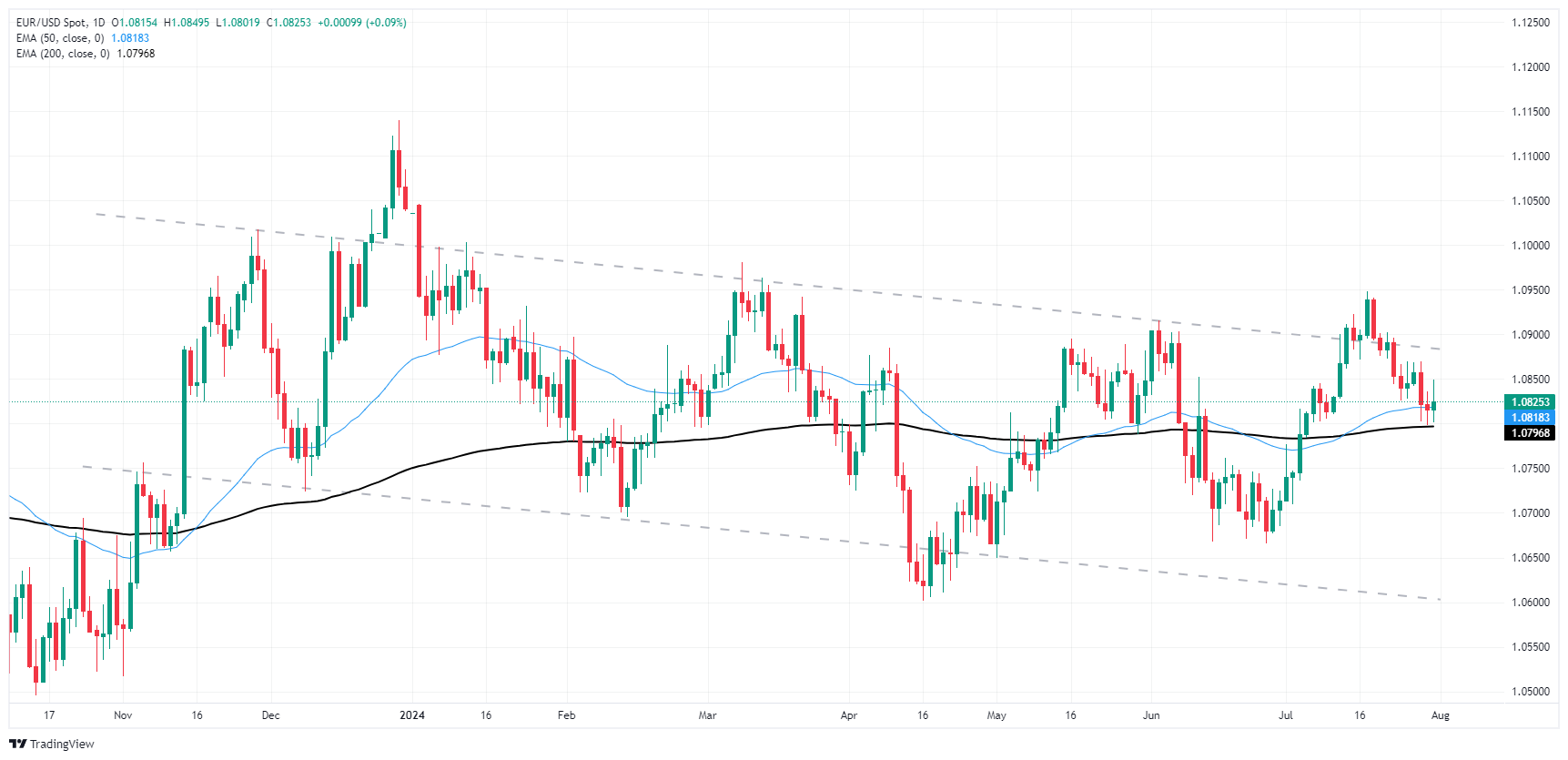
Nonfarm Payrolls FAQs
Nonfarm Payrolls (NFP) are part of the US Bureau of Labor Statistics monthly jobs report. The Nonfarm Payrolls component specifically measures the change in the number of people employed in the US during the previous month, excluding the farming industry.
The Nonfarm Payrolls figure can influence the decisions of the Federal Reserve by providing a measure of how successfully the Fed is meeting its mandate of fostering full employment and 2% inflation. A relatively high NFP figure means more people are in employment, earning more money and therefore probably spending more. A relatively low Nonfarm Payrolls’ result, on the either hand, could mean people are struggling to find work. The Fed will typically raise interest rates to combat high inflation triggered by low unemployment, and lower them to stimulate a stagnant labor market.
Nonfarm Payrolls generally have a positive correlation with the US Dollar. This means when payrolls’ figures come out higher-than-expected the USD tends to rally and vice versa when they are lower. NFPs influence the US Dollar by virtue of their impact on inflation, monetary policy expectations and interest rates. A higher NFP usually means the Federal Reserve will be more tight in its monetary policy, supporting the USD.
Nonfarm Payrolls are generally negatively-correlated with the price of Gold. This means a higher-than-expected payrolls’ figure will have a depressing effect on the Gold price and vice versa. Higher NFP generally has a positive effect on the value of the USD, and like most major commodities Gold is priced in US Dollars. If the USD gains in value, therefore, it requires less Dollars to buy an ounce of Gold. Also, higher interest rates (typically helped higher NFPs) also lessen the attractiveness of Gold as an investment compared to staying in cash, where the money will at least earn interest.
Nonfarm Payrolls is only one component within a bigger jobs report and it can be overshadowed by the other components. At times, when NFP come out higher-than-forecast, but the Average Weekly Earnings is lower than expected, the market has ignored the potentially inflationary effect of the headline result and interpreted the fall in earnings as deflationary. The Participation Rate and the Average Weekly Hours components can also influence the market reaction, but only in seldom events like the “Great Resignation” or the Global Financial Crisis.
Author

Joshua Gibson
FXStreet
Joshua joins the FXStreet team as an Economics and Finance double major from Vancouver Island University with twelve years' experience as an independent trader focusing on technical analysis.