EUR/USD remains below 1.0900 as Fed pushes back early rate-cut bets
- EUR/USD declines as the Fed maintains a hawkish outlook on interest rates.
- Fed Chairman Powell said May’s soft CPI report is encouraging but insufficient to build confidence for rate cuts.
- ECB policymakers see a bumpy path towards the 2% inflation target.

EUR/USD remains below the round-level figure of 1.0800 in Thursday’s New York session. The major currency pair falls as the US Dollar (USD) remains firm even though the United States (US) Producer Price Index (PPI) and Consumer Price Index (CPI) report for May turned out softer than expected. The report shows that the monthly core PPI was unchanged, and the headline figures declined by 0.2%, while investors anticipated them to rise. Annual headline PPI surprisingly decelerated to 2.2%, while economists forecasted the data to grow strongly by 2.5% from the April release of 2.3%, upwardly revised from 2.2%. The core PPI declined to 2.3% from the estimates and the prior release of 2.4%.
Generally, producers reduce the prices of goods and services at their premises when they expect or experience a soft demand environment. This has boosted expectations of a cooling inflation outlook. However, the US Dollar (USD) holds strength as the Federal Reserve's (Fed) hawkish guidance outweighs softening inflation prospects. The US Dollar Index (DXY) holds intraday gains near a crucial resistance of 105.00.
On Wednesday, the Fed kept interest rates unchanged in the range of 5.25%- 5.50% for the seventh straight time, as expected. Policymakers projected fewer rate cuts for this year than they expected three months ago.
Specifically, the Fed’s dot plot indicated that policymakers see only one rate cut this year against the three forecasted in March. Fed officials scaled back the number of rate cuts due to the strong labor market and stubbornly higher inflation in the January-March period. Also, they revised the year-end forecast for the core Personal Consumption Expenditures Price Index (PCE), which is the Fed’s preferred inflation measure, higher to 2.8% from March’s estimate of 2.6%.
In the press conference, Fed Chair Jerome Powell said the May’s CPI report is encouraging but also that policymakers want to see more good data to gain confidence before turning to policy normalization. Fed Powell didn’t provide any cues about Fed rate-cut timing and advocated for maintaining the current interest rate framework for a longer period. Powell added that “unexpected easing” in the labor market could force policymakers to address rate cuts early, but also that the employment outlook appears to be firm.
Daily digest market movers: EUR/USD falls amid uncertainty over French elections
- Investors look for fresh cues about the French election outcome. Polls show that Marine Le Pen's far-right National Rally has presented a strong claim for parliamentary elections but it is slightly short of having an absolute majority. Meanwhile, French Finance Minister Bruno Le Maire said that if RN gains power and goes ahead with its program, “a debt crisis is possible in France," Reuters reported.
- On the monetary policy front, European Central Bank’s (ECB) policymakers have refused to commit to any specific rate-cut trajectory. Conversely, ECB officials have cautioned about inflation remaining persistent due to stubborn price growth in the services sector, which is mainly driven by wage growth.
- This week, ECB President Christine Lagarde said in an interview that last week’s rate-cut move doesn’t commit any linear declining path. "There might be periods where we hold rates again,” she added, according to Reuters.
- Supporting other ECB policymakers, Governing Council member Bostjan Vasle commented that more rate cuts are possible if the disinflation process continues. However, Vasle warned that the process could slow down as wage momentum is relatively strong.
EUR/USD Price Today:
Euro PRICE Today
The table below shows the percentage change of Euro (EUR) against listed major currencies today. Euro was the strongest against the Australian Dollar.
| EUR | USD | GBP | JPY | CAD | AUD | NZD | CHF | |
|---|---|---|---|---|---|---|---|---|
| EUR | -0.37% | -0.11% | -0.14% | -0.12% | 0.04% | -0.03% | -0.28% | |
| USD | 0.37% | 0.26% | 0.22% | 0.25% | 0.42% | 0.35% | 0.08% | |
| GBP | 0.11% | -0.26% | -0.04% | -0.00% | 0.17% | 0.07% | -0.17% | |
| JPY | 0.14% | -0.22% | 0.04% | 0.03% | 0.22% | 0.10% | -0.13% | |
| CAD | 0.12% | -0.25% | 0.00% | -0.03% | 0.17% | 0.09% | -0.16% | |
| AUD | -0.04% | -0.42% | -0.17% | -0.22% | -0.17% | -0.09% | -0.33% | |
| NZD | 0.03% | -0.35% | -0.07% | -0.10% | -0.09% | 0.09% | -0.25% | |
| CHF | 0.28% | -0.08% | 0.17% | 0.13% | 0.16% | 0.33% | 0.25% |
The heat map shows percentage changes of major currencies against each other. The base currency is picked from the left column, while the quote currency is picked from the top row. For example, if you pick the Euro from the left column and move along the horizontal line to the US Dollar, the percentage change displayed in the box will represent EUR (base)/USD (quote).
Technical Analysis: EUR/USD faces selling pressure near 1.0800
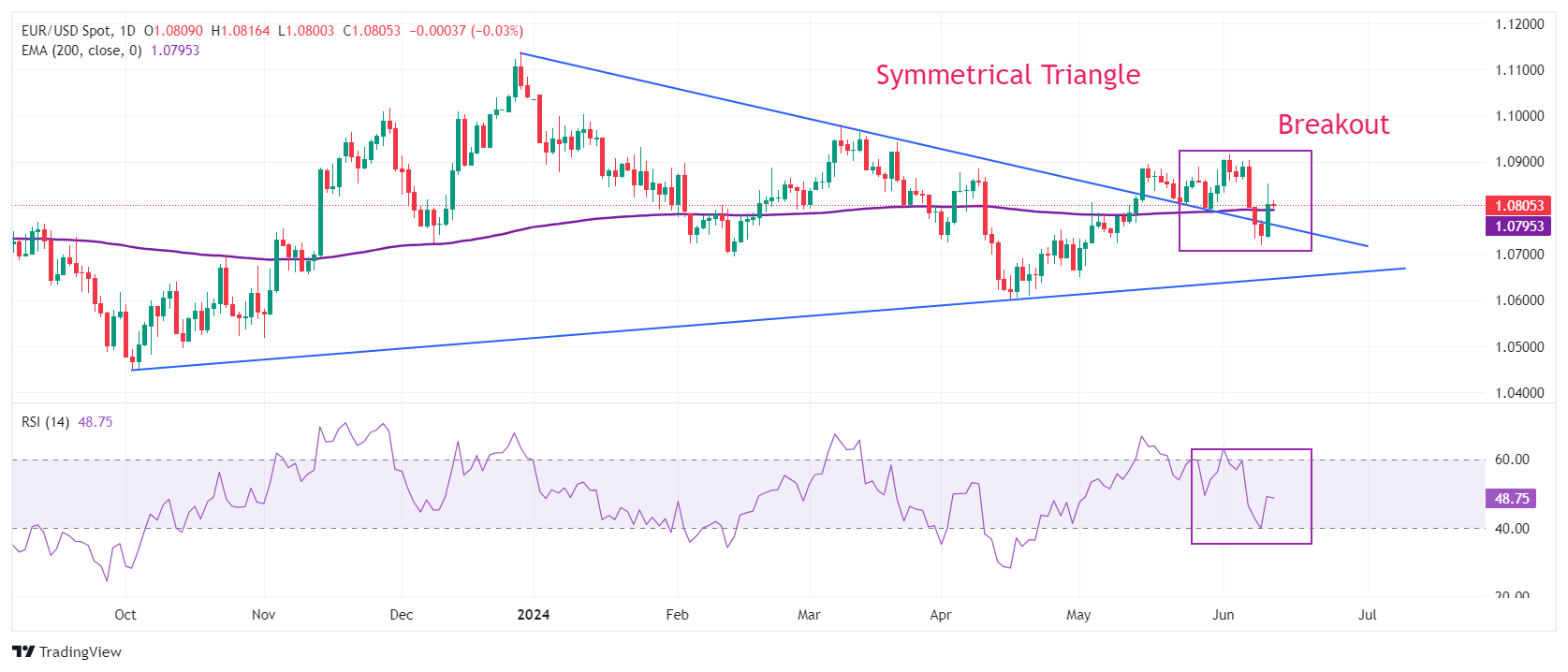
EUR/USD declines to 1.0800 after posting a fresh three-day high near 1.0850. Earlier, the shared currency pair recovered swiftly after sliding to an almost five-week low near 1.0710. The near-term outlook of the major currency pair improved after it break above the Symmetrical Triangle chart formation on the daily time frame. The shared currency pair aims for a two-month high near 1.0900.
The long-term outlook of the shared currency pair remains uncertain as it hovers near the 200-day Exponential Moving Average (EMA), which trades around 1.0800.
The 14-period Relative Strength Index (RSI) finds a cushion near 40.00 and is expected to oscillate in the 40.00-60.00 range, which indicates that the current consolidation could persist.
Economic Indicator
Fed Monetary Policy Statement
Following the Federal Reserve's (Fed) rate decision, the Federal Open Market Committee (FOMC) releases its statement regarding monetary policy. The statement may influence the volatility of the US Dollar (USD) and determine a short-term positive or negative trend. A hawkish view is considered bullish for USD, whereas a dovish view is considered negative or bearish.
Read more.Last release: Wed Jun 12, 2024 18:00
Frequency: Irregular
Actual: -
Consensus: -
Previous: -
Source: Federal Reserve
Author

Sagar Dua
FXStreet
Sagar Dua is associated with the financial markets from his college days. Along with pursuing post-graduation in Commerce in 2014, he started his markets training with chart analysis.

















