EUR/USD churns but finds fresh Friday highs after US NFP sparks rate cut hopes
- EUR/USD clipped into 1.0840 after broad-market risk appetite rally after US NFP print.
- Sharp NFP revisions have reignited hopes for a September Fed rate cut.
- Coming up next week: Fed Chair Powell, US CPI print, German Retail Sales.

EUR/USD whipsawed after a mixed US Nonfarm Payrolls (NFP) print on Friday before settling on the high side, tapping in a peak bid near 1.3840 just ahead of the trading week’s close.
European Industrial Production fell steeper than expected on Friday, contracting -2.5% MoM in May and hobbling Fiber risk appetite. Pan-EU Retail Sales beat forecasts, printing at 0.3% YoY versus the expected 0.1%, but still eased from the previous 0.6%.
Read more: US Nonfarm Payrolls increase 206,000 in June vs. 190,000 forecast
Investors have ignored the better-than-expected Non-Farm Payrolls (NFP) report and are instead paying attention to increasing unemployment, slowing wage growth, and downward revisions to previous job reports. As a result, they are increasing their bets that the Federal Reserve will be pushed to cut interest rates sooner rather than later. The CME's FedWatch Tool shows that the rate markets are currently pricing in an almost 80% probability of at least a quarter-point rate cut on September 18. Friday's US Non-Farm Payrolls (NFP) exceeded median market forecasts by adding 206K net new jobs in June. This figure was higher than the expected 190K, but the previous month's number was revised down sharply to 218K from the initial 272K.
The growth in US Average Hourly Earnings for the year ending June slowed to the expected 3.9% year-over-year, from the previous period's 4.1%. Additionally, the US Unemployment Rate increased to 4.1%, marking the first rise since December 2021. This was slightly higher than the expected 4.0% hold forecasted by the market.
Fed Semi-Annual Policy Report: Need greater confidence before moving to rate cuts
Fiber traders will be looking out for an appearance from Federal Reserve (Fed) Chairman Jerome Powell on Tuesday, followed by final inflation figures from both the EU and the US on Thursday. Next Friday will close out next week with German Retail Sales, as well as US Producer Price Index (PPI) inflation and University of Michigan Consumer Sentiment Index survey results.
Economic Indicator
Nonfarm Payrolls
The Nonfarm Payrolls release presents the number of new jobs created in the US during the previous month in all non-agricultural businesses; it is released by the US Bureau of Labor Statistics (BLS). The monthly changes in payrolls can be extremely volatile. The number is also subject to strong reviews, which can also trigger volatility in the Forex board. Generally speaking, a high reading is seen as bullish for the US Dollar (USD), while a low reading is seen as bearish, although previous months' reviews and the Unemployment Rate are as relevant as the headline figure. The market's reaction, therefore, depends on how the market assesses all the data contained in the BLS report as a whole.
Read more.Last release: Fri Jul 05, 2024 12:30
Frequency: Monthly
Actual: 206K
Consensus: 190K
Previous: 272K
Source: US Bureau of Labor Statistics
America’s monthly jobs report is considered the most important economic indicator for forex traders. Released on the first Friday following the reported month, the change in the number of positions is closely correlated with the overall performance of the economy and is monitored by policymakers. Full employment is one of the Federal Reserve’s mandates and it considers developments in the labor market when setting its policies, thus impacting currencies. Despite several leading indicators shaping estimates, Nonfarm Payrolls tend to surprise markets and trigger substantial volatility. Actual figures beating the consensus tend to be USD bullish.
EUR/USD technical outlook
EUR/USD drifted into the high end in largely one-sided trading this week, climbing from the early week’s low bids near 1.0710. Fiber climbed 1.25% bottom-to-top through the trading week, and chalked in seven consecutive trading days in the green.
Fiber bidders have extended price action north of the 200-day Exponential Moving Average (EMA) at 1.0784, but a rough descending channel is still pricing in downside technical pressure just above 1.0860.
EUR/USD hourly chart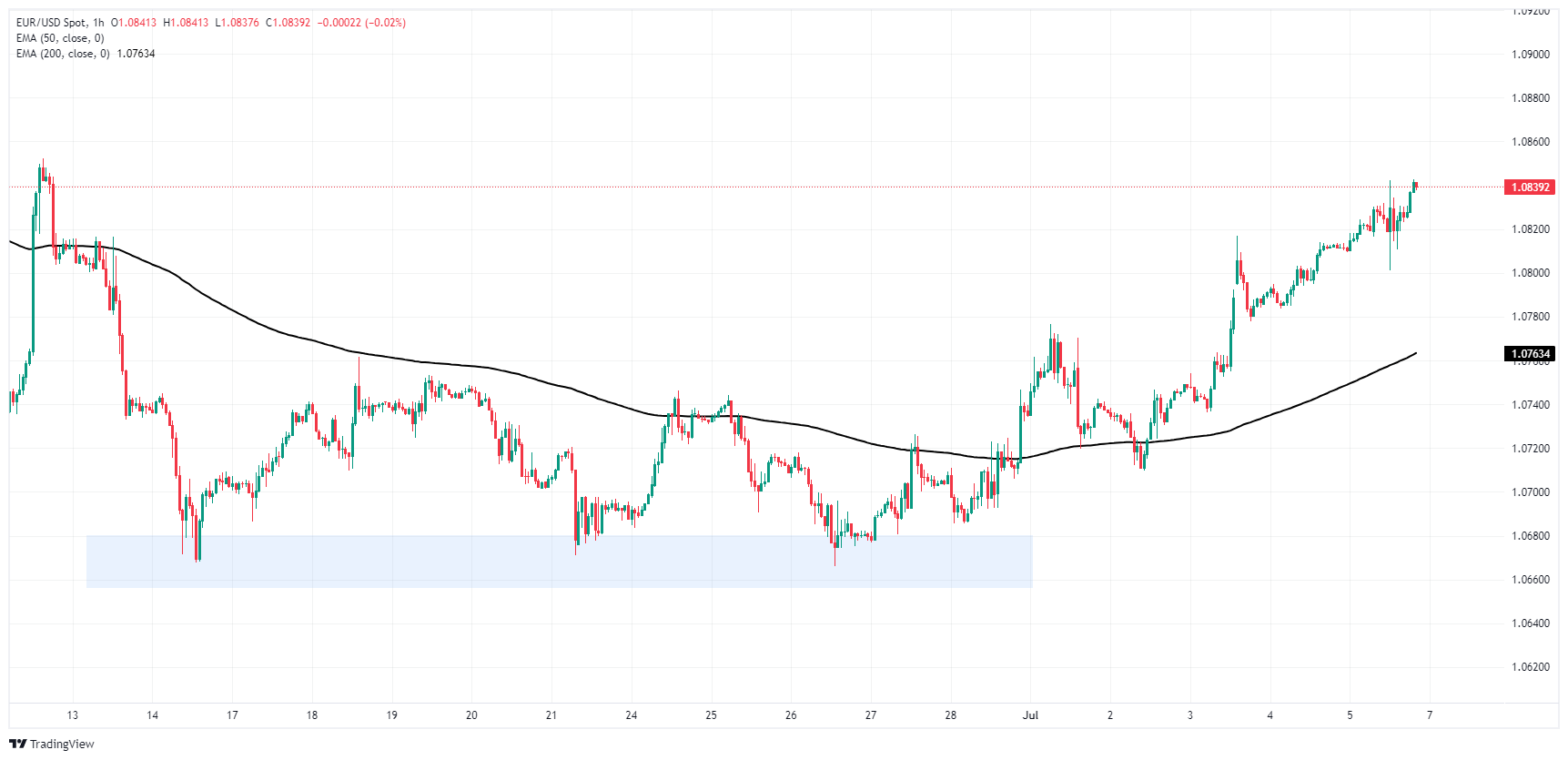
EUR/USD daily chart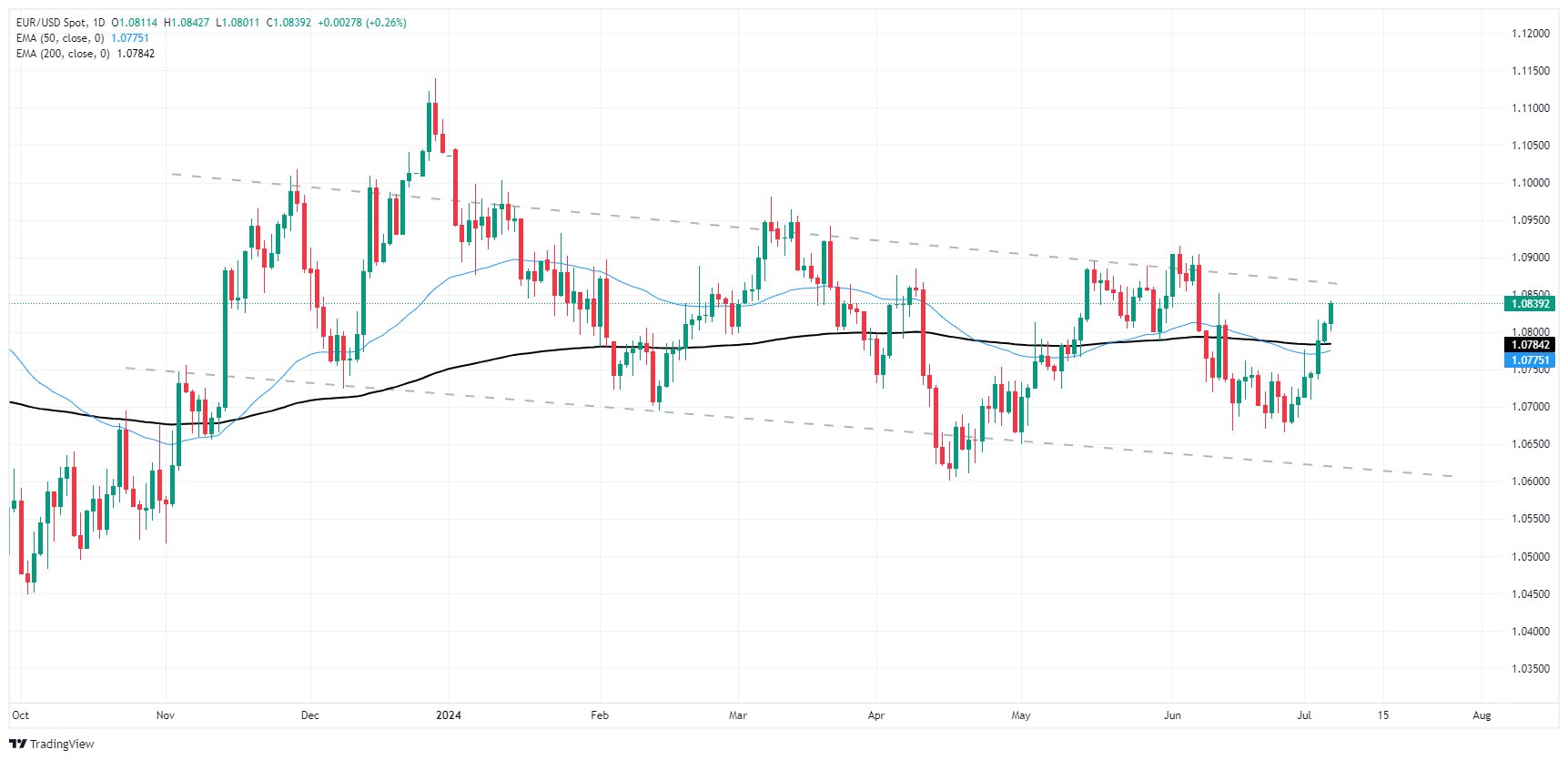
Euro FAQs
The Euro is the currency for the 20 European Union countries that belong to the Eurozone. It is the second most heavily traded currency in the world behind the US Dollar. In 2022, it accounted for 31% of all foreign exchange transactions, with an average daily turnover of over $2.2 trillion a day. EUR/USD is the most heavily traded currency pair in the world, accounting for an estimated 30% off all transactions, followed by EUR/JPY (4%), EUR/GBP (3%) and EUR/AUD (2%).
The European Central Bank (ECB) in Frankfurt, Germany, is the reserve bank for the Eurozone. The ECB sets interest rates and manages monetary policy. The ECB’s primary mandate is to maintain price stability, which means either controlling inflation or stimulating growth. Its primary tool is the raising or lowering of interest rates. Relatively high interest rates – or the expectation of higher rates – will usually benefit the Euro and vice versa. The ECB Governing Council makes monetary policy decisions at meetings held eight times a year. Decisions are made by heads of the Eurozone national banks and six permanent members, including the President of the ECB, Christine Lagarde.
Eurozone inflation data, measured by the Harmonized Index of Consumer Prices (HICP), is an important econometric for the Euro. If inflation rises more than expected, especially if above the ECB’s 2% target, it obliges the ECB to raise interest rates to bring it back under control. Relatively high interest rates compared to its counterparts will usually benefit the Euro, as it makes the region more attractive as a place for global investors to park their money.
Data releases gauge the health of the economy and can impact on the Euro. Indicators such as GDP, Manufacturing and Services PMIs, employment, and consumer sentiment surveys can all influence the direction of the single currency. A strong economy is good for the Euro. Not only does it attract more foreign investment but it may encourage the ECB to put up interest rates, which will directly strengthen the Euro. Otherwise, if economic data is weak, the Euro is likely to fall. Economic data for the four largest economies in the euro area (Germany, France, Italy and Spain) are especially significant, as they account for 75% of the Eurozone’s economy.
Another significant data release for the Euro is the Trade Balance. This indicator measures the difference between what a country earns from its exports and what it spends on imports over a given period. If a country produces highly sought after exports then its currency will gain in value purely from the extra demand created from foreign buyers seeking to purchase these goods. Therefore, a positive net Trade Balance strengthens a currency and vice versa for a negative balance.
Author

Joshua Gibson
FXStreet
Joshua joins the FXStreet team as an Economics and Finance double major from Vancouver Island University with twelve years' experience as an independent trader focusing on technical analysis.