EUR/USD backslides ahead of Fed rate call
- EUR/USD shed 0.6% on Tuesday as market sentiment pulls back.
- Latest Fed rate call expected to be a hold, investors waiting to see changes in narrative.
- Tariff threats continue to hang over trader risk appetite, keeping Greenback bid.

EUR/USD pared recent gains on Tuesday, shedding six-tenths of one percent and inching back toward the 1.0400 handle as markets gear up for another outing from the Federal Reserve (Fed) on Wednesday. Markets are overwhelmingly expecting a flat rate hold from the Fed in January, but investors will be keeping a close eye on not only Fed Chair Jerome Powell’s press conference, but any tweets from US President Donald Trump.
The economic calendar is lacking any meaningful data on the European side for the front half of the week. Fiber traders will have to wait until Thursday’s Gross Domestic Product (GDP) updates from both Germany and the pan-EU area for the fourth quarter.
Late Monday, US President Donald Trump swiftly resumed his aggressive tariff agenda, reiterating his intention to impose hefty import fees on a broad spectrum of foreign goods and industries. This latest version of his plan involves vague tariffs on steel, copper, aluminum, various semiconductors, and foreign microprocessors in general, aimed at compelling foreign businesses to relocate their factories to the US.
Persuading these sectors to shift production domestically is a challenging task, as establishing factories in the US is typically costly, and US labor demands significantly higher wages compared to countries that produce industrial goods on a large scale. As a result, import fees are unlikely to influence production decisions significantly; instead, they may lead to inflation and reduced consumer spending.
The Federal Reserve is expected to announce its latest interest rate decision on Wednesday. While no change in the fed funds rate is anticipated this week, traders will closely watch for updates on the ongoing tensions between Fed Chair Jerome Powell and President Trump. The Fed's considerable autonomy limits the White House's influence over interest rates, a situation President Trump has expressed frustration about in the past. Trump’s recent claims that he will “demand” lower interest rates are expected to impact Chair Powell’s upcoming press conference.
EUR/USD price forecast
The Euro’s backslide against the Greenback on Tuesday puts the Fiber in a tenuous technical scenario: a bearish turnaround in EUR/USD bids is forming a technical rejection from the 50-day Exponential Moving Average (EMA) declining into 1.0460. The pair is poised for further losses on a technical basis, unless bidders are able to muscle price action back into the green and on a path toward the 200-day EMA, floating just south of the 1.0700 handle.
EUR/USD daily chart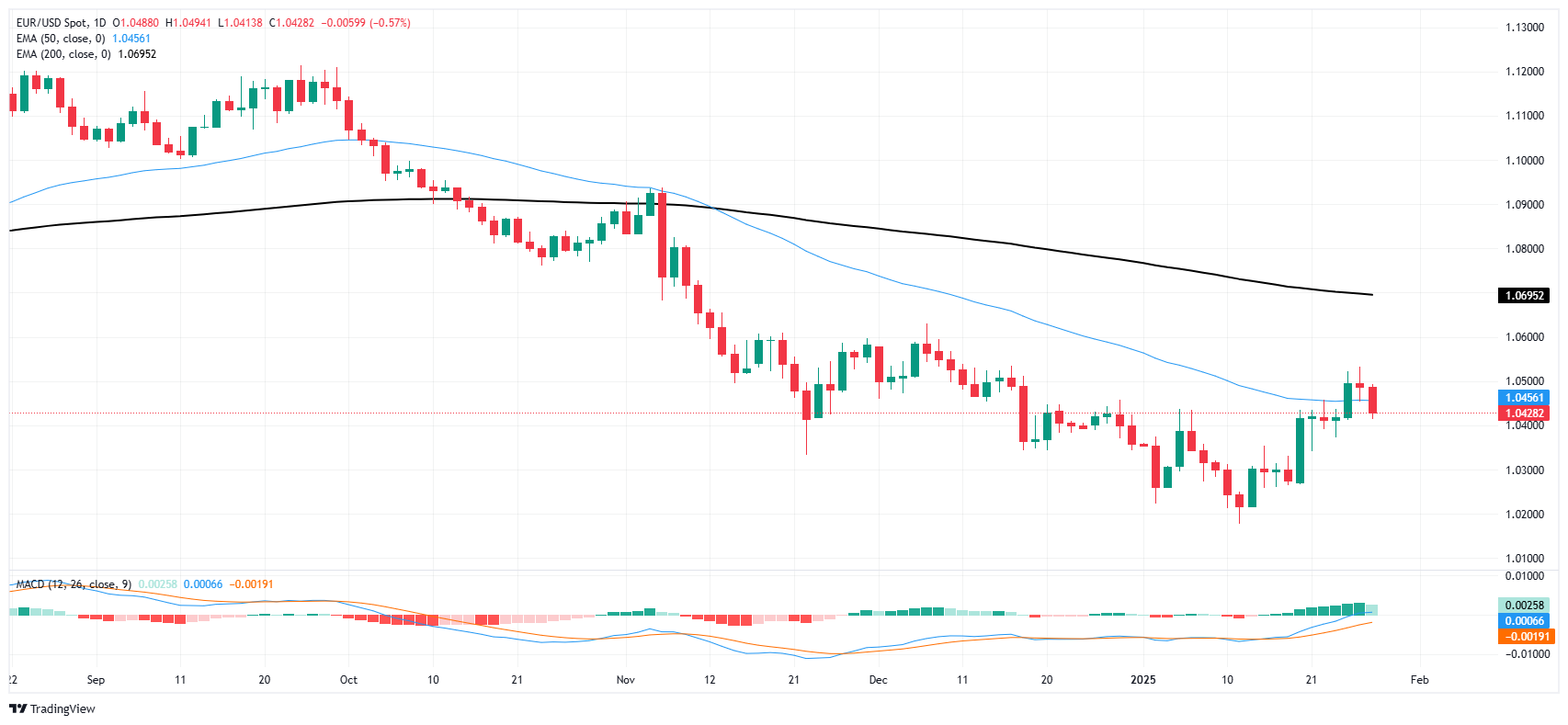
Euro FAQs
The Euro is the currency for the 19 European Union countries that belong to the Eurozone. It is the second most heavily traded currency in the world behind the US Dollar. In 2022, it accounted for 31% of all foreign exchange transactions, with an average daily turnover of over $2.2 trillion a day. EUR/USD is the most heavily traded currency pair in the world, accounting for an estimated 30% off all transactions, followed by EUR/JPY (4%), EUR/GBP (3%) and EUR/AUD (2%).
The European Central Bank (ECB) in Frankfurt, Germany, is the reserve bank for the Eurozone. The ECB sets interest rates and manages monetary policy. The ECB’s primary mandate is to maintain price stability, which means either controlling inflation or stimulating growth. Its primary tool is the raising or lowering of interest rates. Relatively high interest rates – or the expectation of higher rates – will usually benefit the Euro and vice versa. The ECB Governing Council makes monetary policy decisions at meetings held eight times a year. Decisions are made by heads of the Eurozone national banks and six permanent members, including the President of the ECB, Christine Lagarde.
Eurozone inflation data, measured by the Harmonized Index of Consumer Prices (HICP), is an important econometric for the Euro. If inflation rises more than expected, especially if above the ECB’s 2% target, it obliges the ECB to raise interest rates to bring it back under control. Relatively high interest rates compared to its counterparts will usually benefit the Euro, as it makes the region more attractive as a place for global investors to park their money.
Data releases gauge the health of the economy and can impact on the Euro. Indicators such as GDP, Manufacturing and Services PMIs, employment, and consumer sentiment surveys can all influence the direction of the single currency. A strong economy is good for the Euro. Not only does it attract more foreign investment but it may encourage the ECB to put up interest rates, which will directly strengthen the Euro. Otherwise, if economic data is weak, the Euro is likely to fall. Economic data for the four largest economies in the euro area (Germany, France, Italy and Spain) are especially significant, as they account for 75% of the Eurozone’s economy.
Another significant data release for the Euro is the Trade Balance. This indicator measures the difference between what a country earns from its exports and what it spends on imports over a given period. If a country produces highly sought after exports then its currency will gain in value purely from the extra demand created from foreign buyers seeking to purchase these goods. Therefore, a positive net Trade Balance strengthens a currency and vice versa for a negative balance.
Author

Joshua Gibson
FXStreet
Joshua joins the FXStreet team as an Economics and Finance double major from Vancouver Island University with twelve years' experience as an independent trader focusing on technical analysis.