|

EUR/USD attempts a recovery post-IFO, still below 1.10

  • EUR/USD breathes some respite post-German data.
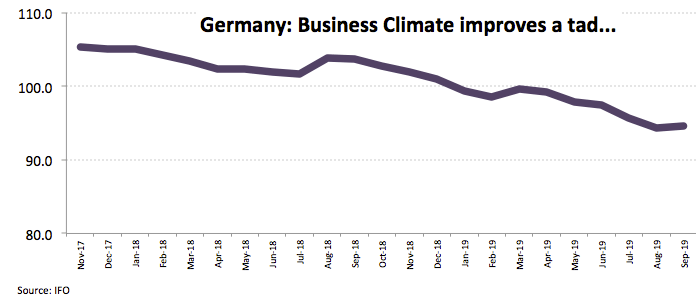
  • German Business Climate slightly improved in September.
  • US Consumer Confidence next of relevance later in the session.

The single currency debates between gains and losses vs. the Greenback on Tuesday, with EUR/USD still parked around the 1.0990 region.

EUR/USD support emerged near 1.0970

The decline in spot appears to have run out of steam so far on Tuesday, particularly after the positive results from the German IFO.

In fact, Business Climate in Germany improved a tad to 94.6 (from 94.3) for the current month, while Current Assessment also bettered to 98.5 (from 97.4). On the soft side, Business Expectations eased to 90.8 (from 91.3).

These auspicious results gave some oxygen to the beleaguered pair, although a re-test/surpass of the critical 1.10 barrier still looks elusive amidst trade uncertainty, declining European yields and a stronger Dollar.

What to look for around EUR

EUR is facing extra downside pressure at the beginning of the week and threatens to extend the move to 2019 lows in the 1.0920 region, as any recovery in the German economy appears to take longer than expected in light of the recent flash PMIs. The unremitting slowdown in the region justifies the looser for longer monetary conditions by the ECB and adds to the probability that the German economy could slip into technical recession in Q3. Adding to this gloomy scenario, potential US tariffs on imports of EU cars remain well on the table, while persistent uncertainty around Brexit adds to the downbeat outlook.

EUR/USD levels to watch

At the moment, the pair is losing 0.03% at 1.0989 and a break below 1.0966 (low Sep.23) would target 1.0925 (2019 low Sep.3) en route to 1.0839 (monthly low May 11 2017). On the flip side, the initial hurdle emerges at 1.1029 (21-day SMA) followed by 1.1109 (monthly high Sep.13) and finally 1.1163 (high Aug.26).
Author

Pablo Piovano

Born and bred in Argentina, Pablo has been carrying on with his passion for FX markets and trading since his first college years.


More from Pablo Piovano
Share:

Editor's Picks

AUD/USD turns south toward 0.6900 as USD firms up

AUD/USD sees fresh selling and drops toward 0.6900 in late Asian trading on Monday, as renewed US Dollar strength weighs on the pair amid lingering Middle East and Russia-Ukraine geopolitical tensions. Focus remains on Oil prices, Treasury bond yields, and RBA expectations for fresh trading impetus in the major.

USD/JPY retakes 158.00 amid hawkish BoJ bets, firmer USD

USD/JPY erases losses and retakes 158.00 in the Asian session on Monday, trading within a one-week-old range. Geopolitical uncertainty continues to underpin the US Dollar, despite fading Fed rate hike hopes, supporting the pair's rebound. However, further upside could be capped by hawkish BoJ expectations and looming intervention risks that could support the Japanese Yen.

Gold trades flat as stronger US Dollar offsets easing Fed rate-hike bets

Gold trades little changed on Monday after giving back most of its early gains. The metal remains caught between easing Fed interest-rate hike bets and a stronger US Dollar (USD), while US Treasury yields also remain elevated near multi-year highs.

Crypto Today: Bitcoin rally slows while Ethereum and XRP extend recovery amid slowing ETF inflows

Bitcoin is narrowly consolidating while trading above $86,000 at the time of writing on Monday. Altcoins, on the other hand, show a positive outlook, with Ethereum edging higher above $2,700 while Ripple steadies above $1.52.

Eurozone inflation just hit 3.8%, its highest in three years. This chart shows why the ECB can’t simply hike its way out

The ECB would normally have a relatively straightforward answer to inflation running almost twice its target: raise interest rates. But these are not normal circumstances. This time, the bond market is already doing part of the tightening for it, leaving the ECB facing an increasingly difficult dilemma.

Eurozone inflation just hit 3.8%, its highest in three years. This chart shows why the ECB can’t simply hike its way out

The ECB would normally have a relatively straightforward answer to inflation running almost twice its target: raise interest rates. But these are not normal circumstances. This time, the bond market is already doing part of the tightening for it, leaving the ECB facing an increasingly difficult dilemma.














