EUR/USD is at parity risk as traders price in four ECB rate cuts this year
- EUR/USD finds interim support near 1.0220; however, more downside looks likely.
- The Fed is expected to cut interest rates two times this year.
- Investors await the US ISM Manufacturing PMI and the German HICP data for December.

EUR/USD finds temporary support in Friday’s North American session after diving to near 1.0220 on Thursday, the lowest level seen in over two years. Market experts see the major currency pair falling further to parity on Federal Reserve (Fed) – European Central Bank’s (ECB) divergent views on the monetary policy outlook.
On the left side of the Atlantic, Fed officials have guided less interest rate cuts in 2025, while on the right, ECB policymakers see the continuation of the policy-easing cycle at the current pace.
According to the latest dot plot in the Fed’s Summary of Economic Projections, Fed officials see Federal fund rates heading to 3.9% by year-end. This indicates that policymakers expect two interest rate cuts this year, compared to four forecasted in September.
Market participants have also trimmed Fed dovish bets. They expect policies under President-elect Donald Trump's administration, such as tight immigration, higher import tariffs, and lower taxes, to boost the growth rate and inflationary pressures in the United States (US) economy.
The US Dollar Index (DXY), which tracks the Greenback’s value against six major currencies, edges down on Friday but is still close to its highest level in two years, above 109.00.
Going forward, investors will pay close attention to a slew of US labor market-related economic indicators, which will influence Fed interest rate expectations. Currently, the Fed is almost certain to keep interest rates steady in the range of 4.25%-4.50% in January’s policy meeting.
In Friday’s session, the US Dollar will be guided by the US ISM Manufacturing Purchasing Managers Index (PMI) data for December, which will be published at 15:00 GMT. The PMI is expected to remain at 48.4, suggesting that manufacturing sector activities contracted at a steady pace.
US Dollar PRICE Today
The table below shows the percentage change of US Dollar (USD) against listed major currencies today. US Dollar was the strongest against the Canadian Dollar.
| USD | EUR | GBP | JPY | CAD | AUD | NZD | CHF | |
|---|---|---|---|---|---|---|---|---|
| USD | -0.31% | -0.22% | -0.22% | 0.06% | -0.26% | -0.26% | -0.37% | |
| EUR | 0.31% | 0.08% | 0.05% | 0.37% | 0.05% | 0.05% | -0.06% | |
| GBP | 0.22% | -0.08% | 0.00% | 0.29% | -0.04% | -0.03% | -0.14% | |
| JPY | 0.22% | -0.05% | 0.00% | 0.28% | -0.04% | -0.03% | -0.14% | |
| CAD | -0.06% | -0.37% | -0.29% | -0.28% | -0.33% | -0.32% | -0.43% | |
| AUD | 0.26% | -0.05% | 0.04% | 0.04% | 0.33% | 0.00% | -0.11% | |
| NZD | 0.26% | -0.05% | 0.03% | 0.03% | 0.32% | -0.01% | -0.12% | |
| CHF | 0.37% | 0.06% | 0.14% | 0.14% | 0.43% | 0.11% | 0.12% |
The heat map shows percentage changes of major currencies against each other. The base currency is picked from the left column, while the quote currency is picked from the top row. For example, if you pick the US Dollar from the left column and move along the horizontal line to the Japanese Yen, the percentage change displayed in the box will represent USD (base)/JPY (quote).
Daily digest market movers: EUR/USD walks on thin rope with German HICP in focus
- EUR/USD is unlikely to hold the immediate support of 1.0220 as traders have priced in 113 basis points (bps) interest rate reduction by the ECB this year. This suggests that there will be at least four interest rate cuts of 25 bps on the backdrop of deepening risks of Eurozone inflation undershooting the central bank’s target of 2%.
- ECB officials are also comfortable with market pricing in four interest rate cuts. On Thursday, ECB Governing Council member and Governor of Bank of Greece Yannis Stournaras said in an interview on Skai Radio that the base interest rates of the central bank should fall to “around 2%” near the “autumn of this year”. This indicates that the ECB will cut its Deposit Facility rate in each of its next four policy meetings.
- Apart from the risks of inflation remaining persistently lower, weak economic activity and the likely impact of a trade war with the US on the Eurozone’s exports sector have also boosted the ECB's dovish bets. On Thursday, the HCOB Manufacturing PMI for December, compiled by S&P Global, showed that manufacturing sector activity contracted at a slightly faster pace than the preliminary reading. The Manufacturing PMI came in at 45.1, compared to the flash estimate of 45.2.
- Going forward, investors will focus on the preliminary German and Eurozone Harmonized Index of Consumer Prices (HICP) data for December, which will be released on Monday and Tuesday, respectively.
Technical Analysis: EUR/USD stays under pressure as key EMAs slope downwards
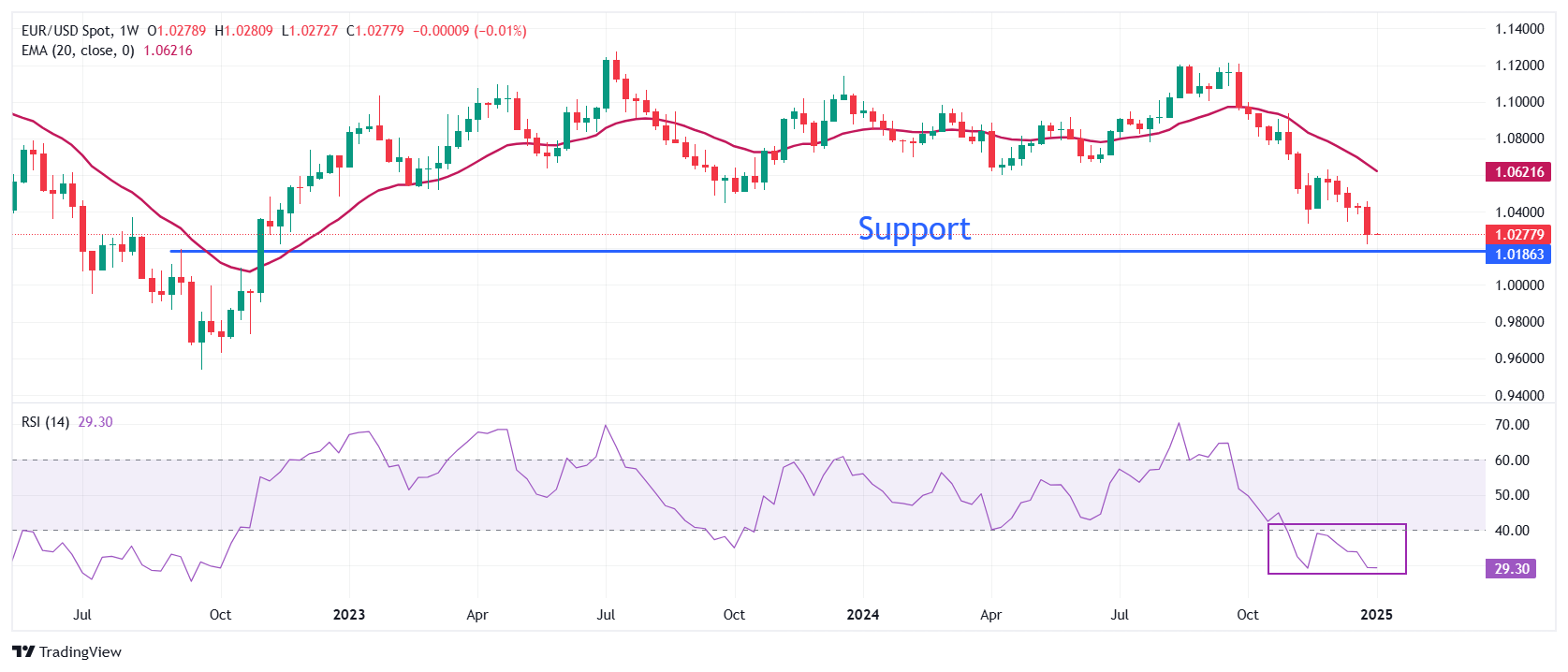
EUR/USD faced a sharp sell-off after breaking below the two-year low of 1.0330 on Thursday. The outlook of the major currency pair is broadly bearish as the 20-week Exponential Moving Average (EMA) at 1.0620 is declining.
The 14-week Relative Strength Index (RSI) slides to near 30.00, indicating a strong downside momentum. However, a slight recovery cannot be ruled out as the momentum oscillator has turned oversold.
Looking down, the pair could find support near the round-level support of 1.0100. Conversely, the weekly high of 1.0458 will be the key barrier for the Euro bulls.
ECB FAQs
The European Central Bank (ECB) in Frankfurt, Germany, is the reserve bank for the Eurozone. The ECB sets interest rates and manages monetary policy for the region. The ECB primary mandate is to maintain price stability, which means keeping inflation at around 2%. Its primary tool for achieving this is by raising or lowering interest rates. Relatively high interest rates will usually result in a stronger Euro and vice versa. The ECB Governing Council makes monetary policy decisions at meetings held eight times a year. Decisions are made by heads of the Eurozone national banks and six permanent members, including the President of the ECB, Christine Lagarde.
In extreme situations, the European Central Bank can enact a policy tool called Quantitative Easing. QE is the process by which the ECB prints Euros and uses them to buy assets – usually government or corporate bonds – from banks and other financial institutions. QE usually results in a weaker Euro. QE is a last resort when simply lowering interest rates is unlikely to achieve the objective of price stability. The ECB used it during the Great Financial Crisis in 2009-11, in 2015 when inflation remained stubbornly low, as well as during the covid pandemic.
Quantitative tightening (QT) is the reverse of QE. It is undertaken after QE when an economic recovery is underway and inflation starts rising. Whilst in QE the European Central Bank (ECB) purchases government and corporate bonds from financial institutions to provide them with liquidity, in QT the ECB stops buying more bonds, and stops reinvesting the principal maturing on the bonds it already holds. It is usually positive (or bullish) for the Euro.
Author

Sagar Dua
FXStreet
Sagar Dua is associated with the financial markets from his college days. Along with pursuing post-graduation in Commerce in 2014, he started his markets training with chart analysis.















