Dow Jones Industrial Average climbs on Thursday to recapture 550 points
- The Dow Jones climbed more than one percent on Thursday.
- Investors have renewed their vigor after a brief pullback period.
- Markets shrug off decline in manufacturing surveys, bid up softer benefits claims.

The Dow Jones Industrial Average (DJIA) lurched higher on Thursday, climbing around550 points as investors stepped back into their bidding shoes. Weekly US Jobless Claims eased slightly on a weekly basis, while traders brushed off a contraction in the Philadelphia Fed Manufacturing Index. Markets also bid up an upswing in Existing Home Sales Change. Industrials and Financials are the strongest-performing sectors for the day.
US Initial Jobless Claims printed lower than expected on Thursday, showing 213K net new jobless benefits seekers for the week ended November 15, below the 220K expected and down from the previous revised weekly figure of 219K. Existing Home Sales Change also accelerated in October, rising to 3.4% after the previous month’s revised -1.3% contraction.
The Philadelphia Fed’s Manufacturing Survey for November threw up another warning sign, pulling back to -5.5 and falling sharply from the previous month’s 10.3 and tumbling past the median forecast of 8.0. The downside print in aggregated expectations did little to contain markets, which were determined to shake off near-term declines and push back toward record highs.
Dow Jones news
A broad uptick in sector-wide risk appetite on Thursday has bolstered the Dow Jones back into the bullish end, with all but five of the major index’s listed securities climbing from the day’s opening bids. Salesforce (CRM) rose nearly 5%, breaking above $341 per share as analysts raise their price forecasts for CRM ahead of the digital database management company’s third-quarter earnings reports due during the first week of December.
Elsewhere, Nvidia (NVDA) is having a whipsaw kind of day, surging to new record highs before slumping back as investors battle out conflicting opinions on the chipmaker's recent quarterly results.
Dow Jones price forecast
The Dow Jones is back into testing the 44,000 major handle on Thursday, rallying 600 points from the day’s lows near 43,200. After a brief backslide that saw the major equity index decline 3.7% from record highs near 44,485, bullish momentum has returned to the fold.
A consistent pattern of higher lows has kept the gas burning in a one-sided bull run that kicked off in November of 2023. Price action has entirely outrun the 200-day Exponential Moving Average (EMA) for 12 months straight, and timing short entries is proving to be a hazardous endeavor. Bidders still have to push prices above 44,400 before they can claim further record highs, and the 50-day EMA is keeping a tight technical floor under intraday momentum from 42,600.
Dow Jones daily chart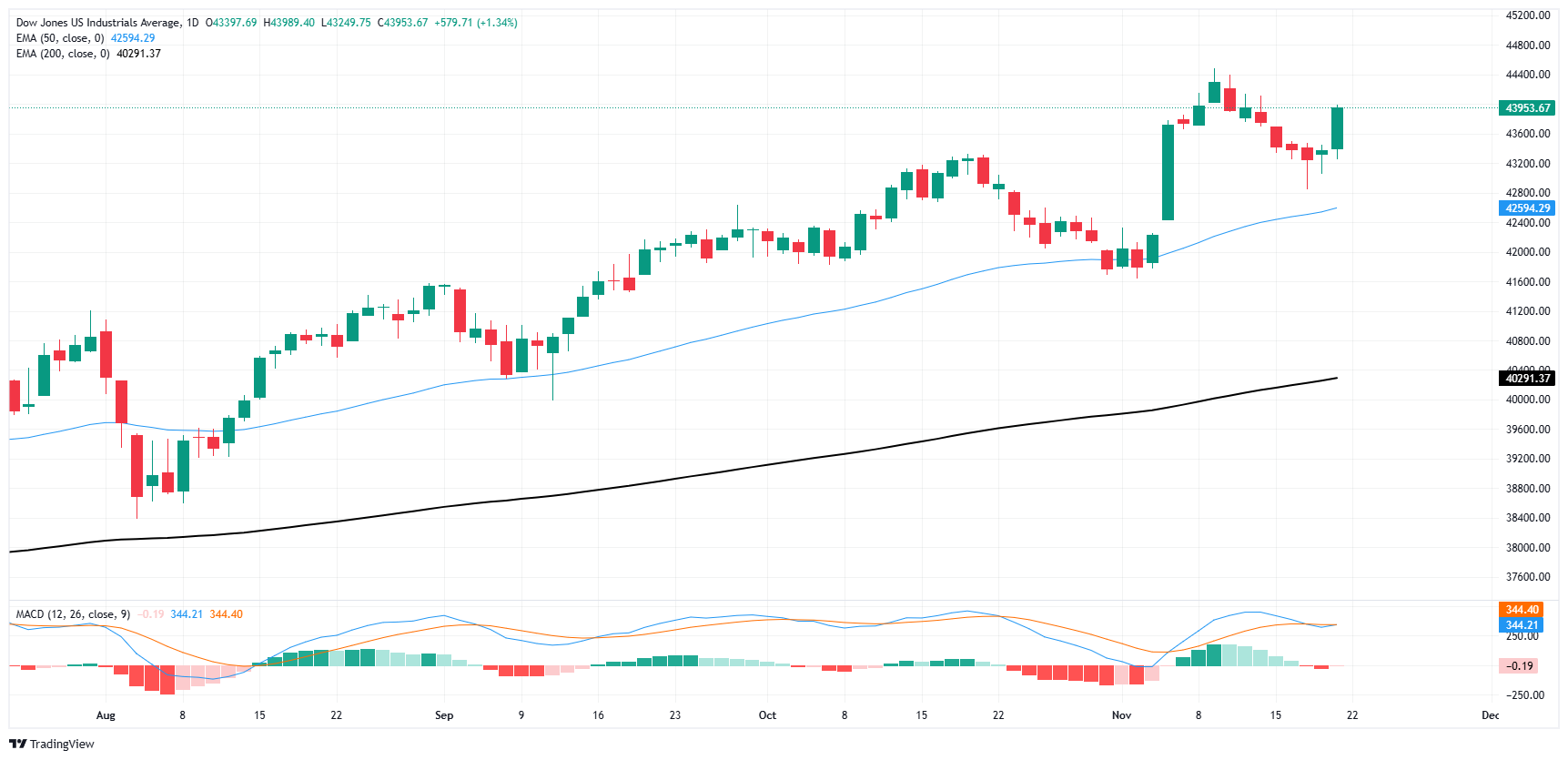
Risk sentiment FAQs
In the world of financial jargon the two widely used terms “risk-on” and “risk off'' refer to the level of risk that investors are willing to stomach during the period referenced. In a “risk-on” market, investors are optimistic about the future and more willing to buy risky assets. In a “risk-off” market investors start to ‘play it safe’ because they are worried about the future, and therefore buy less risky assets that are more certain of bringing a return, even if it is relatively modest.
Typically, during periods of “risk-on”, stock markets will rise, most commodities – except Gold – will also gain in value, since they benefit from a positive growth outlook. The currencies of nations that are heavy commodity exporters strengthen because of increased demand, and Cryptocurrencies rise. In a “risk-off” market, Bonds go up – especially major government Bonds – Gold shines, and safe-haven currencies such as the Japanese Yen, Swiss Franc and US Dollar all benefit.
The Australian Dollar (AUD), the Canadian Dollar (CAD), the New Zealand Dollar (NZD) and minor FX like the Ruble (RUB) and the South African Rand (ZAR), all tend to rise in markets that are “risk-on”. This is because the economies of these currencies are heavily reliant on commodity exports for growth, and commodities tend to rise in price during risk-on periods. This is because investors foresee greater demand for raw materials in the future due to heightened economic activity.
The major currencies that tend to rise during periods of “risk-off” are the US Dollar (USD), the Japanese Yen (JPY) and the Swiss Franc (CHF). The US Dollar, because it is the world’s reserve currency, and because in times of crisis investors buy US government debt, which is seen as safe because the largest economy in the world is unlikely to default. The Yen, from increased demand for Japanese government bonds, because a high proportion are held by domestic investors who are unlikely to dump them – even in a crisis. The Swiss Franc, because strict Swiss banking laws offer investors enhanced capital protection.
Author

Joshua Gibson
FXStreet
Joshua joins the FXStreet team as an Economics and Finance double major from Vancouver Island University with twelve years' experience as an independent trader focusing on technical analysis.

















