Crude Oil pops above $69.00 ahead of weekly EIA print
- Israel and Iran-backed militant group Hezbollah in Lebanon have signed a ceasefire deal.
- A few OPEC+ core countries already started discussions on its production restart plans ahead of Sunday's meeting.
- The US Dollar Index breaks lower after of a chunky economic data release from US data.

Crude Oil is popping higher on Wednesday, flirting with a near 1% gain on the day ahead of this week's stockpile change numbers from the Energy Information Administration (EIA). The move comes with several Organization of the Petroleum Exporting Countries and its allies (OPEC+) delegates confirming talks are underway for another delay of plans for its production normalization. The postponement could take months, with even talks of a pushback to the second quarter of 2025, Bloomberg reports.
The US Dollar Index (DXY), which measures the Greenback’s performance against a basket of currencies, is struggling again ahead of Thursday and Friday's Thanksgiving festivities. The release of the Federal Reserve (Fed) Minutes on Wednesday was the cue for traders to start taking profit in the Greenback rally, with only a rate cut pause or an actual rate cut under consideration for the upcoming Fed meeting in December.
With the shortened trading week, all main economic data releases, such as a revised reading for the third quarter of the US Gross Domestic Product (GDP), the Personal Consumption Expenditures Price Index (PCE), and the Durable Goods Orders reading for October, have already been published this Wednesday. The miss on estimates in Durable Goods drew the most attention while US GDP beared no big surprises.
At the time of writing, Crude Oil (WTI) trades at $69.05 and Brent Crude at $72.70.
Oil news and market movers: EIA drawdown could be fundamental
- A ceasefire deal has been signed between Israel and Hezbollah in Lebanon and should see tensions in the Middle East fade from now, with a risk premium to be further priced out of Crude Oil.
- Key OPEC+ nations began discussions on Tuesday to delay the Oil production restart planned for January, potentially for several months, delegates said, reported by Bloomberg.
- Goldman Sachs joins RBC in its latest investor note, pointing to signs of increasing compliance with OPEC+ production quotas making it likely the alliance will decide to extend output cuts set to end in January when it meets this weekend, Reuters reports.
- The weekly Crude Stockpile release from the American Petroleum Institute (API) on Tuesday came in at a drawdown of 5.935 million barrels compared to the previous build of 4.753 million.
- At 15:30 GMT, the Energy Information Administration (EIA) will release its weekly Crude Stockpile Change findings. Expectations are for a draw of 1.3 million barrels in the week ending on November 22 compared to the previous build of 0.545 million.
Oil Technical Analysis: Brief squeeze into year-end
Crude Oil price is attempting to recover again this week after a failed attempt on Tuesday. The question at hand is when OPEC+ could be able to control the Crude price action again, with markets already pricing in another delay towards the March statement and later dates in 2025. Without additional measures to limit supply, a return for Crude to higher prices is out of the question.
On the upside, the pivotal level at $71.46 and the 100-day Simple Moving Average (SMA) at $72.40 are the two main resistances. The 200-day SMA at $76.32 is still far off, although it could be tested if tensions intensify further. In its rally towards that 200-day SMA, the pivotal level at $75.27 could still slow down any upticks.
On the other side, traders need to look towards $67.12 – a level that held the price in May and June 2023 – to find the first support. In case that breaks, the 2024 year-to-date low emerges at $64.75, followed by $64.38, the low from 2023.
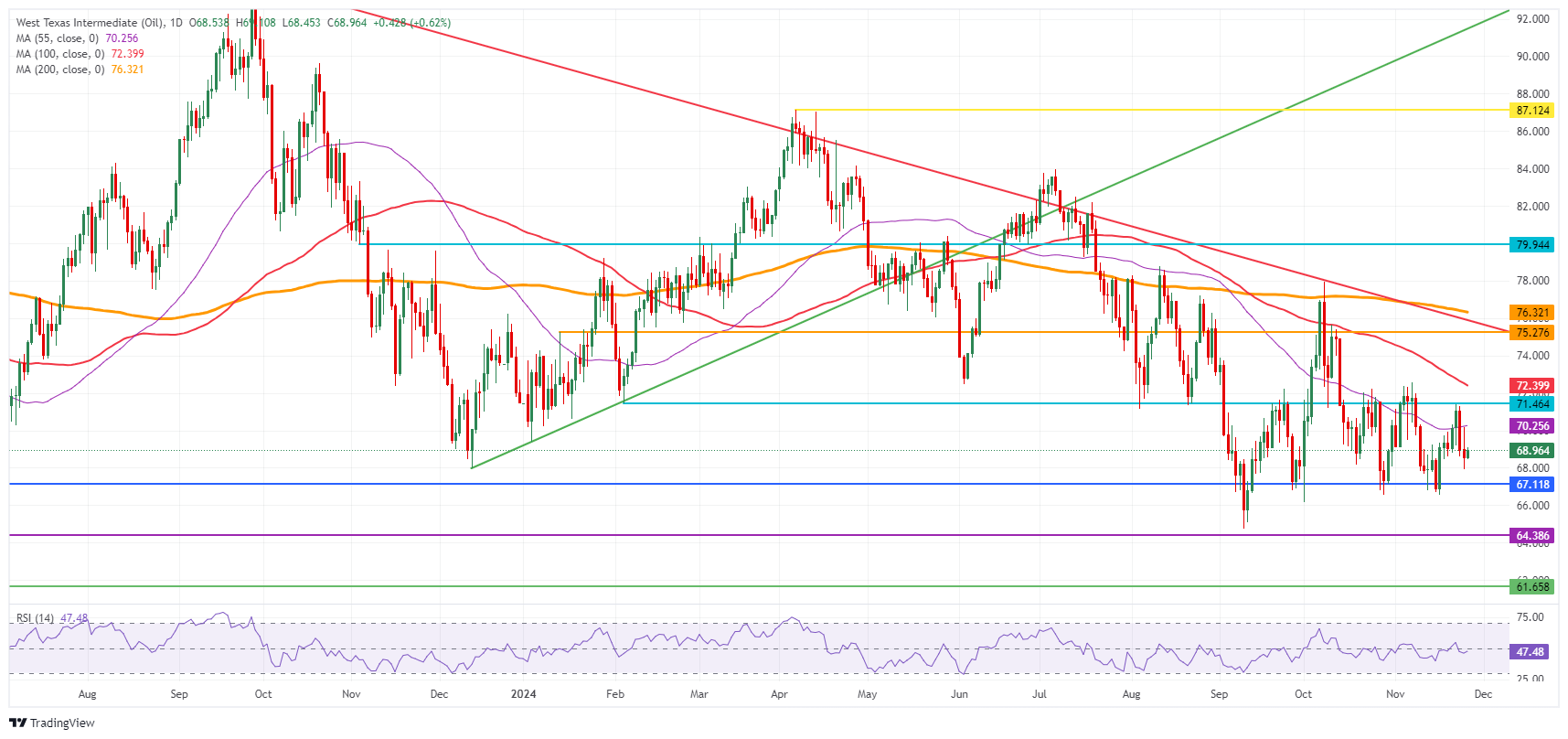
US WTI Crude Oil: Daily Chart
WTI Oil FAQs
WTI Oil is a type of Crude Oil sold on international markets. The WTI stands for West Texas Intermediate, one of three major types including Brent and Dubai Crude. WTI is also referred to as “light” and “sweet” because of its relatively low gravity and sulfur content respectively. It is considered a high quality Oil that is easily refined. It is sourced in the United States and distributed via the Cushing hub, which is considered “The Pipeline Crossroads of the World”. It is a benchmark for the Oil market and WTI price is frequently quoted in the media.
Like all assets, supply and demand are the key drivers of WTI Oil price. As such, global growth can be a driver of increased demand and vice versa for weak global growth. Political instability, wars, and sanctions can disrupt supply and impact prices. The decisions of OPEC, a group of major Oil-producing countries, is another key driver of price. The value of the US Dollar influences the price of WTI Crude Oil, since Oil is predominantly traded in US Dollars, thus a weaker US Dollar can make Oil more affordable and vice versa.
The weekly Oil inventory reports published by the American Petroleum Institute (API) and the Energy Information Agency (EIA) impact the price of WTI Oil. Changes in inventories reflect fluctuating supply and demand. If the data shows a drop in inventories it can indicate increased demand, pushing up Oil price. Higher inventories can reflect increased supply, pushing down prices. API’s report is published every Tuesday and EIA’s the day after. Their results are usually similar, falling within 1% of each other 75% of the time. The EIA data is considered more reliable, since it is a government agency.
OPEC (Organization of the Petroleum Exporting Countries) is a group of 12 Oil-producing nations who collectively decide production quotas for member countries at twice-yearly meetings. Their decisions often impact WTI Oil prices. When OPEC decides to lower quotas, it can tighten supply, pushing up Oil prices. When OPEC increases production, it has the opposite effect. OPEC+ refers to an expanded group that includes ten extra non-OPEC members, the most notable of which is Russia.
Author

Filip Lagaart
FXStreet
Filip Lagaart is a former sales/trader with over 15 years of financial markets expertise under its belt.