Crude Oil flirts with 1.5% gains on possible positive outlook for first half 2025
- Oil prices bounce over 1.25% higher on Thursday after three consecutive days in the red.
- Bloomberg Intelligence forecasts that the US Crude inventories might face sharp daily drawdowns in 2025.
- The US Dollar Index trades softer, pressured by profit taking after its steep rally on Wednesday due to a hawkish tilt from the Fed.

Crude Oil prices are rallying and are moving comfortably above $70.00 on the back of some support provided by a Bloomberg Intelligence article. US commercial crude inventories could decline by roughly 537,000 barrels a day in 2025, according to the Bloomberg supply and demand calculator. Although President-elect Donald Trump has promised to drill more domestic Oil, it will take several months or years before those new sites and wells become fully operational, while demand is set to pick up under Trump’s reform programs.
The US Dollar Index (DXY) – which measures the performance of the US Dollar (USD) against a basket of currencies – retreats from a fresh over-two-year high reached on Wednesday, falling back below 108.00 as traders unwind or reduce their Greenback exposure with year-end in sight. The last stretch higher came after the Federal Reserve (Fed) lowered its policy rate by 25 basis points as expected. However, the central bank became hawkish by signaling fewer rate cuts in 2025, possibly only two from the four previously forecasted.
At the time of writing, Crude Oil (WTI) trades at $70.22 and Brent Crude at $73.27
Oil news and market movers: Trump plans to gobble up US Crude storage supply
- Drillers in North Dakota at the Bakken Oil formation produced 1.178 million barrels per day in October, the lowest since July, according to the state data, Reuters reports. Production fell by 1.8% against the previous month and 6.2% against last year.
- China’s biggest Oil refiner said the country’s gasoline demand peaked last year and declines would accelerate as the shift to electric vehicles gathers pace, Bloomberg reports.
- Nigerian President Bola Tinubu is banking on an increase in Oil revenue to help fund record spending outlined in the 2025 budget presented to parliament on Wednesday. The government envisions spending 49.7 trillion naira ($32 billion) and collecting 34.8 trillion naira of revenue in the fiscal year starting January 1, Bloomberg reports.
- Glencore Plc has become an active buyer of spot Oil cargoes from the Middle East for December, as the merchant starts procuring crude for the Bukom refinery in Singapore, according to traders, Reuters reports.
Oil Technical Analysis: Make it count!
Crude Oil prices might see a simmering of hope for some upside potential in 2025. President-elect Donald Trump might be ready to pump more Oil in the US, though several shale projects still need to be developed and excavated before they become fully operational. With expectations that demand will be boosted once Trump takes office in January, some upside might take place in the first quarter or first half of 2025.
Looking up, $71.46 (February 5 low) and the 100-day Simple Moving Average (SMA) at $70.88 act as firm resistance levels. If Oil traders can plow through those levels, the next pivotal level will be $75.27 (January 12 high). However, watch out for quick profit-taking as the year-end quickly approaches.
On the downside, the 55-day SMA at $70.02 has been chopped up too many times this week and has lost relevance for now. That means that $67.12 – a level that held the price in May and June 2023 and during the last quarter of 2024 – is still the first solid support nearby. In case that breaks, the 2024 year-to-date low emerges at $64.75, followed by $64.38, the low from 2023.
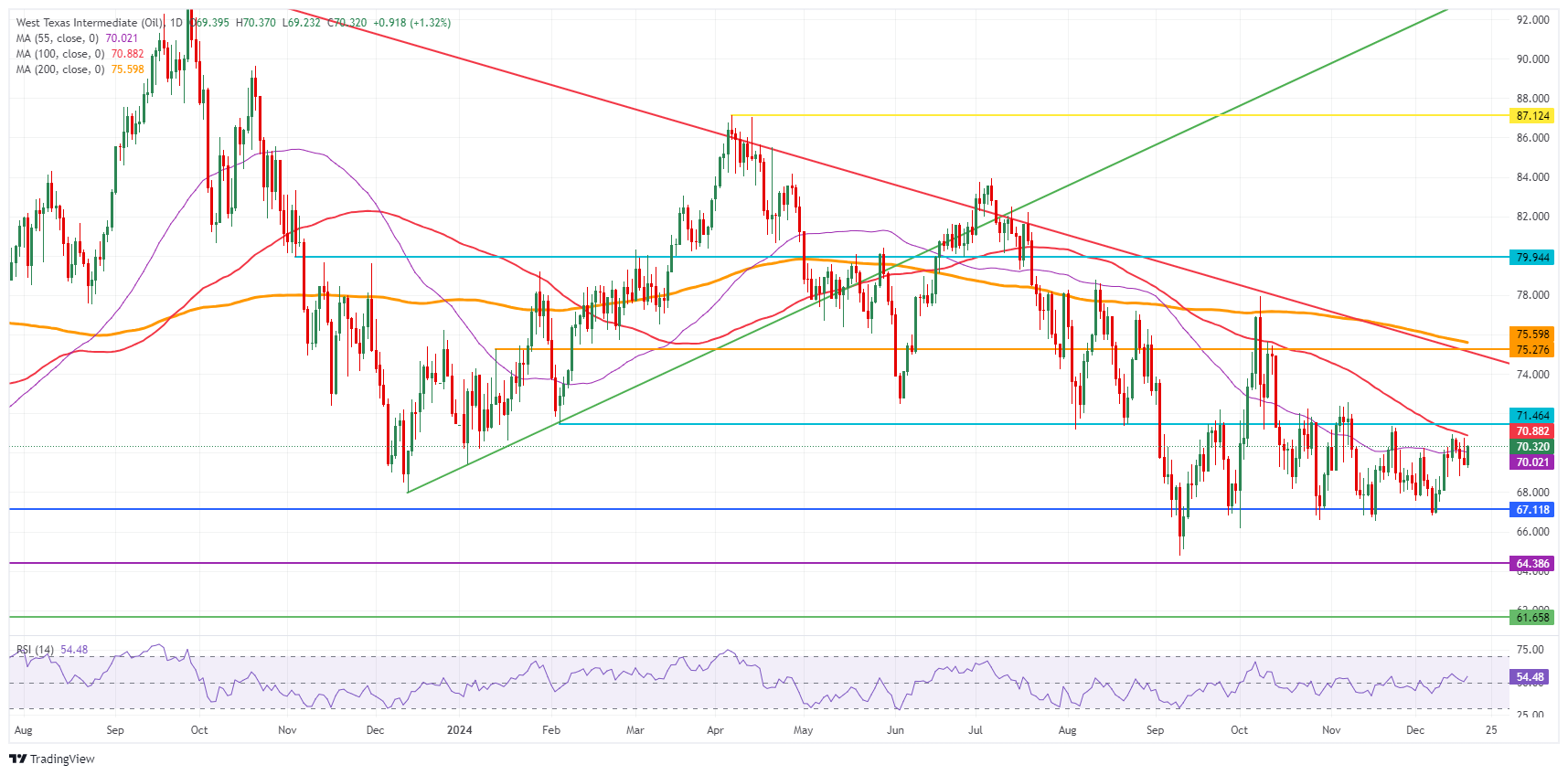
US WTI Crude Oil: Daily Chart
WTI Oil FAQs
WTI Oil is a type of Crude Oil sold on international markets. The WTI stands for West Texas Intermediate, one of three major types including Brent and Dubai Crude. WTI is also referred to as “light” and “sweet” because of its relatively low gravity and sulfur content respectively. It is considered a high quality Oil that is easily refined. It is sourced in the United States and distributed via the Cushing hub, which is considered “The Pipeline Crossroads of the World”. It is a benchmark for the Oil market and WTI price is frequently quoted in the media.
Like all assets, supply and demand are the key drivers of WTI Oil price. As such, global growth can be a driver of increased demand and vice versa for weak global growth. Political instability, wars, and sanctions can disrupt supply and impact prices. The decisions of OPEC, a group of major Oil-producing countries, is another key driver of price. The value of the US Dollar influences the price of WTI Crude Oil, since Oil is predominantly traded in US Dollars, thus a weaker US Dollar can make Oil more affordable and vice versa.
The weekly Oil inventory reports published by the American Petroleum Institute (API) and the Energy Information Agency (EIA) impact the price of WTI Oil. Changes in inventories reflect fluctuating supply and demand. If the data shows a drop in inventories it can indicate increased demand, pushing up Oil price. Higher inventories can reflect increased supply, pushing down prices. API’s report is published every Tuesday and EIA’s the day after. Their results are usually similar, falling within 1% of each other 75% of the time. The EIA data is considered more reliable, since it is a government agency.
OPEC (Organization of the Petroleum Exporting Countries) is a group of 12 Oil-producing nations who collectively decide production quotas for member countries at twice-yearly meetings. Their decisions often impact WTI Oil prices. When OPEC decides to lower quotas, it can tighten supply, pushing up Oil prices. When OPEC increases production, it has the opposite effect. OPEC+ refers to an expanded group that includes ten extra non-OPEC members, the most notable of which is Russia.
Author

Filip Lagaart
FXStreet
Filip Lagaart is a former sales/trader with over 15 years of financial markets expertise under its belt.