Crude Oil pares back earlier incurred losses and turns nearly flat on Monday
- Oil prices are paring back earlier losses with China concers abating near the US trading session.
- Traders have trimmed already portions of their Oil exposure ahead of year-end while Chinese Retail Sales growth came in far below expectations.
- The US Dollar Index trades around 107.00 with traders rebalancing ahead of the Federal Reserve interest rate meeting.

Crude Oil is bouncing off vital support around $70.00 and heads back to $71.00, after earlier selling pressure emerged on the back of Chinese Retail Sales data for November which dampened hopes for a speedy recovery in the region. The 3% growth was far below consensus and the situation is set to deteriorate further as tanker rates on key routes to China are falling to the lowest level this year, pointing to even more sluggish demand ahead.
The US Dollar Index (DXY) – which measures the performance of the US Dollar (USD) against a basket of currencies – is softer on Monday amid a recovery in the Euro (one of the main contributors in the Index). Germany’s preliminary reading of its Services Purchasing Managers Index (PMI) for December popped back to 51, out from contraction territory. Meanwhile, Germany is set to see its government toppled on Monday, with snap elections set for February 23 2025.
At the time of writing, Crude Oil (WTI) trades at $70.56 and Brent Crude at $73.89
Oil news and market movers: And Trump does not even start to pump up more Oil
- Rates for transporting crude on the largest vessels from the Middle East to China, a benchmark route, have sunk by a third this year as demand in the top importer slows and OPEC+ delays the restart of idled supply, Bloomberg reports.
- The global Oil market is expected to remain well-supplied in 2025, according to the International Energy Agency (IEA), even as the Organisation of the Petroleum Exporting Countries (OPEC) maintains production cuts and demand projections show slight growth, Reuters reports.
- Recent China Crude Oil import data suggests a pickup, although storage data reveals a pickup in volumes as well, Reuters reports.
- Iranian crude exports to China have been disrupted by broader US sanctions on tankers, according to Vortexa Ltd., squeezing flows to the OPEC producer’s most important customer, Bloomberg reports.
Oil Technical Analysis: Technical bounce for now
Crude Oil prices are seeing their over 5% profitable rally stall and are giving back gains on Monday after Chinese Retail data revealed a slower-than-expected growth. This adds to doubts for the overall 2025 outlook, where a Chinese revival is one of the factors that is key to get the overall Oil consumption going up again. Should President-elect Donald Trump add further all the promised tariffs, Chinese Oil demand could deteriorate further in 2025.
Looking up, $71.46 and the 100-day Simple Moving Average (SMA) at $71.08 are acting as firm resistance levels on the upside. On Friday, already some selling pressure unfolded ahead of the 100-day SMA. In case Oil traders can plough through that level, $75.27 is up next as a pivotal level.
On the downside, it is too early to see if the 55-day SMA will be reclaimed again at $70.11. That means that $67.12 – a level that held the price in May and June 2023 – is still the first solid support nearby. In case that breaks, the 2024 year-to-date low emerges at $64.75 followed by $64.38, the low from 2023.
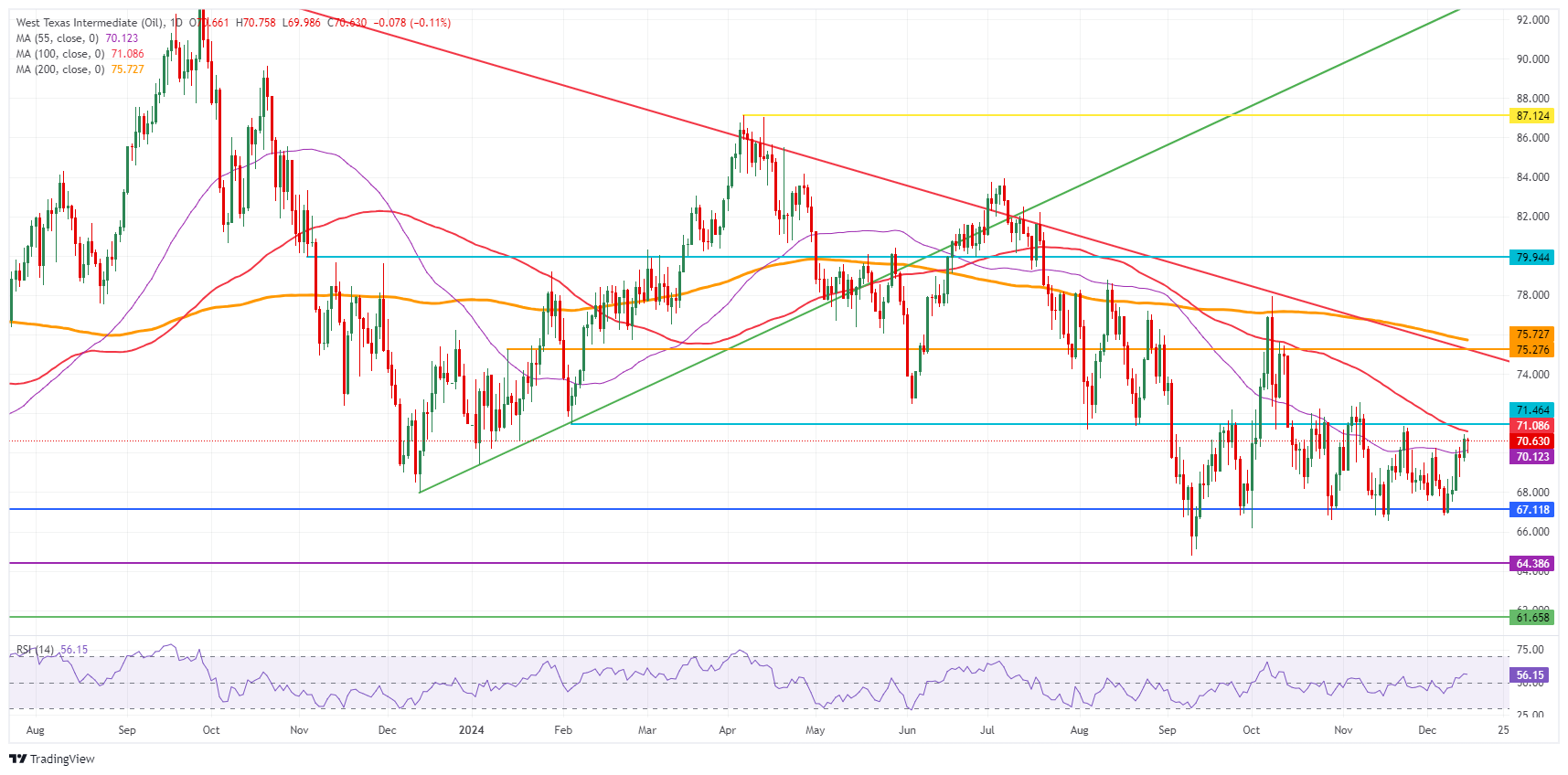
US WTI Crude Oil: Daily Chart
WTI Oil FAQs
WTI Oil is a type of Crude Oil sold on international markets. The WTI stands for West Texas Intermediate, one of three major types including Brent and Dubai Crude. WTI is also referred to as “light” and “sweet” because of its relatively low gravity and sulfur content respectively. It is considered a high quality Oil that is easily refined. It is sourced in the United States and distributed via the Cushing hub, which is considered “The Pipeline Crossroads of the World”. It is a benchmark for the Oil market and WTI price is frequently quoted in the media.
Like all assets, supply and demand are the key drivers of WTI Oil price. As such, global growth can be a driver of increased demand and vice versa for weak global growth. Political instability, wars, and sanctions can disrupt supply and impact prices. The decisions of OPEC, a group of major Oil-producing countries, is another key driver of price. The value of the US Dollar influences the price of WTI Crude Oil, since Oil is predominantly traded in US Dollars, thus a weaker US Dollar can make Oil more affordable and vice versa.
The weekly Oil inventory reports published by the American Petroleum Institute (API) and the Energy Information Agency (EIA) impact the price of WTI Oil. Changes in inventories reflect fluctuating supply and demand. If the data shows a drop in inventories it can indicate increased demand, pushing up Oil price. Higher inventories can reflect increased supply, pushing down prices. API’s report is published every Tuesday and EIA’s the day after. Their results are usually similar, falling within 1% of each other 75% of the time. The EIA data is considered more reliable, since it is a government agency.
OPEC (Organization of the Petroleum Exporting Countries) is a group of 12 Oil-producing nations who collectively decide production quotas for member countries at twice-yearly meetings. Their decisions often impact WTI Oil prices. When OPEC decides to lower quotas, it can tighten supply, pushing up Oil prices. When OPEC increases production, it has the opposite effect. OPEC+ refers to an expanded group that includes ten extra non-OPEC members, the most notable of which is Russia.
Author

Filip Lagaart
FXStreet
Filip Lagaart is a former sales/trader with over 15 years of financial markets expertise under its belt.