Canadian Dollar goes sideways after Tuesday’s Fed fizzle
- Canadian Dollar struggled to develop momentum with little of note on the docket.
- Canada is largely absent from the economic calendar this week.
- Fed Chair Powell stuck close to the usual script, giving investors little to work with.

The Canadian Dollar (CAD) found little reason to move in any particular direction on Monday with little meaningful data on the offering and a flubbed US Federal Reserve (Fed) appearance that gave markets nothing to work with.
The only economic datapoint from Canada this week will be May’s Building Permits to be released on Friday, but little market impact is expected. The CAD has pushed into the middle against the US Dollar (USD), and a lack of a meaningful release schedule on the Canadian side exposes the Canadian Dollar to broader market flows.
Fed Chairman Jerome Powell gave the first half of his two-day testimony before US Congressional committees on Tuesday, delivering the Fed’s semiannual Monetary Policy Report to the Senate Committee on Banking, Housing, and Urban Affairs. Fed Chair Powell struck a familiar tone, sticking close to talking points that have been made before and highlighting the Fed’s willingness to wait as long as is necessary for inflation to ease towards the Fed’s 2% annual target. Investors, hoping for further signs of the Fed stepping towards interest rate cuts, interpreted the appearance as more hawkish than hoped, drawing risk appetite down and bolstering the Greenback.
Fed Chair Powell will give the second half of the Fed’s Monetary Policy Report to the Congressional House Committee on Financial Services on Wednesday. No changes in rhetoric or new information are expected in the follow-up presentation heading into the midweek.
Later in the week, June’s US Consumer Price Index (CPI) inflation is scheduled for Thursday, followed by Friday’s US Producer Price Index (PPI) wholesale inflation, also for June. Core CPI in June is expected to hold steady at 3.4% YoY, while core PPI for the same period is expected to tick upwards to 2.5% from the previous period’s 2.3%. In both cases, meeting forecasts will disappoint markets that are overwhelmingly betting on slowing inflation to deliver at least a quarter-point rate cut from the Fed at the September 18 rate call.
USD/CAD technical outlook
USD/CAD is stuck in place near 1.3640, treading water and moving in a tight cycle as the pair remains unable to break above 1.3650. Last week’s rebound from the last swing low towards 1.3600 failed to muscle the pair back above the 200-hour Exponential Moving Average (EMA) at 1.2656, but bidding pressure remains too high to allow a backslide into fresh lows.
USD/CAD daily candlesticks are mired in a technical trap, caught in congestion between the 200-day EMA at 1.3590 and a supply zone priced in above the last peak near 1.3750.
USD/CAD hourly chart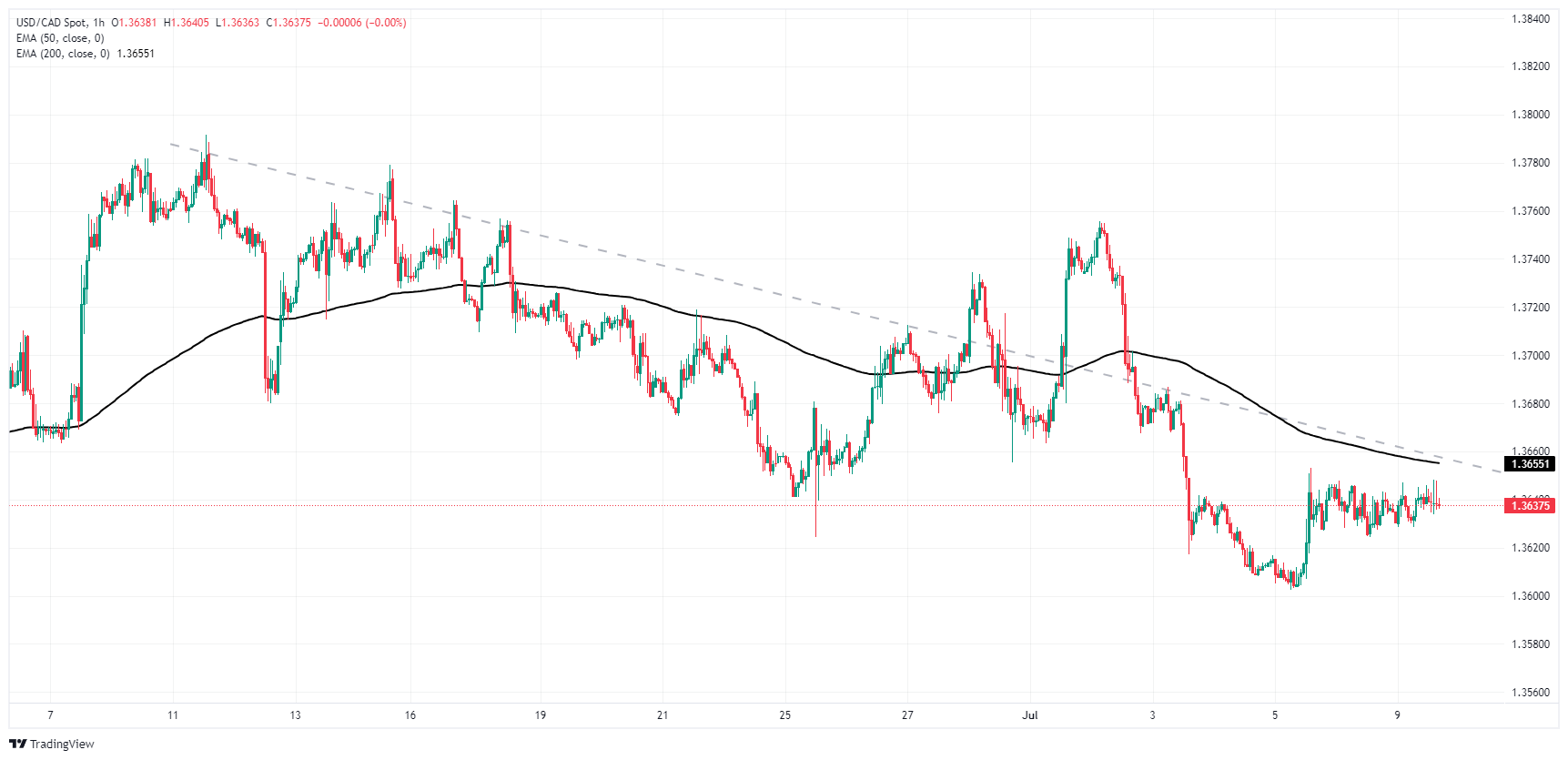
USD/CAD daily chart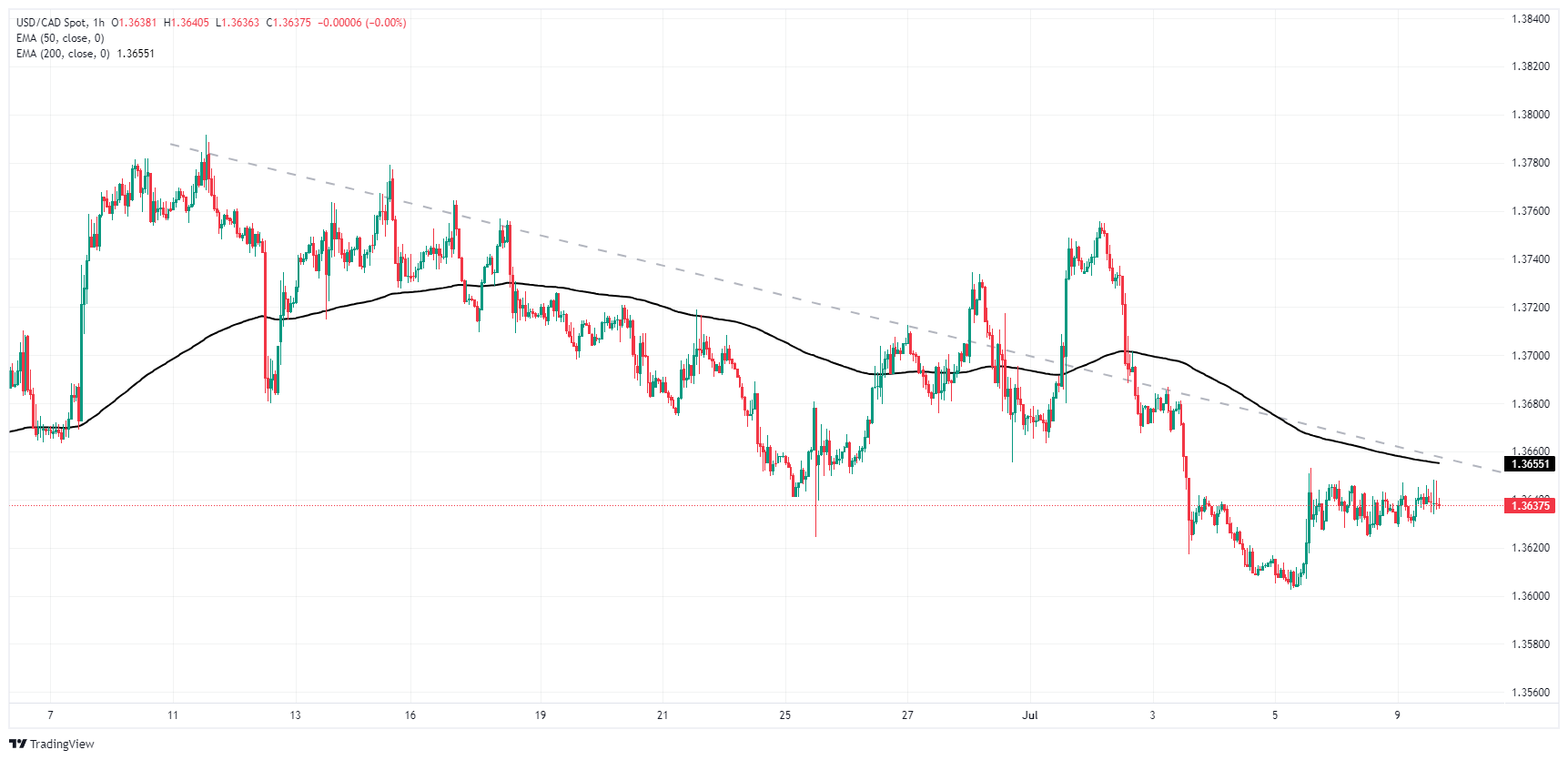
Canadian Dollar FAQs
The key factors driving the Canadian Dollar (CAD) are the level of interest rates set by the Bank of Canada (BoC), the price of Oil, Canada’s largest export, the health of its economy, inflation and the Trade Balance, which is the difference between the value of Canada’s exports versus its imports. Other factors include market sentiment – whether investors are taking on more risky assets (risk-on) or seeking safe-havens (risk-off) – with risk-on being CAD-positive. As its largest trading partner, the health of the US economy is also a key factor influencing the Canadian Dollar.
The Bank of Canada (BoC) has a significant influence on the Canadian Dollar by setting the level of interest rates that banks can lend to one another. This influences the level of interest rates for everyone. The main goal of the BoC is to maintain inflation at 1-3% by adjusting interest rates up or down. Relatively higher interest rates tend to be positive for the CAD. The Bank of Canada can also use quantitative easing and tightening to influence credit conditions, with the former CAD-negative and the latter CAD-positive.
The price of Oil is a key factor impacting the value of the Canadian Dollar. Petroleum is Canada’s biggest export, so Oil price tends to have an immediate impact on the CAD value. Generally, if Oil price rises CAD also goes up, as aggregate demand for the currency increases. The opposite is the case if the price of Oil falls. Higher Oil prices also tend to result in a greater likelihood of a positive Trade Balance, which is also supportive of the CAD.
While inflation had always traditionally been thought of as a negative factor for a currency since it lowers the value of money, the opposite has actually been the case in modern times with the relaxation of cross-border capital controls. Higher inflation tends to lead central banks to put up interest rates which attracts more capital inflows from global investors seeking a lucrative place to keep their money. This increases demand for the local currency, which in Canada’s case is the Canadian Dollar.
Macroeconomic data releases gauge the health of the economy and can have an impact on the Canadian Dollar. Indicators such as GDP, Manufacturing and Services PMIs, employment, and consumer sentiment surveys can all influence the direction of the CAD. A strong economy is good for the Canadian Dollar. Not only does it attract more foreign investment but it may encourage the Bank of Canada to put up interest rates, leading to a stronger currency. If economic data is weak, however, the CAD is likely to fall.
Author

Joshua Gibson
FXStreet
Joshua joins the FXStreet team as an Economics and Finance double major from Vancouver Island University with twelve years' experience as an independent trader focusing on technical analysis.