New Zealand Dollar remains solid after RBNZ's decision, US PCE Price Index awaited
- The New Zealand Dollar advanced as the RBNZ reduced its Official Cash Rate by 50 basis points in November.
- RBNZ Governor Orr noted that the forecasts align with a potential 50 basis point cut in February 2025.
- The USD struggles due to bond market optimism following President-elect Donald Trump's decision to nominate fund manager Scott Bessent.

The New Zealand Dollar (NZD) breaks its five-day losing streak against the US Dollar (USD) following the Reserve Bank of New Zealand's (RBNZ) interest rate decision on Wednesday. The central bank announced a further cut to its Official Cash Rate (OCR), lowering it by 50 basis points (bps) from 4.75% to 4.25% in November. Furthermore, investors await the US Personal Consumption Expenditure (PCE) Price Index and quarterly Gross Domestic Product Annualized scheduled to be released later in the North American session.
The RBNZ justified this rate cut by citing a bleak economic outlook and a decline in inflation, which has now returned to the central bank's target range of 1% to 3%. Earlier this year, the central bank reduced the OCR by 25 bps in August and followed with a 50 bps reduction in October.
RBNZ Governor Adrian Orr delivered prepared remarks on the policy statement during the post-meeting press conference. Orr clarified the misconception that the bank's projections indicate a slower pace of rate cuts, noting that the forecasts align with a potential 50 basis point cut in February 2025, contingent on economic activity. He also expressed confidence that domestic inflation pressures will continue to ease.
The NZD faced challenges due to weaker market sentiment, largely driven by President-elect Donald Trump's announcement of a 10% tariff increase on all Chinese goods entering the United States (US), as well as a 25% tariff on imports from Mexico and Canada. Since China is a significant trade partner for New Zealand, any economic disruption in China has a direct impact on New Zealand's economy.
New Zealand Dollar appreciates as US Dollar faces challenges due to bond market optimism
- The USD faced pressure amid bond market optimism following President-elect Donald Trump's decision to nominate fund manager Scott Bessent, a seasoned Wall Street veteran and fiscal conservative, as US Treasury Secretary.
- However, downside risks for the USD remain limited. Preliminary S&P Global US Purchasing Managers’ Index (PMI) data have bolstered expectations that the Federal Reserve might slow the pace of rate cuts. According to the CME FedWatch Tool, the probability of a quarter-point rate cut has dropped to 57.7%.
- The latest Federal Open Market Committee's (FOMC) Meeting Minutes for the policy meeting held on November 7, indicated that policymakers are adopting a cautious stance on cutting interest rates, citing easing inflation and a robust labor market.
- US President-elect Donald Trump is expected to appoint Jamieson Greer as the US Trade Representative, Bloomberg reported on Tuesday. Greer’s nomination highlights the central role of tariffs in Trump’s economic strategy.
- On Tuesday, Chicago Fed President Austan Goolsbee indicated that the Fed is likely to continue lowering interest rates toward a neutral stance that neither stimulates nor restricts economic activity. Meanwhile, Minneapolis Fed President Neel Kashkari highlighted that it remains appropriate to consider another rate cut at the Fed’s December meeting, according to Bloomberg.
- In November, S&P Global US Composite PMI climbed to 55.3, indicating the strongest growth in private sector activity since April 2022. Meanwhile, the US Services PMI rose to 57.0, up from 55.0, significantly surpassing market expectations of 55.2, marking the sharpest expansion in the services sector since March 2022.
- New Zealand’s Gross Domestic Product (GDP) shrank by 0.2% in the second quarter (Q2), following a revised 0.1% growth in the previous quarter. Economists had anticipated a 0.4% contraction for the period, while the RBNZ forecasted a 0.5% decline.
- Stats NZ showed on October 16 that New Zealand’s annual Consumer Price Index (CPI) rose 2.2% in Q3, aligning with market forecasts and marking a sharp slowdown from the 3.3% growth in Q2.
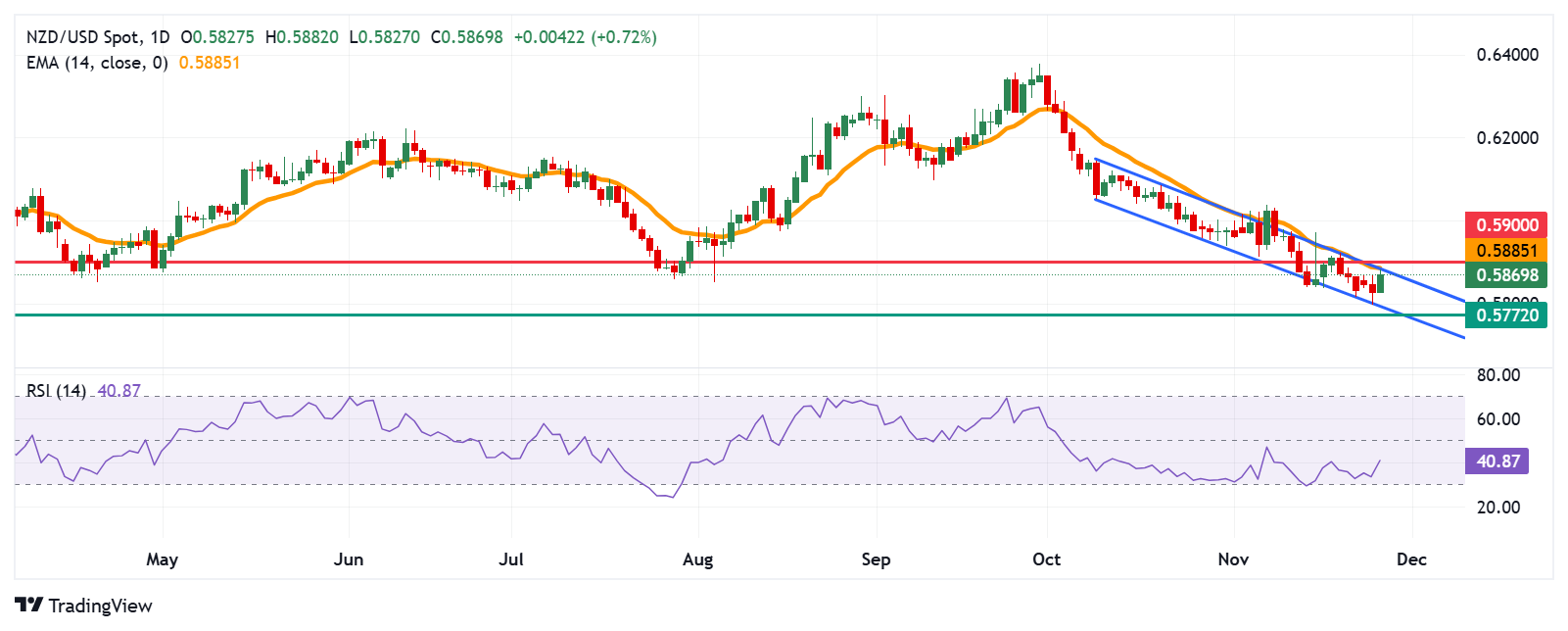
New Zealand Dollar tests the descending channel’s upper boundary near 0.5900
The NZD/USD pair trades near 0.5880 on Wednesday. A daily chart review highlights a deepening bearish trend as the pair moves within a descending channel pattern. Meanwhile, the 14-day Relative Strength Index (RSI) stays below 50, signaling persistent negative sentiment.
For support levels, the NZD/USD pair may navigate the region around the psychological level of 0.5800, which coincides with the lower boundary of the descending channel. A decisive break below this level would drive the pair toward its two-year low of 0.5772, last seen in November 2023.
On the upside, immediate resistance lies at the 14-day Exponential Moving Average (EMA) of 0.5886, which aligns with the upper boundary of the descending channel. A further barrier appears at the psychological level of 0.5900.
NZD/USD: Daily Chart
New Zealand Dollar PRICE Today
The table below shows the percentage change of New Zealand Dollar (NZD) against listed major currencies today. New Zealand Dollar was the strongest against the Canadian Dollar.
| USD | EUR | GBP | JPY | CAD | AUD | NZD | CHF | |
|---|---|---|---|---|---|---|---|---|
| USD | 0.02% | -0.09% | -0.44% | 0.05% | -0.21% | -0.64% | -0.13% | |
| EUR | -0.02% | -0.11% | -0.46% | 0.03% | -0.22% | -0.65% | -0.16% | |
| GBP | 0.09% | 0.11% | -0.34% | 0.14% | -0.11% | -0.54% | -0.05% | |
| JPY | 0.44% | 0.46% | 0.34% | 0.50% | 0.24% | -0.19% | 0.30% | |
| CAD | -0.05% | -0.03% | -0.14% | -0.50% | -0.25% | -0.69% | -0.19% | |
| AUD | 0.21% | 0.22% | 0.11% | -0.24% | 0.25% | -0.43% | 0.05% | |
| NZD | 0.64% | 0.65% | 0.54% | 0.19% | 0.69% | 0.43% | 0.49% | |
| CHF | 0.13% | 0.16% | 0.05% | -0.30% | 0.19% | -0.05% | -0.49% |
The heat map shows percentage changes of major currencies against each other. The base currency is picked from the left column, while the quote currency is picked from the top row. For example, if you pick the New Zealand Dollar from the left column and move along the horizontal line to the US Dollar, the percentage change displayed in the box will represent NZD (base)/USD (quote).
Economic Indicator
Personal Consumption Expenditures - Price Index (YoY)
The Personal Consumption Expenditures (PCE), released by the US Bureau of Economic Analysis on a monthly basis, measures the changes in the prices of goods and services purchased by consumers in the United States (US). The YoY reading compares prices in the reference month to a year earlier. Price changes may cause consumers to switch from buying one good to another and the PCE Deflator can account for such substitutions. This makes it the preferred measure of inflation for the Federal Reserve. Generally, a high reading is bullish for the US Dollar (USD), while a low reading is bearish.
Read more.Next release: Wed Nov 27, 2024 13:30
Frequency: Monthly
Consensus: 2.3%
Previous: 2.1%
Source: US Bureau of Economic Analysis
Author

Akhtar Faruqui
FXStreet
Akhtar Faruqui is a Forex Analyst based in New Delhi, India. With a keen eye for market trends and a passion for dissecting complex financial dynamics, he is dedicated to delivering accurate and insightful Forex news and analysis.

















