Alibaba Stock Forecast: BABA surged past $104 on renewed China optimism
- Alibaba benefits from renewed confidence in China stocks.
- BABA stock surged 5.34% on Tuesday and settled above $104.
- Chinese regulators have closed their investigation into Didi Global.

Update: BABA stock witnessed an explosive rally on Tuesday, as it gained as much as 5.36% to reach the highest level in two months at $104.46. Alibaba's share price eased a bit to settle the day at $104.32. BABA stock price snapped its two-day losing streak and rallied hard on hopes that Beijing is close to ending a yearlong regulatory crackdown on the Chinese tech companies. Nasdaq Golden Dragon China Index also soared 5.4%. Meanwhile, JP Morgan Chase said that the 2021's deep selloff in Chinese stocks could finally be on the verge of a turnaround. Further, a Tuesday turnaround on Wall Street, despite the surge in the US Treasury yields and disappointing World Bank’s growth outlook, also aided the upswing in Alibaba shares.
Alibaba (BABA) stock had many admirers on Monday to start the week. Shares of China's largest e-commerce provider charged ahead by 6.2% after news emerged during the Hong Kong session that Chinese regulators were ending their high-profile investigation of Didi Global.
Also read: Didi Global Stock News and Forecast: DIDI spikes on end of Chinese data investigation
Though Alibaba's planned IPO of former subsidiary Ant Global is what initially launched the great Chinese ADR sell-off in late 2020, Didi Global became the poster child of a tempestuous Chinese regulatory hierarchy after state officers began a combative probe into Didi's data collection practices just days after the company listed for the first time in the US. Didi quickly descended from its $14 IPO price to trade below $2 when it announced in May that it would comply with state direction and delist its US shares.
Didi, along with two other Chinese companies listed in the US, is expected to face a major fine and must hand the state 1% ownership. The end of the investigation, however, seemingly also brings to an end the 18-month tech crackdown that has cost Chinese investors at least $1 trillion in share value.
Though BABA shares traded as high as $102.42 on Monday, they could not maintain their perch atop the ever-important $100 psychological level and instead closed at $99.01. In Tuesday's premarket, BABA stock is once again advancing – at the time of writing it is up 1.4% at $100.37. $100 has acted as both resistance and support in the past six months, and yesterday was no different.
Alibaba Stock Forecast: First target is $110
BABA stock price has been trading within a symmetrical wedge structure (blue) since March 15. Before that the top line of the formation began back on November 18, 2021, and until February 24 strong support was found at $110.
Alibaba stock attempted to break through the $100 barrier in late April and early May but gave up after four sessions. Now the top line of the wedge sits at $101. This will make the area even more difficult to power through. If BABA shares can close above the April 29 high of $103.51, then this will signal a new bear rally. The first bull target is $110, as mentioned previously. This level acted as first support, and then resistance, from December 2021 through this April consistently.
Above here is further resistance at $119.60. Both levels will supply likely take profit points for bullish traders. Support should sit somewhere between $83 and $84 on the ascending bottom line of the wedge.
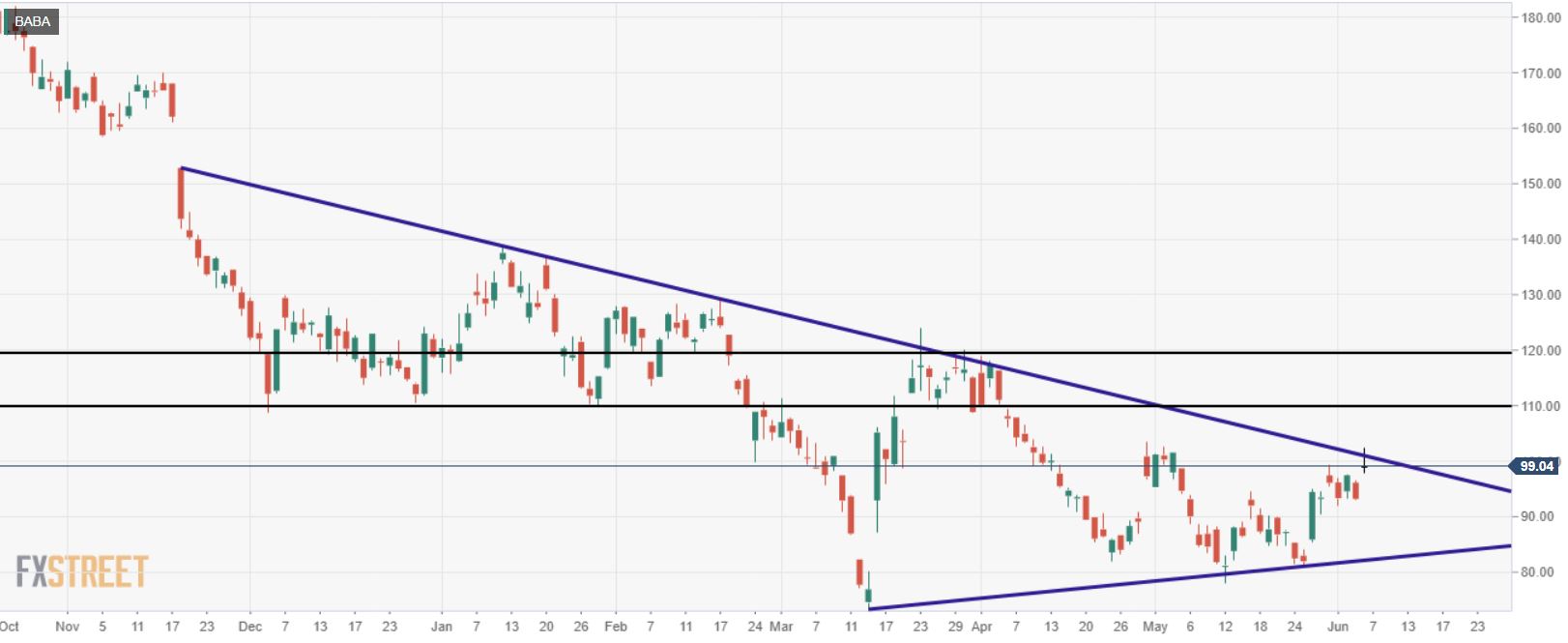
BABA daily chart
Previous updates
Update: BABA stock added 5.34% on Tuesday, up roughly 12% ever since the week started, ending the day at $104.32 per share. Wall Street closed with substantial gains, despite lingering risk-aversion. The Dow Jones Industrial Average added 264 points, while the S&P 500 advanced 0.96%. As for the Nasdaq Composite, the index settled at 12,179 up 0.94% or 113 points. Easing government bond yields helped equities to recover some of the ground lost at the beginning of the week, although gains were limited by continued recession-related concerns. Fears that the US economy may suffer a recession were a report from the World Bank, downgrading this year's global growth forecast from 4.1% to 2.9%.
Like this article? Help us with some feedback by answering this survey:
Author

Clay Webster
FXStreet
Clay Webster grew up in the US outside Buffalo, New York and Lancaster, Pennsylvania. He began investing after college following the 2008 financial crisis.

















