XRP struggles under $0.50 while lawsuit against Ripple CEO goes to trial
- Ripple CEO Brad Garlinghouse faces trial in connection with statements made in a 2017 interview.
- Ripple proponents unpack the impact of the trial on the SEC vs. Ripple lawsuit development and past rulings.
- XRP is stuck under $0.50 after two consecutive days of failure to break past the resistance.
XRP remains range-bound under the $0.50 resistance on Friday after news that Ripple CEO Brad Garlinghouse will have to face a trial in California regarding some statements he made in 2017.
In an interview back then, Garlinghouse said he was being “long” on XRP while mass selling the altcoin, words that a judge will need to determine if they were “misleading,” as the civil securities lawsuit alleges.
Daily digest market movers: Ripple CEO faces trial in California court
- Judge Phyllis Hamilton dismissed four class action claims against Ripple. However, he allowed one state law claim against CEO Brad Garlinghouse to proceed to trial, per a Coindesk report.
- The Ripple executive faces charges brought against him referring to his “misleading statements” in a TV interview. Garlinghouse allegedly violated California’s securities laws by saying back then that he was “very, very long XRP” while selling millions of XRP tokens across exchange platforms throughout 2017.
- Court documents show that Ripple lawyers argue that XRP fails to meet the definition of a security under the Howey Test. Therefore it “cannot give rise to a claim for misleading statements in connection with a security,” they argue.
- Judge Hamilton said in a ruling on Thursday that Ripple’s lawyers urged her to follow the reasoning of Judge Analisa Torres, who ruled in July 2023 that XRP did not satisfy the Howey Test and thus it isn’t a security.
- The Judge turned down the ruling and differed from Torres’ legal opinion of XRP failing to satisfy the Howey Test. In her ruling, Judge Hamilton wrote,
“The court declines to find as a matter of law that a reasonable investor would have derived any expectation of profit from general cryptocurrency market trends, as opposed to Ripple’s efforts to facilitate XRP’s use in cross-border payments, among other things. Accordingly, the [court] cannot find as a matter of law that Ripple’s conduct would not have led a reasonable investor to have an expectation of profit due to the efforts of others.”
- XRP holders and proponents like attorney Bill Morgan are debating whether Judge Analisa Torres’ ruling holds, in case of XRP sale on exchanges and institutional sales by Ripple.
In substance, she is kind of making the point I made in a post 11 months ago https://t.co/369naQfuqj pic.twitter.com/O8nV6NEqOY
— bill morgan (@Belisarius2020) June 20, 2024
Technical analysis: XRP range bound under $0.50
Ripple is trading sideways below the resistance at $0.50 on Friday. After failed attempts to close above $0.50 on two consecutive days, the altcoin is trading at $0.4915.
Ripple could dip to the Fair Value Gap extending between $0.4813 and $0.4886 before attempting another run up to resistance at $0.5015. This resistance level aligns with the 23.6% Fibonacci retracement of the decline from the March 11 top of $0.7429 to the April 13 low of $0.4269.
The Moving Average Convergence Divergence (MACD) indicator shows green histogram bars above the neutral line. MACD crossed over the signal line on Tuesday, providing a bullish sign that however has still yet to materialize.
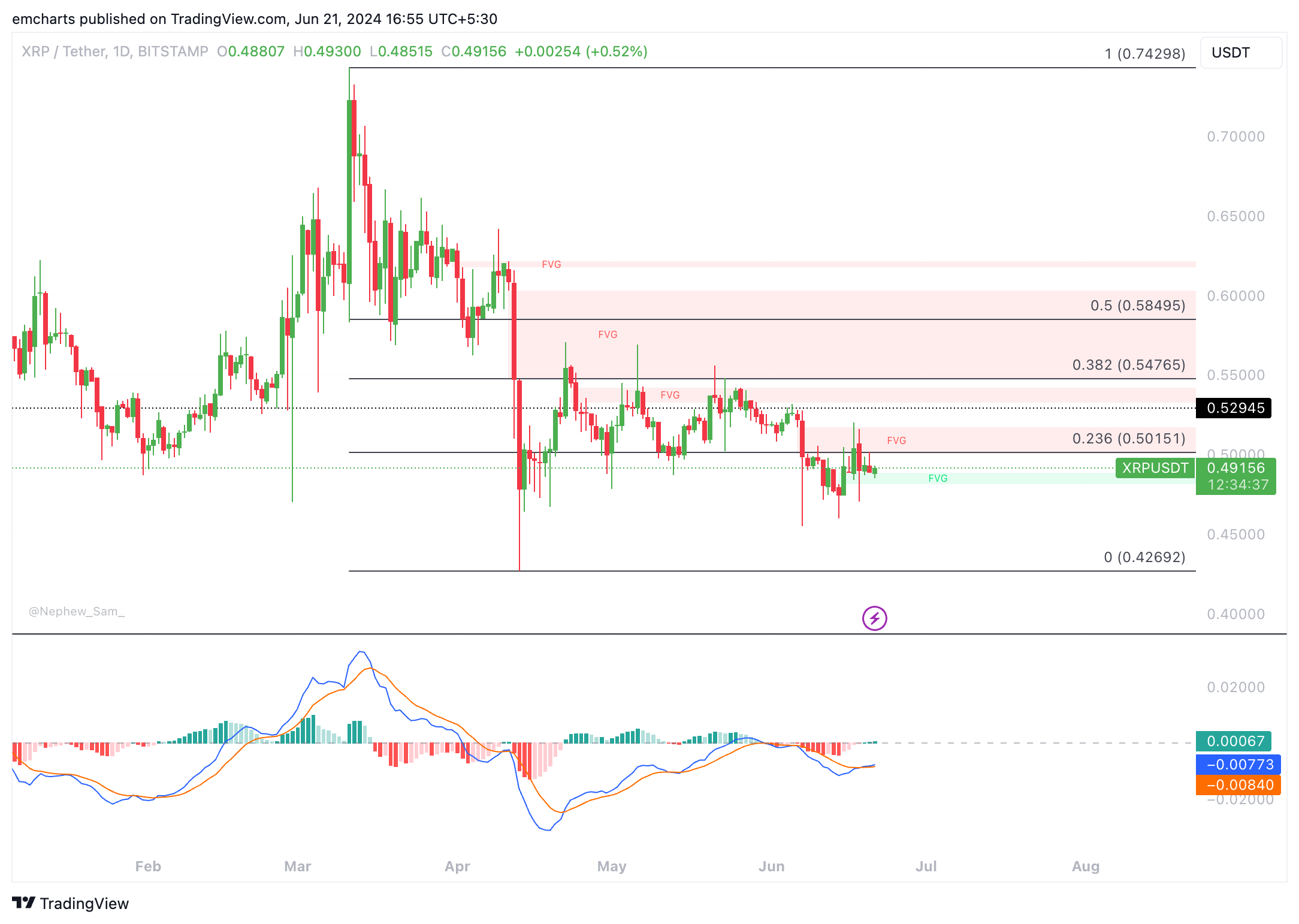
XRP/USDT 1-day chart
A close below the Fair Value Gap’s lower boundary at $0.4813 could invalidate the bullish, prompting further losses for XRP. In this case, Ripple could find support at the June 7 low of $0.4551, a level that has been respected for over two months.
SEC vs Ripple lawsuit FAQs
It depends on the transaction, according to a court ruling released on July 14: For institutional investors or over-the-counter sales, XRP is a security. For retail investors who bought the token via programmatic sales on exchanges, on-demand liquidity services and other platforms, XRP is not a security.
The United States Securities & Exchange Commission (SEC) accused Ripple and its executives of raising more than $1.3 billion through an unregistered asset offering of the XRP token. While the judge ruled that programmatic sales aren’t considered securities, sales of XRP tokens to institutional investors are indeed investment contracts. In this last case, Ripple did breach the US securities law and will need to keep litigating over the around $729 million it received under written contracts.
The ruling offers a partial win for both Ripple and the SEC, depending on what one looks at. Ripple gets a big win over the fact that programmatic sales aren’t considered securities, and this could bode well for the broader crypto sector as most of the assets eyed by the SEC’s crackdown are handled by decentralized entities that sold their tokens mostly to retail investors via exchange platforms, experts say. Still, the ruling doesn’t help much to answer the key question of what makes a digital asset a security, so it isn’t clear yet if this lawsuit will set precedent for other open cases that affect dozens of digital assets. Topics such as which is the right degree of decentralization to avoid the “security” label or where to draw the line between institutional and programmatic sales are likely to persist.
The SEC has stepped up its enforcement actions toward the blockchain and digital assets industry, filing charges against platforms such as Coinbase or Binance for allegedly violating the US Securities law. The SEC claims that the majority of crypto assets are securities and thus subject to strict regulation. While defendants can use parts of Ripple’s ruling in their favor, the SEC can also find reasons in it to keep its current strategy of regulation by enforcement.
The court decision is a partial summary judgment. The ruling can be appealed once a final judgment is issued or if the judge allows it before then. The case is in a pretrial phase, in which both Ripple and the SEC still have the chance to settle.
Author

Ekta Mourya
FXStreet
Ekta Mourya has extensive experience in fundamental and on-chain analysis, particularly focused on impact of macroeconomics and central bank policies on cryptocurrencies.