Ripple tackles $0.50 resistance, holders await lawsuit ruling post SEC enforcement lead’s step down
- The US SEC’s head of enforcement for crypto assets steps down after nine years at the agency.
- The resignation of David Hirsch occurs in the final stage of the lawsuit between Ripple and the SEC.
- XRP fails to hold above $0.50 on Tuesday after closing above this level on Monday.
XRP trades in the red on Tuesday as Ripple (XRP) holders are awaiting developments in the US Securities and Exchange Commission’s (SEC) lawsuit against the firm with the case drawing to a close. The overall direction of the legal battle could be about to change as David Hirsh, the US regulator's enforcement lead for the crypto unit, stepped down from his position last week. This has raised concerns in the community regarding the future course of the SEC vs. Ripple lawsuit.
In its latest letter on June 15, The SEC addressed Ripple’s request for $10 million in fines, rejecting the possibility of such a penalty but opening the door to a $102 million settlement, well below the $2 billion initially demanded.
XRP price falls on Tuesday, trading at around $0.49, after closing above $0.50 on Monday for the first time in ten days.
Daily digest market movers: Ripple holders await lawsuit outcome with changes at SEC
- SEC’s head of the crypto asset unit in the enforcement division, David Hirsch announced his resignation after nine years at the agency, in a LinkedIn post.
- The departure of the head of enforcement raises concerns among XRP holders awaiting a lawsuit outcome since Hirsch led the agency’s legal actions against Coinbase and Solana.
- Hirsch’s departure from the regulator’s office at a critical time is noted by XRP holders and traders.
- The enforcement lead’s departure may have an impact on the ruling or the path forward between the two parties is anticipated by market participants following the lawsuit’s updates closely.
- In a letter on June 15, the SEC commented on Ripple’s request for a $10 million penalty and said that even by the firm’s logic (presented in its previous filings and after comparisons drawn between Ripple and Terraform Labs’ lawsuits) it owes at least $102.6 million in penalties.
- XRP holders are awaiting a court ruling on the issue of the penalty and the alleged securities violation by Ripple. The date of the ruling isn’t set.
Technical analysis: XRP closes above $0.50 for the first time in ten days
News of the departure of SEC’s top crypto enforcer seemed to bring some relief to XRP holders on Monday, although any optimism proved to be short-lived. On the daily chart, the altcoin pushed above $0.50 and closed above this level for the first time in ten days. However, prices are back below this key level on Tuesday as XRP loses around 3% on the day.
Looking up, after being in a state of decline for over two months, XRP could target the $0.5330 resistance that coincides with its June 5 high.
The Moving Average Convergence Divergence indicator is flashing shorter red histogram bars, and the MACD line crossed above the signal line on Tuesday, supporting a thesis of recovery in XRP. The shorter histogram bars show that the underlying negative momentum is fading.
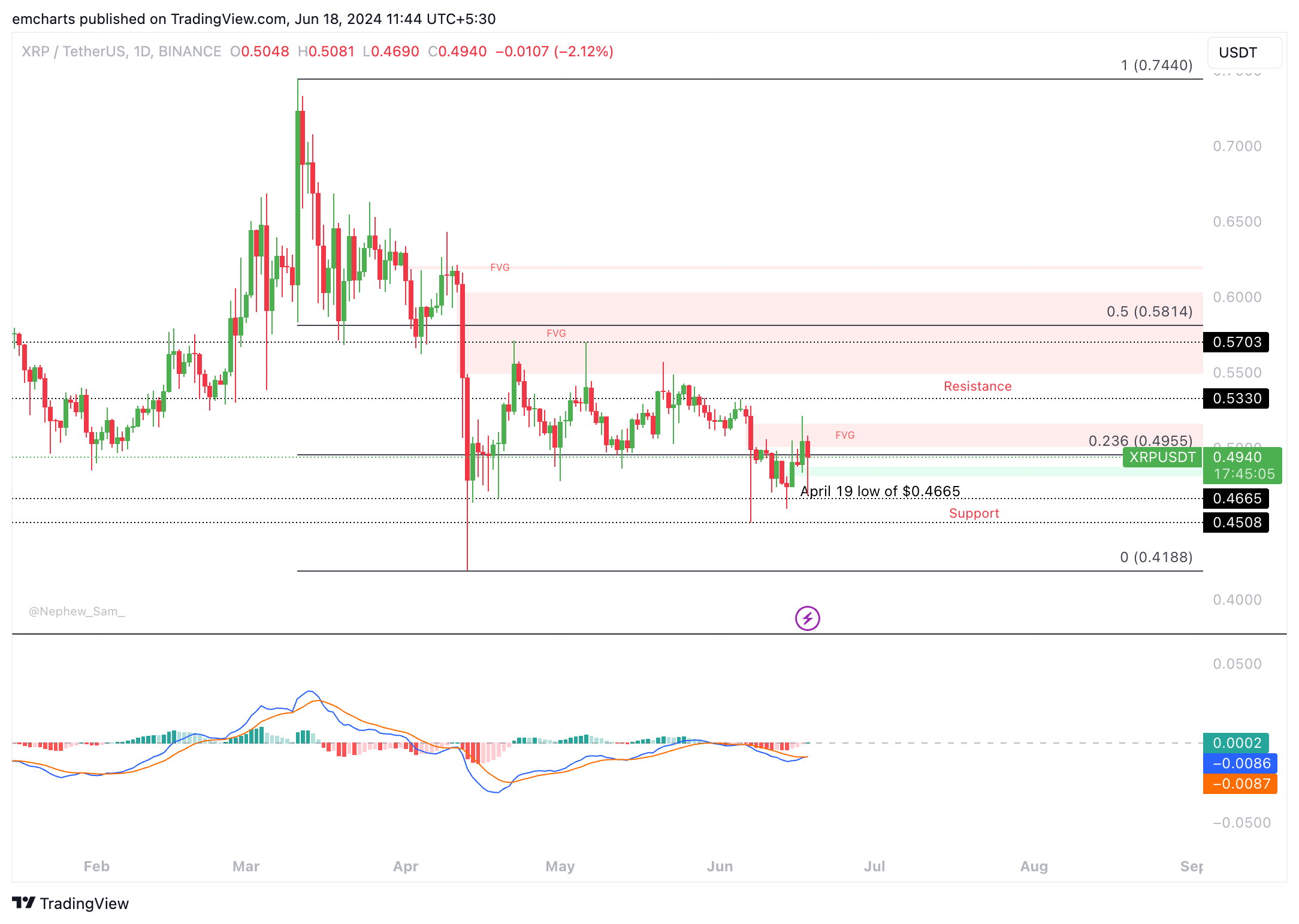
XRP/USDT 1-day chart
However, if Ripple closes below the June 14 high of $0.4813, it could invalidate the bullish thesis. Looking down, XRP could find support at the April 19 low of $0.4665, a key level that has acted as support for more than two months on several occasions.
SEC vs Ripple lawsuit FAQs
It depends on the transaction, according to a court ruling released on July 14: For institutional investors or over-the-counter sales, XRP is a security. For retail investors who bought the token via programmatic sales on exchanges, on-demand liquidity services and other platforms, XRP is not a security.
The United States Securities & Exchange Commission (SEC) accused Ripple and its executives of raising more than $1.3 billion through an unregistered asset offering of the XRP token. While the judge ruled that programmatic sales aren’t considered securities, sales of XRP tokens to institutional investors are indeed investment contracts. In this last case, Ripple did breach the US securities law and will need to keep litigating over the around $729 million it received under written contracts.
The ruling offers a partial win for both Ripple and the SEC, depending on what one looks at. Ripple gets a big win over the fact that programmatic sales aren’t considered securities, and this could bode well for the broader crypto sector as most of the assets eyed by the SEC’s crackdown are handled by decentralized entities that sold their tokens mostly to retail investors via exchange platforms, experts say. Still, the ruling doesn’t help much to answer the key question of what makes a digital asset a security, so it isn’t clear yet if this lawsuit will set precedent for other open cases that affect dozens of digital assets. Topics such as which is the right degree of decentralization to avoid the “security” label or where to draw the line between institutional and programmatic sales are likely to persist.
The SEC has stepped up its enforcement actions toward the blockchain and digital assets industry, filing charges against platforms such as Coinbase or Binance for allegedly violating the US Securities law. The SEC claims that the majority of crypto assets are securities and thus subject to strict regulation. While defendants can use parts of Ripple’s ruling in their favor, the SEC can also find reasons in it to keep its current strategy of regulation by enforcement.
The court decision is a partial summary judgment. The ruling can be appealed once a final judgment is issued or if the judge allows it before then. The case is in a pretrial phase, in which both Ripple and the SEC still have the chance to settle.
Author

Ekta Mourya
FXStreet
Ekta Mourya has extensive experience in fundamental and on-chain analysis, particularly focused on impact of macroeconomics and central bank policies on cryptocurrencies.