TRON’s Justin Sun battles negativity surrounding Huobi insolvency after 12% weekly decline
- Justin Sun asks the TRON community to ignore the fear, uncertainty and doubt surrounding Huobi exchange and its token.
- Crypto Twitter is rife with speculation of Huobi exchange’s insolvency and a TRON price decline.
- Experts note that liquid assets on the Huobi exchange in total cover less than a third of the platform’s USDT obligations.

Adam Cochran, a crypto analyst and investor has raised concerns about Huobi’s solvency in a series of tweets. Cochran’s report comes at a time when there is speculation of executives of the Huobi exchange and TRON being taken into custody by Chinese authorities.
The reports remain unconfirmed and founder Justin Sun has assured the TRON community that the speculation and rumors are just creating Fear, Uncertainty and Doubt (FUD). Sun believes that the community should keep building and ignore the rumors.
Also read: Ripple XRP price rally to $10 is likely after one final shakeout, according to proponents
TRON founder fights FUD in the community
Adam Cochran informed his 207,000 followers that Huobi exchange is likely headed towards insolvency with its liquid assets accounting for a third of its USDT obligations. Following the reports of executives being taken in custody by Chinese authorities, Cochran shared his analysis of the exchange’s assets.
Cochran alleges that Sun has been using the exchange to divert funds to other DeFi projects that the TRON founder is associated with. This leaves Huobi grappling with insufficient assets to meet its obligations.
The analyst shared the exchange’s total balance as of August 6 in his tweey. The total balance is $2.5 billion of which $662 million is TRON, $500 million is Huobi Token, $884 million is Bitcoin (which is supposed to also cover the $3 billion in BTC issued on TRON) $168 million is HBTC This leaves $286 million in other assets.
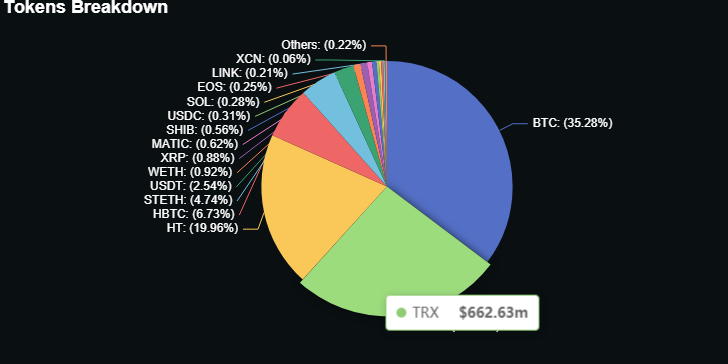
Huobi token breakdown as of August 6
All other liquid assets on the exchange are less than a third of the reported amount of USDT obligations.
1/3
— Adam Cochran (adamscochran.eth) (@adamscochran) August 6, 2023
Huobi's current total balance is $2.5B
of which $662M is Tron,
$500M is HT,
$884M is BTC (which is supposed to also cover the $3B in BTC issued on Tron)
$168M is HBTC
This leaves $286M in other assets. pic.twitter.com/UeuOEKCxQH
TRON price declined from $0.083 on Monday to $0.077 at the time of writing. This represents a drop of 7.2% over the past seven days. It remains to be seen whether Sun’s assurance catalyzes a recovery of sentiment among TRON holders and fuels a price rally.
Bitcoin, altcoins, stablecoins FAQs
What is Bitcoin?
Bitcoin is the largest cryptocurrency by market capitalization, a virtual currency designed to serve as money. This form of payment cannot be controlled by any one person, group, or entity, which eliminates the need for third-party participation during financial transactions.
What are altcoins?
Altcoins are any cryptocurrency apart from Bitcoin, but some also regard Ethereum as a non-altcoin because it is from these two cryptocurrencies that forking happens. If this is true, then Litecoin is the first altcoin, forked from the Bitcoin protocol and, therefore, an “improved” version of it.
What are stablecoins?
Stablecoins are cryptocurrencies designed to have a stable price, with their value backed by a reserve of the asset it represents. To achieve this, the value of any one stablecoin is pegged to a commodity or financial instrument, such as the US Dollar (USD), with its supply regulated by an algorithm or demand. The main goal of stablecoins is to provide an on/off-ramp for investors willing to trade and invest in cryptocurrencies. Stablecoins also allow investors to store value since cryptocurrencies, in general, are subject to volatility.
What is Bitcoin Dominance?
Bitcoin dominance is the ratio of Bitcoin's market capitalization to the total market capitalization of all cryptocurrencies combined. It provides a clear picture of Bitcoin’s interest among investors. A high BTC dominance typically happens before and during a bull run, in which investors resort to investing in relatively stable and high market capitalization cryptocurrency like Bitcoin. A drop in BTC dominance usually means that investors are moving their capital and/or profits to altcoins in a quest for higher returns, which usually triggers an explosion of altcoin rallies.
Like this article? Help us with some feedback by answering this survey:
Author

Ekta Mourya
FXStreet
Ekta Mourya has extensive experience in fundamental and on-chain analysis, particularly focused on impact of macroeconomics and central bank policies on cryptocurrencies.