LUNC ranks among trending tokens alongside Dollar pegged stablecoin USTC, eyes recovery
- Terra Classic USD and Terra Luna Classic tokens are trending among market participants after overnight price gains.
- USTC rallied to $0.078 local top after its 2022 collapse, garnering hope among traders.
- LUNC price noted a pullback after yielding 26% weekly gains for holders.

Terra Luna Classic (LUNC) and Terra Classic USD (USTC) both tokens are trending among traders after noting a massive surge in their price. Santiment analysts believe these tokens are gaining popularity after their collapse, likely to see a revival.
Also read: Dogecoin price might recover losses if volume picks up
LUNC and USTC prices might recover
In 2022, sister tokens Terra USD (UST) and LUNA suffered an implosion when UST depegged. In the aftermath of the event, Terra LUNA was revived as Terra LUNA Classic (LUNC). Terra Classic USD remained de-pegged and the community has been brainstorming ways to establish the stablecoin’s $1 peg again.
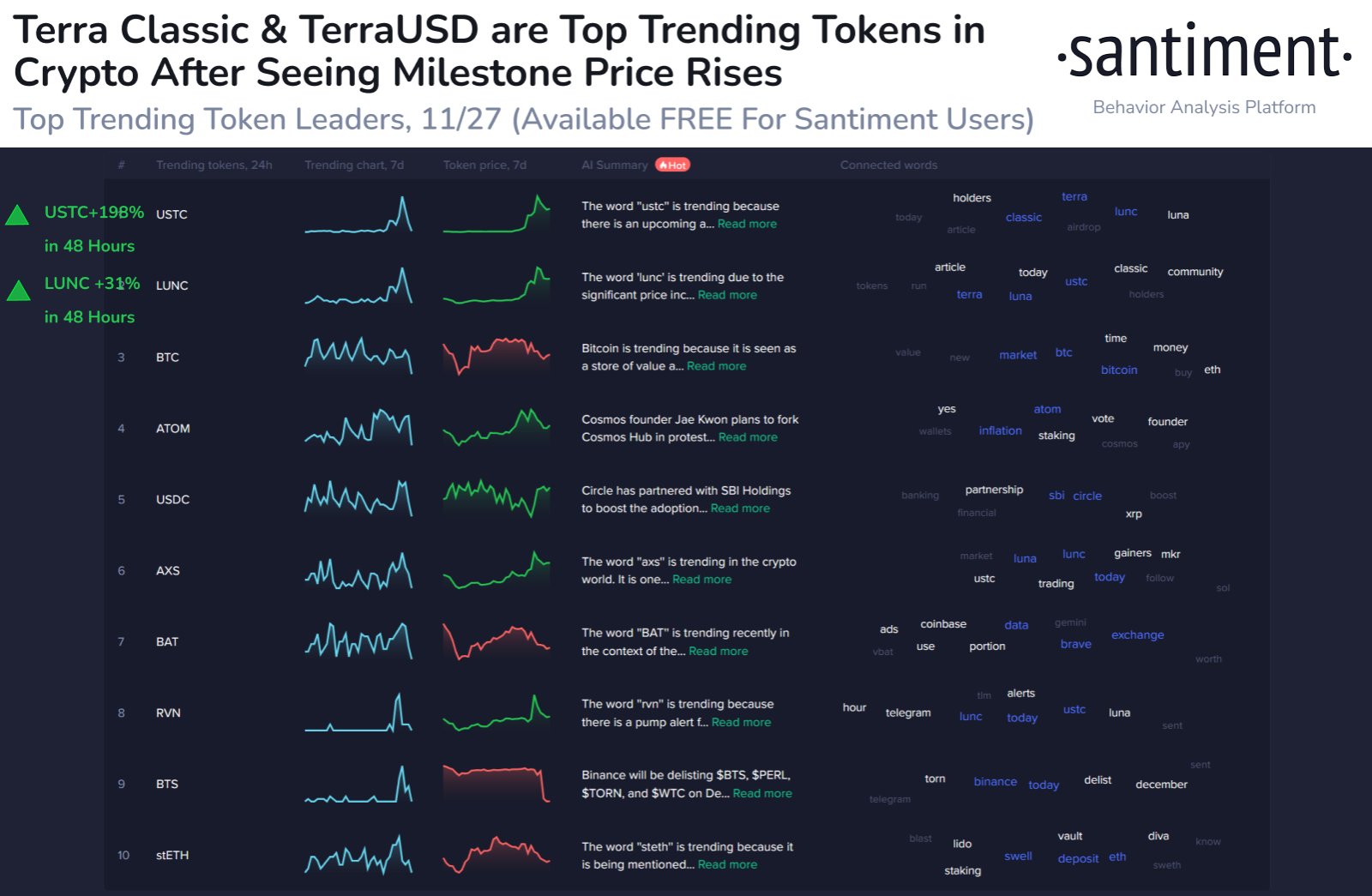
Based on data from crypto intelligence tracker Santiment, two tokens, LUNC and USTC noted milestone price rises in the past week. LUNC price rallied 26% in the past week while Dollar-pegged stablecoin USTC attempted a recovery and climbed 200% in the same timeframe.
Milestone weekly gains in the two tokens have resulted in LUNC and USTC emerging as top trending cryptocurrencies on Santiment’s tracker. It's important to note that the two tokens have experienced a pullback in their prices since then.
LUNC and USTC are trending
After reaching a local peak of $0.078, USTC price corrected to $0.0404 on Binance. The stablecoin is still far from its $1 peg. LUNC price declined to $0.000095 from its November 27 local top of $0.000128.
LUNC is now trading at $0.000115 on Binance, up 56% in the past week. The token is in its uptrend, yielding gains for holders.
Analysts at Santiment believe that the milestone price rallies in the two cryptocurrencies are likely indicators that market participants are experiencing the fear of missing out (FOMO) on these tokens’ gains and this has driven the assets to the top of the list, ranking above Bitcoin, and Cosmos (ATOM).
Bitcoin, altcoins, stablecoins FAQs
What is Bitcoin?
Bitcoin is the largest cryptocurrency by market capitalization, a virtual currency designed to serve as money. This form of payment cannot be controlled by any one person, group, or entity, which eliminates the need for third-party participation during financial transactions.
What are altcoins?
Altcoins are any cryptocurrency apart from Bitcoin, but some also regard Ethereum as a non-altcoin because it is from these two cryptocurrencies that forking happens. If this is true, then Litecoin is the first altcoin, forked from the Bitcoin protocol and, therefore, an “improved” version of it.
What are stablecoins?
Stablecoins are cryptocurrencies designed to have a stable price, with their value backed by a reserve of the asset it represents. To achieve this, the value of any one stablecoin is pegged to a commodity or financial instrument, such as the US Dollar (USD), with its supply regulated by an algorithm or demand. The main goal of stablecoins is to provide an on/off-ramp for investors willing to trade and invest in cryptocurrencies. Stablecoins also allow investors to store value since cryptocurrencies, in general, are subject to volatility.
What is Bitcoin Dominance?
Bitcoin dominance is the ratio of Bitcoin's market capitalization to the total market capitalization of all cryptocurrencies combined. It provides a clear picture of Bitcoin’s interest among investors. A high BTC dominance typically happens before and during a bull run, in which investors resort to investing in relatively stable and high market capitalization cryptocurrency like Bitcoin. A drop in BTC dominance usually means that investors are moving their capital and/or profits to altcoins in a quest for higher returns, which usually triggers an explosion of altcoin rallies.
Author

Ekta Mourya
FXStreet
Ekta Mourya has extensive experience in fundamental and on-chain analysis, particularly focused on impact of macroeconomics and central bank policies on cryptocurrencies.