Ethereum price: Making a case for ETH underperformance following the Shanghai upgrade completion
- Ethereum price is up almost 60% year-to-date, but has far underperformed Bitcoin despite the network upgrade.
- The battle to keep Ethereum sufficiently and properly decentralized relative to Bitcoin explains ETH underperformance.
- Professional traders do not anticipate a significant price correction resulting from Shanghai Capella upgrade.

Ethereum price (ETH) is up almost 60% year-to-date, but remains far below Bitcoin price (BTC) performance, with an ETH/BTC price ratio that is down to 0.063. Notably, this is the lowest level reached in around nine months.
Shanghai upgrade goes live, Ethereum price has other plans
The Shanghai/Capella upgrade, otherwise defined as the staking unlock event, had been widely advertised since late 2022. After the Shapella upgrade, stakers will be able to unlock their staked Ether (stETH) or stop staking altogether. Notably, as of April 11, more than 170,000 withdrawals had been requested, based on Glassnode data.
The highly anticipated Shanghai/Capella hard fork is scheduled to take place on 12-April-2023, enabling the withdrawal of staked #Ethereum.
— glassnode (@glassnode) April 11, 2023
In this extended edition of the Week On-Chain, we shall evaluate the overall Ethereum staking landscape, develop a framework to establish… pic.twitter.com/EVgsz3s6GG
As the countdown to the event drew near, analysts anticipated a surge in demand for ETH as investors ‘bought the rumor’ with hopes of “selling the news”. A similar trend was observed in 2022 in the days leading to The Merge.
Everyone is waiting for the Shanghai upgrade. It won't be bullish for $ETH#Ethereum pic.twitter.com/G9m59ryI5n
— Johnny Woo | Never DM you for Money (@j0hnnyw00) April 5, 2023
Industry pundits attribute the price action displayed by Ether to the Shanghai/Capella upgrade (Shapella), which took place on April 12 at 10:27 PM UTC.
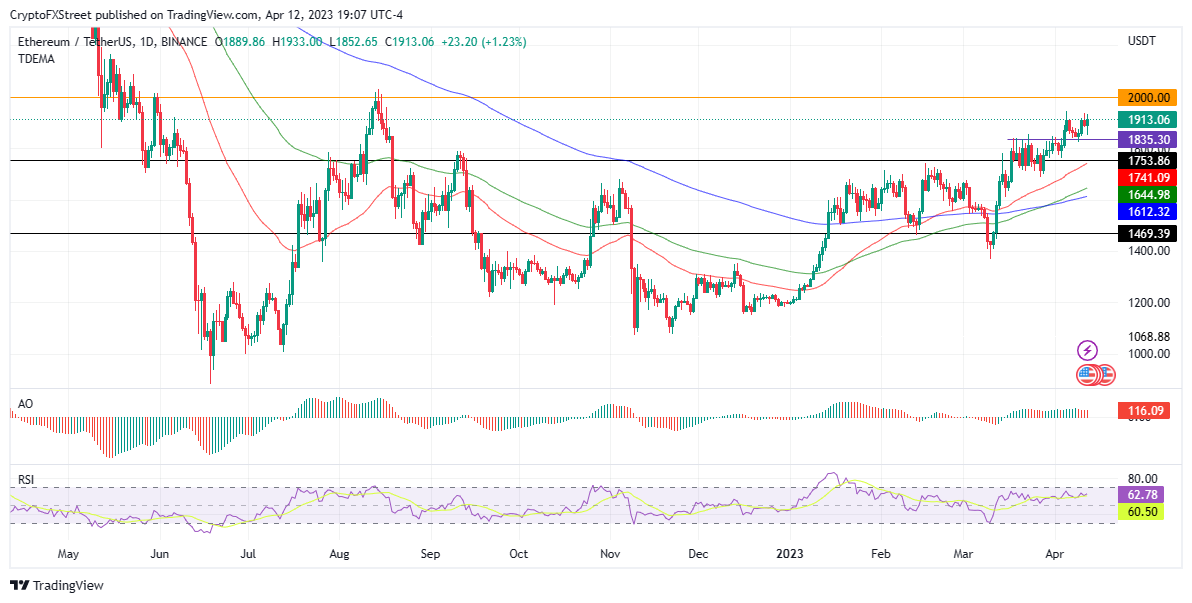
ETH/USDT 1-day chart
Minutes after the upgrade, Ethereum price is only up 1% with negligible fluctuations around the $1,913 level.
With the total stake on the Beacon Chain still above 18.1 million ETH, traders are now worried as they look to analysts for insights about Ether’s potential selling pressure.
Read on to understand the possible reasons for the underperformance displayed by Ethereum price besides the much-hyped Shapella.
Explaining the underperformance of Ethereum price post-Shanghai/Capella upgrade
First, the average transaction fee on the Ethereum network has been above $5 for the last five weeks. Noteworthy, despite minor improvements, Shapella does not address this concern in full. This alone reduces the chances of a bullish breakout in Ethereum price after the upgrade as most decentralized applications (dApps) ad projects will go for second layer and rival networks that offer better rates.
Moreover, Ethereum-based decentralized exchanges have recorded an 84% volume decline after a weekly high of $38.2 billion on March 5. According to DefiLlama’s latest data for the week ending April 2, the volume had plunged to $6.4 billon. On the other hand, rival blockchains recorded a 60% drop in volumes on average over the same duration, indicating that Ethereum had lost its share in the market.
Paul Brody, EY’s global blockchain leader, has identified one of the key reasons behind the underperformance of ETH relative to BTC, citing:
The battle to keep Ethereum sufficiently and properly decentralized.
In this regard, Brody refers to exchanges as “highly centralized custodial validators.” He also notes the presence of certain “semi-centralized players and staking pool operations,” which invest funds from tens of thousands of individual cryptocurrency wallets.
Unbiased bets between Ethereum bulls and bears, Ether derivatives metrics show
Using Ether derivatives metrics, the current market position of professional traders reveals that open interest in Ethereum options for the week ending April 14 is $510 million. This comes amid neutral-to-bullish call signals that outnumber protective put options by almost 40%.
Notably, these ETH options could come up unsuccessful as 60% of their bets were placed at $2,000 or higher for Ethereum price. This means that if ETH remains between $1,800 and $1,900 on April 14 at 8:00 AM UTC, the result is balanced between call and put options.
Furthermore, an expiry price between $1,900 and $2,000 represents a meager $100 million leverage for bulls, which would most likely fail to justify the cost of a price uptick.
On the other hand, an examination of the futures markets can be used to establish whether the Shanghai/Capella upgrade has influenced investors into more risk-averse attitudes. It is worth mentioning that Ether quarterly futures are a favorite among whales and arbitrage tables, which typically trade at a slight premium to spot markets. This suggests that sellers are asking for more money to delay the settlement.
In the ideal market, therefore, futures contracts ought to trade at between 5% and 10% of annualized premium, what is called contango, a very common occurrence in the cryptocurrency arena.
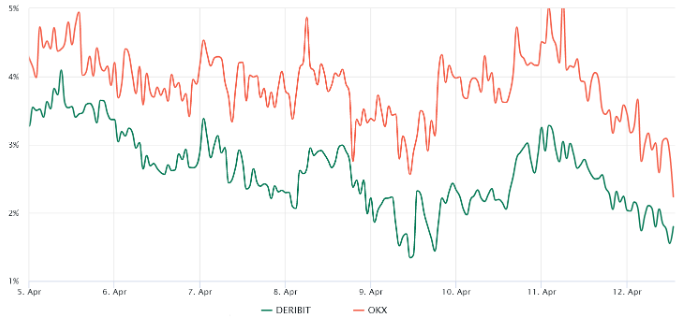
Ethereum 3-month futures annualized premium
As it stands, the premium on Ether futures is at 2%, after dropping from last week’s 4%. Although this is below the 5% neutral threshold, it indicates that there is no excessive short demand.
Next watch: Traders to stay keen on staking unlock requests
Judging from the Ether derivatives, it appears professional traders are not speculating a significant price correction resulting from the Shapella upgrade. Notwithstanding, considering the high transaction fees and plummeting DEX activity, the prospects of a "buy the news" event remain slim.
More experienced traders would have utilized derivatives instruments in their bet against Ethereum price as the event was widely advertised. However, this did not happen given the ETH futures' premium.
Accordingly, there are no clear signs for a rally, although derivatives traders also do not expect any panic selling. This means that unless there is a significant increase in the number of staking unlock requests, Ethereum price could remain near $1,900 for the foreseeable future.
Also Read: Ethereum (ETH) Shanghai upgrade could have this impact on Ether
Author

Lockridge Okoth
FXStreet
Lockridge is a believer in the transformative power of crypto and the blockchain industry.