Ethereum Price Forecast: ETH down despite hype from Beam Chain unveil
Ethereum price today: $3,280
- Ethereum developer Justin Drake proposed the Beam Chain, a new ETH consensus layer to boost throughput and transaction speed.
- The Beam Chain will feature a series of upgrades, including faster block time, quantum security and chain snarkification.
- Ethereum could bounce off the 100-day SMA if its price decline continues.
Ethereum (ETH) is down 1% on Tuesday despite developer Justin Drake proposing the Beam Chain, a new consensus layer that aims to ship a series of changes that will fast-track the Main chain's roadmap to faster block times and quantum resistance.
Ethereum Beam Chain proposal outlined at ETH Devcon
Justin Drake introduced the Beam Chain, a new consensus layer proposal, at the Ethereum Devcon conference on Tuesday. The new Beam Chain aims to improve the current Beacon Chain consensus layer by introducing new features including faster slots, low minimum staking balance (~1 ETH), quantum security, chain snarkification, etcetera.
Faster slots and block times will boost transaction speed and block finality, reducing MEV — a process where validators reorder transactions in a block to extract more value, sometimes at the expense of users. However, this could lead to centralization of nodes due to the hardware requirements needed to handle high transaction throughput.
Quantum security will reduce the possibility of Ethereum suffering from attacks as the world progresses toward a quantum computing era.
Chain snarkification will embed zk-SNARKs, a type of zero-knowledge proof, into the foundation of the consensus layer.
Dubbed the new era of consensus after The Merge, which saw Ethereum transition from a Proof-of-Work (PoW) consensus model to Proof-of-Stake (PoS), the Beam Chain will batch a series of upgrades into one lump that will tackle key challenges in Ethereum's consensus design.
Drake highlighted that since the Beacon Chain went into motion, researchers have seen a series of breakthroughs in cryptography and blockchain engineering. These breakthroughs have caused Ethereum to incur a huge "technical debt" that has hindered developers' ability to build quickly on the chain.
Ethereum currently ships upgrades roughly every year to improve the network gradually. However, with the current roadmap, it will take over a decade for Ethereum to reach the "endgame" proposed in its roadmap.
With the Beam Chain, Drake proposes that Ethereum continues shipping yearly upgrades to handle "low-hanging fruit" but batch and tackle a series of monumental changes within a few years that will accelerate the roadmap to the "endgame."
Will be tweeting slides for others to get the gist of Beam Chain - Justin Drake's reimagining of the consensus layer pic.twitter.com/HEUSTmpOLN
— BREAD (@0xBreadguy) November 12, 2024
According to Drake, developers could start building codes for the Beam Chain in 2026 and potentially begin shipping between 2029 and 2030. While many have criticized the length of production time, Abstract Chain contributor @OxCygaar noted that a large decentralized network like Ethereum needs to take time before embarking on such radical changes to avoid risks.
Meanwhile, Ethereum exchange-traded funds (ETFs) posted a record single-day net inflow of $295.5 million on Tuesday, with Fidelity's FETH and BlackRock's ETHA leading the charge with inflows of $115.5 million and $101.1 million, respectively, per Coinglass data.
Ethereum Price Forecast: ETH could bounce off 100-day SMA if decline continues
Ethereum (ETH) is down 1% after sustaining $129.94 million in liquidations in the past 24 hours, with liquidated long and short positions accounting for $80.44 million and $49.50 million, respectively.
Shortly after rallying to $3,444 in the early Asian session, the top altcoin declined below the resistance level near $3,300.
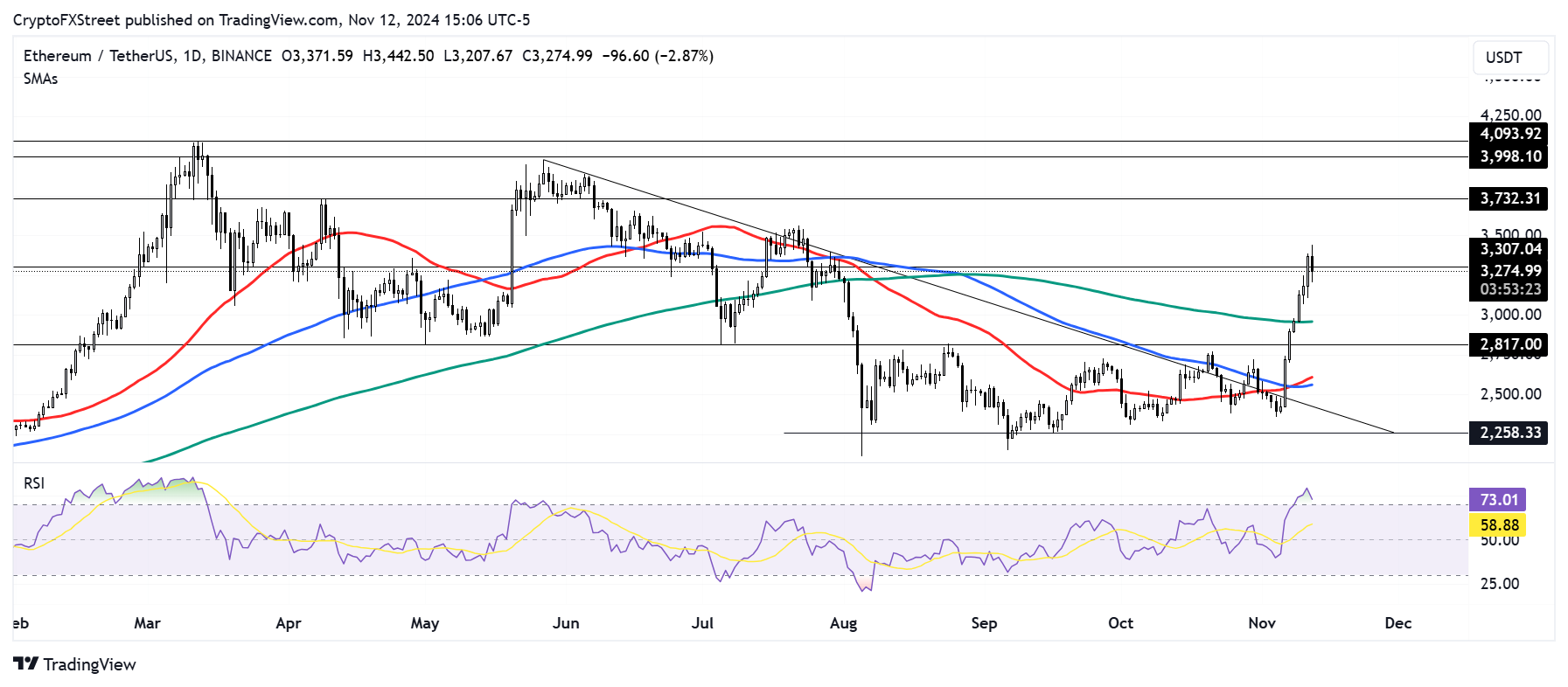
ETH/USDT daily chart
If ETH continues the decline, it could find support near the 100-day Simple Moving Average (SMA) and bounce back to tackle the $3,307 resistance level. ETH could bounce off the $2,817 key support level if the 100-day SMA support fails.
A firm close above $3,307 will see ETH rally toward the resistance level at $3,732.
The Relative Strength Index (RSI) is in its oversold region and trending downward, indicating ETH could continue to experience a correction.
A daily candlestick close below $2,817 will invalidate the thesis.
Ethereum FAQs
Ethereum is a decentralized open-source blockchain with smart contracts functionality. Its native currency Ether (ETH), is the second-largest cryptocurrency and number one altcoin by market capitalization. The Ethereum network is tailored for building crypto solutions like decentralized finance (DeFi), GameFi, non-fungible tokens (NFTs), decentralized autonomous organizations (DAOs), etc.
Ethereum is a public decentralized blockchain technology, where developers can build and deploy applications that function without the need for a central authority. To make this easier, the network leverages the Solidity programming language and Ethereum virtual machine which helps developers create and launch applications with smart contract functionality.
Smart contracts are publicly verifiable codes that automates agreements between two or more parties. Basically, these codes self-execute encoded actions when predetermined conditions are met.
Staking is a process of earning yield on your idle crypto assets by locking them in a crypto protocol for a specified duration as a means of contributing to its security. Ethereum transitioned from a Proof-of-Work (PoW) to a Proof-of-Stake (PoS) consensus mechanism on September 15, 2022, in an event christened “The Merge.” The Merge was a key part of Ethereum's roadmap to achieve high-level scalability, decentralization and security while remaining sustainable. Unlike PoW, which requires the use of expensive hardware, PoS reduces the barrier of entry for validators by leveraging the use of crypto tokens as the core foundation of its consensus process.
Gas is the unit for measuring transaction fees that users pay for conducting transactions on Ethereum. During periods of network congestion, gas can be extremely high, causing validators to prioritize transactions based on their fees.
Author

Michael Ebiekutan
FXStreet
With a deep passion for web3 technology, he's collaborated with industry-leading brands like Mara, ITAK, and FXStreet in delivering groundbreaking reports on web3's transformative potential across diverse sectors. In addition to