Ethereum continues hinting at rally following reduced long liquidations
- Ethereum's price often takes a downward shift after FTX and Alameda sells ETH.
- Traders expect a price rise in ETH following reduced long liquidations and normalizing risk reversals.
- Ethereum needs increased trading volume to break past key resistance levels.

Ethereum (ETH) has continued showing signs of a potential rally on Tuesday as most coins in the crypto market are also posting gains. This comes amid speculation of a potential decline following FTX ETH sales and normalizing ETH risk reversals.
Also read: Ethereum shows signs of a potential rally as suspected Justin Sun wallet buys heavily
Daily digest market movers: FTX sale, normalized risk reversals, active wallet increase
Ethereum's latest price movement is hinting at a potential rally. Here are key market movers driving the second-largest cryptocurrency:
- Since March 1, FTX and Alameda Research have deposited 20,350 ETH at strategic points right before a price dip, according to Spot On Chain. This insight comes as FTX and Alameda deposited 4,500 ETH worth $14.4 million to Binance and Coinbase at $3,207 on Tuesday. Investors may need to observe if ETH will take a downturn as in previous times. Other investors may be using FTX's move as a sell signal, hence the consistent price drop after the firm's ETH sales.
- With ETH's recent price recovery, long traders are looking to gain control as long liquidations have slowed down significantly on Tuesday compared to the past two weeks, according to data from Coinglass. Short liquidations are increasing, with over $13.45 million liquidated, while long liquidations sit at $7.4 million in the past 24 hours.
ETH risk reversals have also normalized above -4%, from -12% one week ago, indicating traders are beginning to expect a price improvement, according to QCP Capital. As a result, "improving speculative sentiment could see short covering and a resumption of leveraged longs," said QCP.
- Meanwhile, Bankless podcast co-host Ryan Sean Adams pointed out the increasing number of active wallets in the Ethereum ecosystem, which has grown to over 10 million weekly active wallets. He speculated that the Ethereum ecosystem can now increase user growth by 10x to 100 million in this bull run.
- The US Securities & Exchange Commission (SEC) has also delayed its response to Franklin Ethereum ETFs, a series of the Franklin Ethereum Trust. The latest spot Ethereum ETF decision delay follows a series of timeline delays the regulator has given to other applicants.
Technical analysis: Ethereum needs increased volume to break past key resistance
Ethereum's recent price movement is teasing that a potential rally is on the horizon as it's attempting to break the upper side of the $2,852 and $3,300 key range. But it must first move past the $3,279 resistance to confirm.
Also read: Ethereum shows firm support at key level as its correlation with US indices increase
However, declining trading volume amid the price increase is a concern. While bulls appear to have taken the wheels again, the reduced trading volume indicates low commitment and uncertainty. ETH could quickly push forward to break past the $3,300 key level if increased volume accompanies the rising bullish sentiment.
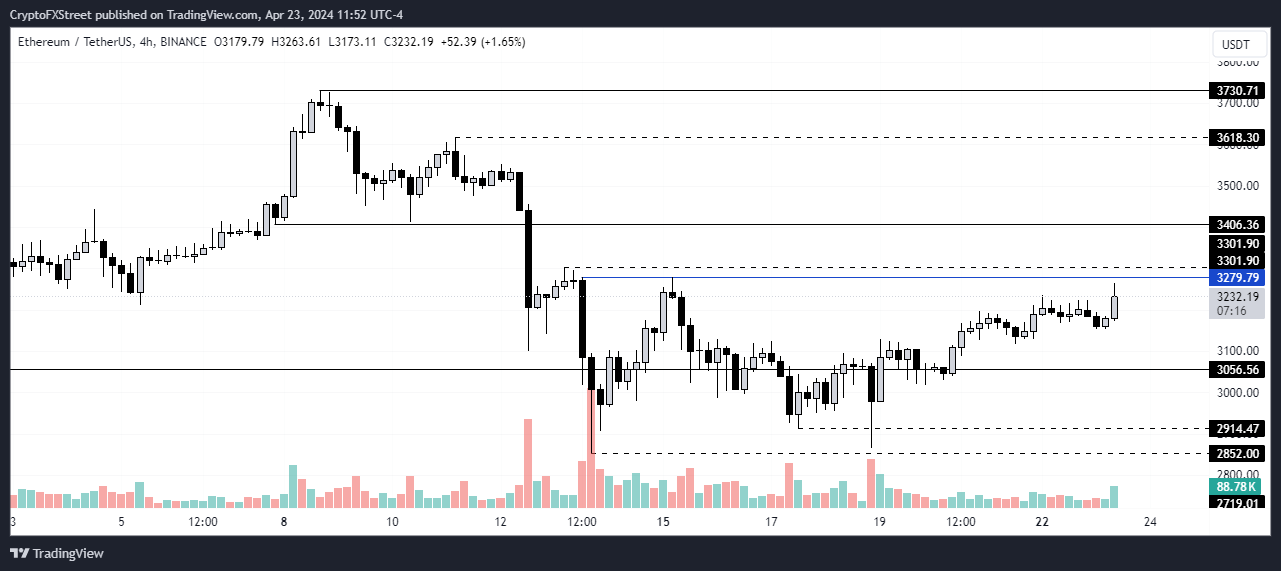
ETH/USDT 4-hour chart
Such a move will see ETH filling the liquidity void of April 13 and aiming for the next resistance of $3,406 formed on April 7. This resistance may prove easy to break past if trading volume increases. However, if volume fails to increase, ETH may fall back to the $3,056 support of March 20.
Additionally, with the halving behind us, Bitcoin's dominance over ETH may reduce in the long term, leaving room for the largest altcoin to craft its own path.
Ethereum is trading around $3,232, up 1.3% on the day at the time of writing.
Ethereum FAQs
Ethereum is a decentralized open-source blockchain with smart contracts functionality. Serving as the basal network for the Ether (ETH) cryptocurrency, it is the second largest crypto and largest altcoin by market capitalization. The Ethereum network is tailored for scalability, programmability, security, and decentralization, attributes that make it popular among developers.
Ethereum uses decentralized blockchain technology, where developers can build and deploy applications that are independent of the central authority. To make this easier, the network has a programming language in place, which helps users create self-executing smart contracts. A smart contract is basically a code that can be verified and allows inter-user transactions.
Staking is a process where investors grow their portfolios by locking their assets for a specified duration instead of selling them. It is used by most blockchains, especially the ones that employ Proof-of-Stake (PoS) mechanism, with users earning rewards as an incentive for committing their tokens. For most long-term cryptocurrency holders, staking is a strategy to make passive income from your assets, putting them to work in exchange for reward generation.
Ethereum transitioned from a Proof-of-Work (PoW) to a Proof-of-Stake (PoS) mechanism in an event christened “The Merge.” The transformation came as the network wanted to achieve more security, cut down on energy consumption by 99.95%, and execute new scaling solutions with a possible threshold of 100,000 transactions per second. With PoS, there are less entry barriers for miners considering the reduced energy demands.
Author

Michael Ebiekutan
FXStreet
With a deep passion for web3 technology, he's collaborated with industry-leading brands like Mara, ITAK, and FXStreet in delivering groundbreaking reports on web3's transformative potential across diverse sectors. In addition to