Ethereum shows firm support at key level as its correlation with US indices increase
- Ethereum's correlation with the traditional market is now higher than Bitcoin's.
- Ethereum restakers may be responsible for its strong support just below the $3,000 level.
- Ethereum could trade sideways for weeks until the SEC's spot Ethereum ETF decision.

Ethereum's (ETH) price continued a sideways movement on Thursday as the market still awaits a trigger. Ethereum isn't alone in this horizontal trend; several major index funds have also traded sideways, underscoring ETH's positive correlation with the traditional financial market.
Read more: Ethereum moves sideways as Q1 report indicates token burns are making it deflationary
Daily digest market movers: traditional market correlation, whale activity, fragile long side
Ethereum has maintained a sideways price movement for the third consecutive day. Here are ETH's key market movers:
- Despite the recent launch of spot Bitcoin (BTC) ETFs in the US, Ethereum's correlation to the traditional market has soared above that of BTC, according to data from The Block. Compared to BTC, Ethereum showed a high correlation to indices like the Nasdaq 100, S&P 500 and Dow Jones Industrial Average. This can be seen in Ethereum's recent price action, which has traded horizontally in tandem with these indices.
- While ETH's price stagnates, whales are making moves behind the scenes. A participant in its initial coin offering (ICO) came online to sell 2,000 ETH for 6 million USDC at $2,997, according to Spot On Chain. The whale bought 33,213 ETH at $0.31 during the Ethereum Genesis ICO. Since then, the whale has sold 5,110 ETH and still holds about 29,700 ETH across three wallets.
Another whale, who spent 10 million USDT to buy 3,279 ETH at $3,050 on Wednesday, withdrew 21,474 ETH — worth $64.7 million — from Binance on Thursday, according to Lookonchain. The whale has bought 107,931 ETH from decentralized exchanges and Binance since April 8.
Also read: Ethereum declines as crypto market crash increases bearish sentiment
- Options indicators also show that "the long side of Ethereum is more fragile and have limited ability to lead the market," according to Greekslive.
Technical analysis: ETH sideways movement may continue for weeks
Ethereum bears attempted to shift its price below the $2,900 key level on Wednesday, but it quickly rebounded to the $3,000 support level on Thursday.
ETH has maintained trading around the range of $2,900 and $3,300 since the market crash of April 12. Despite bulls showing weak hands, bears haven't been able to break below the range.
The scarcity of ETH driven by the increased attractiveness of Ethereum restaking and anticipation of the Bitcoin halving may be what's sustaining its price to stay within the range.
Read more: Ethereum recovers from dip as Hong Kong ETH ETF approval sparks whale buying spree
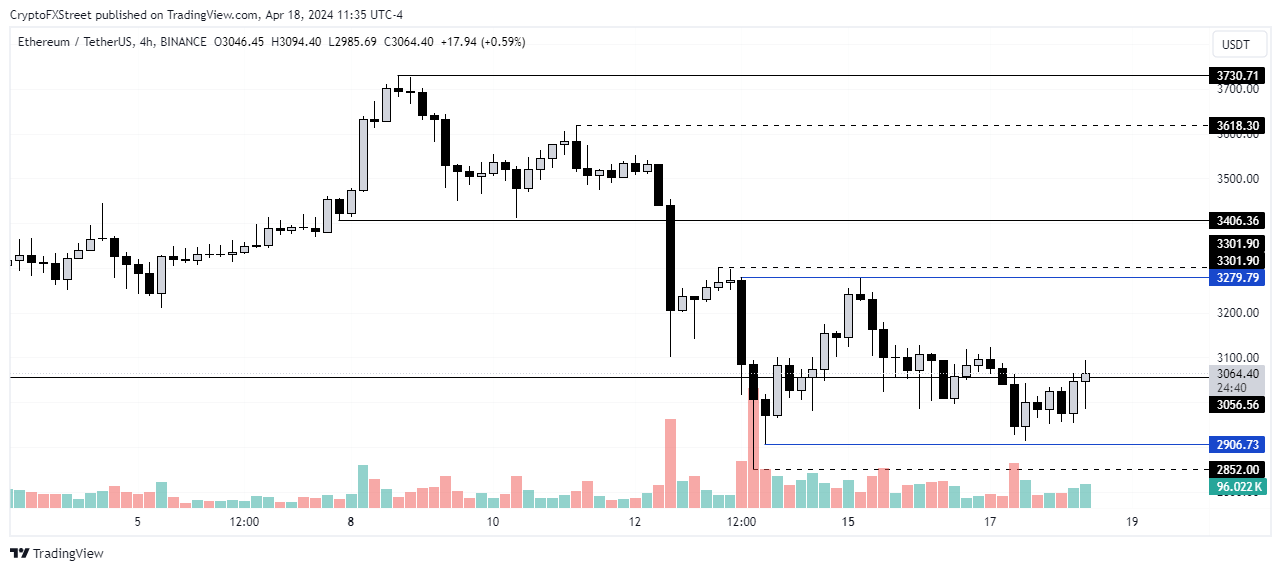
ETH/USDT 4-hour chart
As stated in a previous analysis, ETH may continue the sideways movement. Minor market triggers may see it posting tiny gains but not above or below the $3,300 and $2,852 range identified previously.
The sideways movement may prevail for weeks until days leading to the Securities & Exchange Commission's decision on a spot Ethereum ETF. This thesis would be invalidated if the Bitcoin halving triggers an unlikely rally.
Ethereum is trading at $3,062, up 1.7% on the day.
Ethereum FAQs
Ethereum is a decentralized open-source blockchain with smart contracts functionality. Serving as the basal network for the Ether (ETH) cryptocurrency, it is the second largest crypto and largest altcoin by market capitalization. The Ethereum network is tailored for scalability, programmability, security, and decentralization, attributes that make it popular among developers.
Ethereum uses decentralized blockchain technology, where developers can build and deploy applications that are independent of the central authority. To make this easier, the network has a programming language in place, which helps users create self-executing smart contracts. A smart contract is basically a code that can be verified and allows inter-user transactions.
Staking is a process where investors grow their portfolios by locking their assets for a specified duration instead of selling them. It is used by most blockchains, especially the ones that employ Proof-of-Stake (PoS) mechanism, with users earning rewards as an incentive for committing their tokens. For most long-term cryptocurrency holders, staking is a strategy to make passive income from your assets, putting them to work in exchange for reward generation.
Ethereum transitioned from a Proof-of-Work (PoW) to a Proof-of-Stake (PoS) mechanism in an event christened “The Merge.” The transformation came as the network wanted to achieve more security, cut down on energy consumption by 99.95%, and execute new scaling solutions with a possible threshold of 100,000 transactions per second. With PoS, there are less entry barriers for miners considering the reduced energy demands.
Author

Michael Ebiekutan
FXStreet
With a deep passion for web3 technology, he's collaborated with industry-leading brands like Mara, ITAK, and FXStreet in delivering groundbreaking reports on web3's transformative potential across diverse sectors. In addition to