Bitcoin price steady above 50% of 2023 market range, eyes on halving as key economic and price cycle marker
- Bitcoin price is up 68% since the January 1 low of $16,499, holding above the 50% of 2023 market range.
- NYDIG Q3 research shows BTC is the best-performing asset class of the year on asset class returns metrics.
- ETF continue to be top of mind for BTC potential drivers since BlackRock applied for BTC Spot Exchange-Traded Fund.

Bitcoin (BTC) price is stable in the upper half of the 2023 market range after bouncing from the 50% Fibonacci Retracement level. With this position, a BTC firm has indicated the flagship crypto is doing better than every other asset class on metrics of returns.
is still up by a significant margin on a year-to-date basis, residing high above the midline of the 2023 market range. Meanwhile, Stone Ridge subsidiary and holding company, NYDIG, has indicated that BTC is doing way better than other asset classes on return metrics.
Also Read: Bitcoin holders get clean slate; Will BTC price choose $30,000 or $25,000?
Bitcoin price 70% above 2023 lows, NYDIG acclaims BTC top performer
Bitcoin (BTC) price is up 68% since the year’s lows of $16,507, standing comfortably above the 50% Fibonacci retracement level of $24,217. The price got rejected from the 78.6% Fibonacci retracement at $28,628 on October 2.
With Bitcoin price testing the 70.5% Fibonacci retracement at $27,379, the bulls still have a fighting chance considering the position of the Relative Strength Index (RSI) above 50 and the Awesome Oscillator (AO) still in the positive territory.
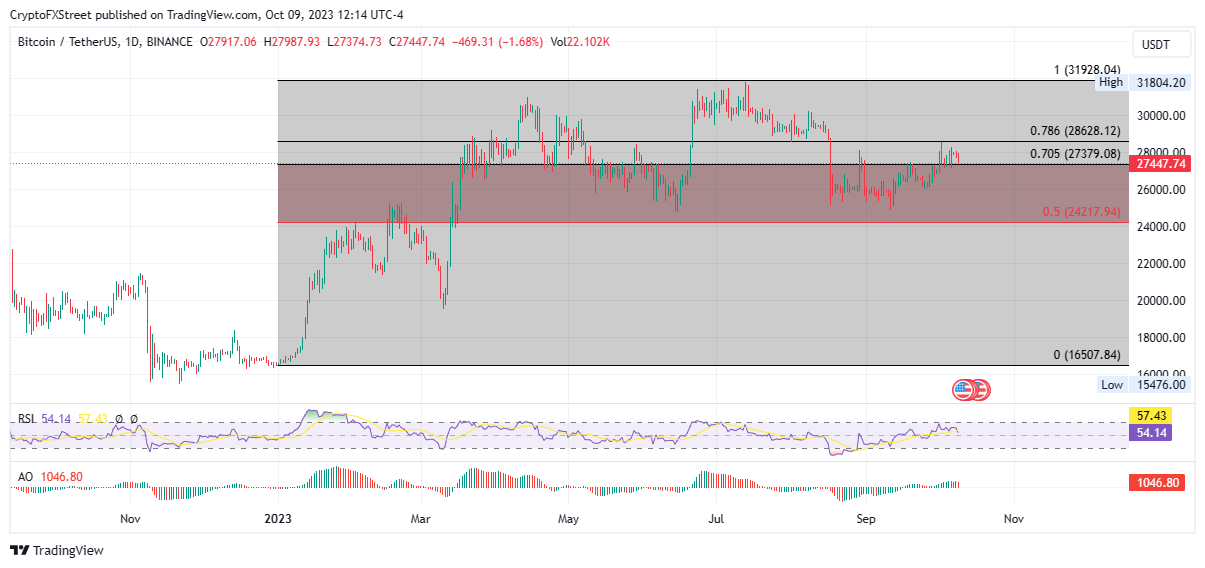
BTC/USDT 1-day chart
Meanwhile, according to recent reports from NYDIG, Bitcoin remains at the helm of the 2023 list of asset-class returns. Specifically, BTC is the top-performing asset class for the year, boasting a stark 63.3% increase year-to-date, as of October 6. The report compared Bitcoin to stock market indices, equities, corporate bonds, and US Treasuries.
With the BTC reading on a year-to-date basis far exceeding returns for every other asset class in the list, Bitcoin price continues to mimic a pattern not so different from past cycles even as the countdown to the next halving continues, anticipated to be around April 2024. The event is critical, viewed as an important economic and price cycle marker.

2023 asset class returns, NYDIG
Historically, Bitcoin price has performed abysmally during Q3, akin to what happened this year, retracing back to the mean position around September before the “Uptober” vibes set in and BTC started to rebound.
For catalyst or impulse trigger, the crypto community continues to look to the US Securities and Exchange Commission (SEC), with the hope of an approval(s) as piles of applications for Bitcoin Spot Exchange-Traded Funds (ETF) issuance lie on the commission’s desk. The optimism gained momentum when BlackRock, the world’s largest asset manager with at least $9.1 trillion assets under management (AUM), joined the race. Its record of accomplishment winning approvals is among the list of reasons why ETF experts such as Eric Balchunas wager on a nod from the financial regulator.
Fun fact: BlackRock's record of getting ETFs approved by the SEC is 575-1. That's another reason this is so big, they don't play around. https://t.co/f7YIhGRmLf
— Eric Balchunas (@EricBalchunas) June 16, 2023
Nevertheless, the commission has continually delayed decisions as deadlines go by, putting off (not out) hope among market onlookers and leaving them only with the BTC halving to look forward to. On this matter Binance CEO Changpeng Zhao (CZ) has forewarned the impatient BTC holders expecting a rally the day after halving that they may have to wait a year longer before the event is priced in.

Binance CEO Changpeng Zhao blog on BTC halving
Also Read: BlackRock Bitcoin ETF application, making a case for SEC approval
Litecoin halving FAQs
When is the next Litecoin halving?
Litecoin’s third block halving event is scheduled to take place at a block height of 2,520,000, which is estimated to happen around August 3. The current block height is 2,511,587. The first halving took place in 2015 after the block height was 840,000. The second Litecoin halving event occurred in 2019 when the total block height hit 1,680,000. This event takes place roughly once every four years.
What will be the new block reward after the third Litecoin halving?
Halving is an important event for both miners and investors. After halving, the block rewards are slashed in half, as the name suggests. The first halving event in 2015 reduced the block reward from 50 to 25 and the second one in 2019 halved it to 12.5. The third halving, which is scheduled on August 3, will further reduce it to 6.25. This means that miners will go from receiving 12.5 LTC for mining a block to 6.25 LTC after the third halving.
How will halving affect Litecoin price?
After a halving event, the emission of LTCs is cut in half, which effectively triggers a reduction in the Litecoin supply. If the demand remains more or less the same, it creates a negative supply shock. The same dynamics are seen if the demand for LTC increases. Due to the reduced supply and high demand, it would trigger a rally in Litecoin price. But traders often anticipate this trend and try to get an exposure to LTC before the halving, causing a premature rally and a sell-the-news drop on the day of the event.
Why is Litecoin halving important to LTC holders?
Following a halving event, miners receive 50% fewer rewards for every block they mine and this creates scarcity in the altcoin, reducing the circulating supply of the asset. The event’s purpose is to control the inflation rate of Litecoin. Halving is therefore a key event that influences the asset’s price and market capitalization over time.
How different is Litecoin halving from Bitcoin halving?
From a technical perspective, it is not any different. But from an investor and miner perspective, there are lot of differences. For example, the concept of halving remains the same for both assets, but due to relatively lower total supply of 21 million and first-mover advantage, Bitcoin’s network effect and large market capitalization as a result has a significant impact on the crypto ecosystem as compared to Litecoin. Additionally, the effect of halving events is more pronounced for Bitcoin, because of the asset’s dominance, hence BTC halving receives more attention.
Author

Lockridge Okoth
FXStreet
Lockridge is a believer in the transformative power of crypto and the blockchain industry.