Bitcoin Price Top Forecast: Bitcoin bulls have to do something with $8,000 resistance before it’s too late
- Bitcoin is stuck below $8,000 handle after a strong sell-off.
- The cryptocurrency market ignored fundamentals, as usual.
- The long-term Bitcoin’s bullish trend is under threat.

It's been a volatile week for cryptocurrency markets as top-three cryptocurrencies were dominated by bears and retreated from multi-months highs reached during the previous week. Bitcoin settled below $8,000 after unsuccessful attempts to clear the $9,000 barrier. While the sell-off still qualifies as a natural correction from overbought levels, the longer Bitcoin stays below $8,000, the stronger the short-term bearish sentiments are.
Ethereum and Ripple have been range-bound for the best part of the week with a bearish bias, while EOS became the biggest loser with over 16'5 of gains on a week-on-week basis.
What's going on in the market
Quite a number of exciting events hit the market this week; however, none of them produced a significant effect on Bitcoin movements. The first digital currency was influenced mainly by technical factors and speculative sentiments.
Meanwhile, the regulators and authorities around the globe start taking the cryptocurrency industry seriously. Thus, in Australia, the country's tax office (ATO, the Australian Tax Office0 initiated investigations of cryptocurrency-related tax evasion schemes. The regulator has discovered 12 international practices used to avoid paying taxes. Naturally, ATO aims to take a strict approach to stop the abuse, which will result in stricter requirements towards KYC (Know Your Customer) procedures and ALM (Anti-Money Laundering) practices of the cryptocurrency-related companies.
Also, Japanese tax authorities plan to crack down on companies and individuals that are underreporting their crypto-related profits. According to recent research, crypto traders in Japan failed to declare cryptocurrency income worth $93 million. Apart from that, the Japanese authorities revised their cryptocurrency laws to impose stricter controls and bring more clarity to the industry.
Facebook announced that its proprietary cryptocurrency known as Global Coin might be issued in June; however, the cryptocurrency community is skeptical about the initiative, because it is said to aggravate the centralization issue and help to concentrate the power in the hands of big corporations. The same critical thinking is applied to JP Morgan's coin.
Notable altcoins developments
BTC/USD, 1D chart
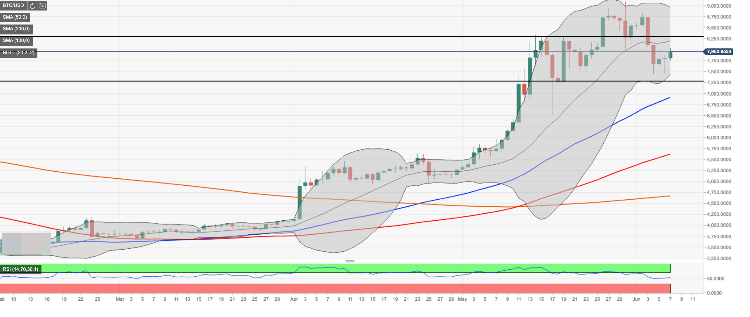
BTC/USD has been hovering below $8,000 for the best part of the week. Several failed attempts to break above this handle deteriorated the short-term technical picture and inspired bearish forecasts among cryptocurrency experts. Basically, a sustainable move above $8,000 is regarded as a prerequisite for the further recovery and retest of $9,000. This resistance area is propped by the upper line of the 1-day Bollinger Band, which means that we will need to see a strong upside momentum to clear the barrier.
However, once it happens, BTC/USD will swiftly retest the recent high of $9,090 and proceed to the next critical resistance at $9,300. Considering an upward-looking Relative Strength Index on both daily and weekly charts, the bullish scenario looks quite realistic, provided that the price moves above $8,000 in the nearest future. Otherwise, the bearish sentiments will start mounting and bring more sellers to the market.
On the downside, BTC/USD needs to stay above $7,600 (the lower line of 1-hour Bollinger Band and 38.2% Fibo retracement monthly) to allow for another leg higher. Once it is cleared, the sell-off is likely to gain traction with the next focus on $7,300 (the lower line of the previous consolidation channel) and $7,000 strengthened by SMA50 (Simple Moving Average) on a daily chart.
Author

Tanya Abrosimova
Independent Analyst