Binance defies regulatory FUD with 22 million new registered users in three months, BNB price drops 30%
- BNB price is down 30% since May, a three-month period that has seen 22 million new users join Binance exchange.
- The disparity comes amid regulatory clampdown against the exchange and its CEO Changpeng Zhao, which worsened broader bear market woes.
- Undeterred, the exchange boasts several advancements, including a Japan re-launch, Dubai MVP licensure, and doubled launch pools, among others.

BNB, the ticker for the Binance Coin crypto, is trading horizontally after a stark drop from the April highs. The sideways move comes as the broader cryptocurrency market continues without a catalyst, with Bitcoin (BTC) price leading the altcoins in the steady slide. For Binance Coin, however, the dormancy comes as the BNB network remains subject to regulatory scrutiny, with both the exchange and its CEO facing civil charges from US regulators.
Binance network bullish developments fail to impart on BNB
BNB price is stuck within a range despite numerous positive network news and efforts by Binance CEO Changpeng Zhao to fight off fear, uncertainty, and doubt (FUD). The token is down 30% since May, during which several value-additions have been recorded on the network.
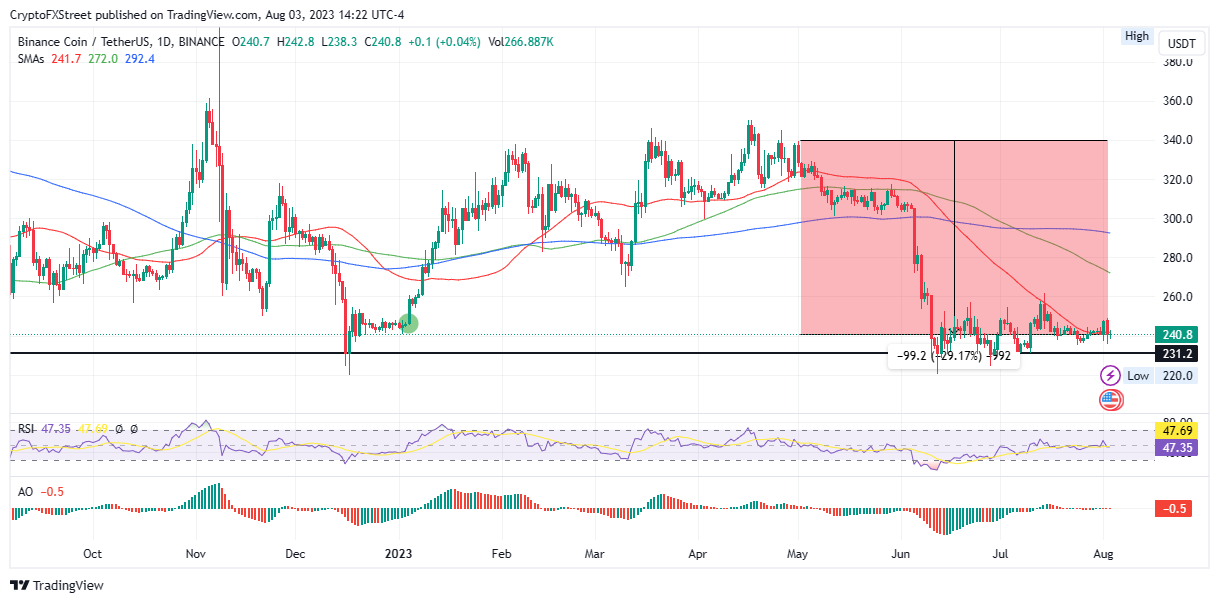
BNB/USDT 1-day chart
Among the positive developments in the network is included a successful launch of Japan subsidiary Binance Japan, which took place on August 2 as part of the exchange's ongoing efforts to leverage the country's Web3 wave. Notably, the launch marks a comeback after regulatory pressure forced the exchange out in 2018. This points to current regulatory compliance by Binance in Japan.
The largest exchange by trading volume has also merited inclusion in the pioneer list in Dubai after being the first exchange in the world to secure an Operational MVP license. This is an upgrade from the 2022 Minimal Viable Product (MVP) license from Dubai's Virtual Assets Regulatory Authority (VARA), giving it the legitimacy to open a domestic bank account to hold clients' funds locally, operate a crypto exchange, and offer payments and custody services.
#Binance FZE, our Dubai based subsidiary, is the world's first exchange to receive the Operational Minimum Viable Product licence in Dubai.
— Binance (@binance) July 31, 2023
Eligible users can now access regulated virtual asset services, such as fiat on and off ramp services via Binance FZE.
More here
While the exchange also boasts two additional Binance Launchpools for farming, CyberConnect (CYBER) and Sei (SEI), the highlight of the ecosystem's growth is that 22 million new registered users have joined the exchange since May, defying all manner of FUD and negative publicity as US regulators continue cracking down on Binance and CZ.
This week at #Binance (so far):
— CZ Binance (@cz_binance) August 3, 2023
- Binance Japan officially launched
- Binance secured an Operational MVP License in Dubai (first exchange in the world to do so)
- 2x new Binance Launchpools - $CYBER & $SEI
- Hit 150M registered Binance users
Keep building.
A lot has happened to the Binance ecosystem since May, from FUD to regulatory scrutiny and the subsequent charges. On June 5, the US Securities and Exchange Commission sued Binance and CZ for securities law violations. While CZ dismissed the news with his signature "4" for fake news or attack, the news sent BNB price down a staggering 10% in 24 hours.
The case advanced to the financial regulator filing to freeze Binance assets for its US subsidiary, BinanceUS. Amid these crises, the exchange withdrew from its Netherlands operations, canceled its license in the UK, and threats for its business in Belgium and Australia over allegations of law violations.
In the latest development, the US Department of Justice (DOJ) has considered levying fraud charges against the exchange but is being held back by concerns of implication to customers. Nevertheless, all these negatives have not stopped 22 million new users from registering with the exchange.
Binance registers 22 million new users despite regulatory attack
Based on the latest data from CZ, Binance exchange users have increased from 128 million in May to 150 million.
This week at #Binance (so far):
— CZ Binance (@cz_binance) August 3, 2023
- Binance Japan officially launched
- Binance secured an Operational MVP License in Dubai (first exchange in the world to do so)
- 2x new Binance Launchpools - $CYBER & $SEI
- Hit 150M registered Binance users
Keep building.
The growth could be attributed to the exchange's dominance in the decentralized finance (DeFi) space, with Binance Smart Chain (BSC) contending strongly against the likes of Ethereum (ETH) in daily volume.

DeFi chains' 24-hour volume
Another possible enabler to users' optimism around Binance is the BNB Chain's newly introduced layer-2 (L2) testnet based on the Optimism OP Stack. The feature addresses the network's "scalability challenge" while bolstering security.
Notwithstanding, the user growth points to the solidity of the DeFi space, with Binance presenting as the leading player, arguably, which explains why user trust continues to abound despite numerous debacles with regulators.
The exchange continues to grow rampantly in developing economies, especially those with less developed financial systems. These include the more populated countries, which justifies why the platform ranks number one in the list of cryptocurrency exchanges today and continues to grow strong despite the regulatory scrutiny from various developed economies.
Cryptocurrency prices FAQs
How do new token launches or listings affect cryptocurrency prices?
Token launches like Arbitrum’s ARB airdrop and Optimism OP influence demand and adoption among market participants. Listings on crypto exchanges deepen the liquidity for an asset and add new participants to an asset’s network. This is typically bullish for a digital asset.
How do hacks affect cryptocurrency prices?
A hack is an event in which an attacker captures a large volume of the asset from a DeFi bridge or hot wallet of an exchange or any other crypto platform via exploits, bugs or other methods. The exploiter then transfers these tokens out of the exchange platforms to ultimately sell or swap the assets for other cryptocurrencies or stablecoins. Such events often involve an en masse panic triggering a sell-off in the affected assets.
How do macroeconomic releases and events affect cryptocurrency prices?
Macroeconomic events like the US Federal Reserve’s decision on interest rates influence risk assets like Bitcoin, mainly through the direct impact they have on the US Dollar. An increase in interest rate typically negatively influences Bitcoin and altcoin prices, and vice versa. If the US Dollar index declines, risk assets and associated leverage for trading gets cheaper, in turn driving crypto prices higher.
How do major crypto upgrades like halvings, hard forks affect cryptocurrency prices?
Halvings are typically considered bullish events as they slash the block reward in half for miners, constricting the supply of the asset. At consistent demand if the supply reduces, the asset’s price climbs. This has been observed in Bitcoin and Litecoin.
Author

Lockridge Okoth
FXStreet
Lockridge is a believer in the transformative power of crypto and the blockchain industry.