USDJPY rightly in focus as the prime example of FX market's perversity

Outlook:
The dollar slide downward was already in progress when the Fed hiked r ates but seemed less aggressively hawkish than the market wanted—or the inflation data warranted.
Regional Feds talking about the Fed sticking to the plan for three hikes this year failed to impress, showing a lack of respect for the Fed. To add insult to injury, disbelief comes right after the Fed managed to herd the bond market cats into accepting the March hike. We never know whether this hurts the Fed's feeling but we can be sure the Fed frowns on its credibility being punched in the nose. NY Fed and chair Yellen speak today and tomorrow. It would be out of keeping with custom for them to promote the dot-plot, but it's not out of the question that one or both of them will slide a hint about June into their prepared speeches.
The other major force at work driving the dollar down is skepticism about Trump having the ability to manage Congress, or Congress' ability to manage itself, to get things done. The healthcare bill coming up for the vote today will almost certainly fail in the House this time, last minute amendments notwithstanding, but even if it were to pass the House, it would fail the Senate. To be fair, it's not really Trump's bill. He never gets his little hands dirty. It's really the Ryan bill. But never mind. It is widely accepted that the plan calls for healthcare, then the budget, then tax reform, then infrastructure spending. In other words, the healthcare bill is a precondition for all the rest of the Trump reflation trade policies.
We don't buy it—Congress can backburner healthcare and move on, but it may choose not to. Or the healthcare bill can go to a new committee for "reconciliation," which is not a win for Ryan/Trump but not a loss, either. This outcome could restore the Trump reflation trade in the blink of the eye. Bottom line, it's far too soon to say the reflation trade is well and truly a dead duck. In fact, we see it coming back to life multiple times after multiple setbacks.
That's if Trump manages to avoid impeachment or the paving of the road to impeachment. It is starting to look as though there really was some collusion of some sort between some Trumpies and the Russians. That this almost certainly didn't affect the election outcome doesn't matter. US citizens are not legally allowed to collude with a hostile foreign government or its proxies, the oligarchs.
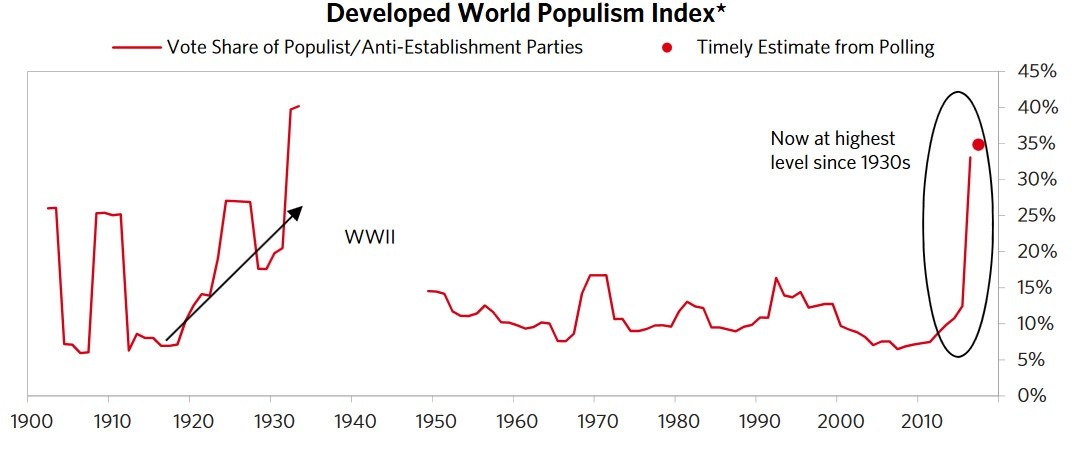
Another big-picture trend in the world today is rising populism—Brexit and Trump, if not LePen (so far). Bridgewater hedge fund manager Ray Dalio takes the populist threat very seriously indeed and has published a report on it (https://www.bridgewater.com/resources/bwam032217.pdf). Dalio thinks populism may have as much influence on economic outcomes as monetary and fiscal policy. Well, when it comes to historic events like the Russian revolution, that is certainly true. But how many of those do we actually have? Dalio lists them. Dalio asserts populism is now at the highest since the 1930's. See the chart. The paper lacks an ending summary—it just fizzles out (on Chavez). Dalio is seeking to get the same Wise Man status as Soros before him. He may be overly impressed with his own brainpower, but he is also performing a useful function—he will get widely read, unlike the equally self-impressed writers in publications like Foreign Affairs.
To return to FX, the dollar/yen is rightly in focus as the prime example of the perversity of the FX market. We say the yen is rising because of a safe-haven flow back into yen by Japanese investors, something the carry-trade gang is counting on. But in the absence of the safe haven flow, the yen "should" be weaker on the yield differential.
The WSJ notes the differential between U.S and Japanese two-year bonds were at 1.6% earlier this month, the most since August 2008. "The U.S.-Japan long-term yield differential rose above 2.5 percentage points in December, its widest in seven years, and has remained close to that level." Such a strong yield advantage should favor the dollar. That the theory is not working means we need to investigate that safe-haven flow phenomenon a little more deeply.
For one thing, it's convenient for the Japanese government that seeks to convince a US president that Japan is not deliberately making or keeping its currency weak to get a trade advantage. This is useful in light of a visit to Japan by VP Pence, probably April 17-19, to hold bilateral trade talks with FinMin Aso. That assumes Trump listens to Pence, which nobody believes for a minute. Anyone expecting the BoJ/MoF to intervene this time to hold the yen at bay will be disappointed—it would be foolish to poke the Trumpian bear.
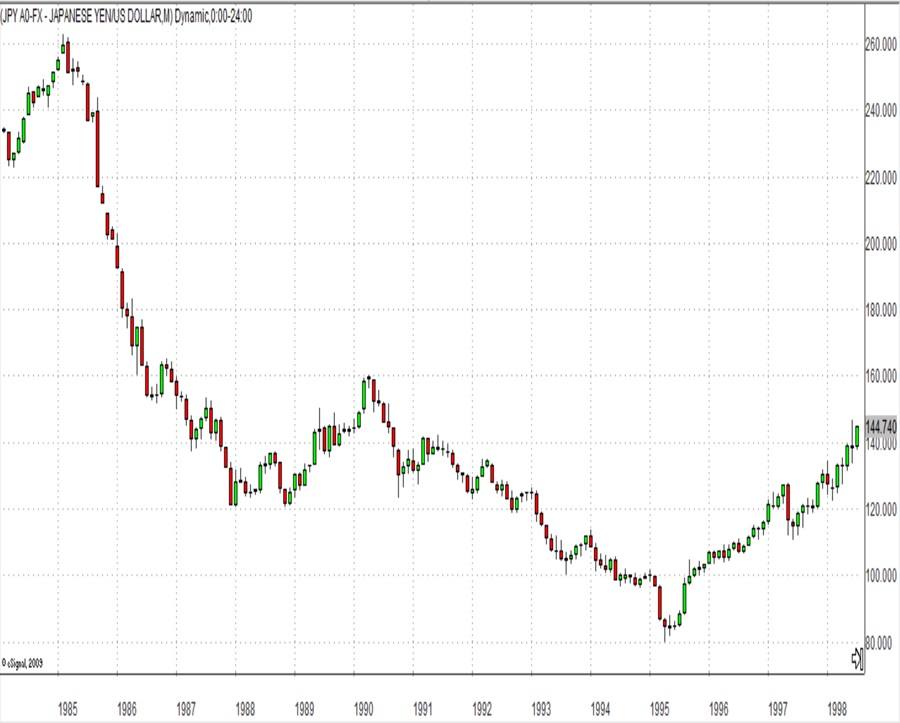
Ah, but where does it end? Some of us old-timers remember the 1990's when the yen hit 76 and the Imperial Palace in Tokyo was said to be worth more than the state of California. See the chart, which shows the dollar/yen falling from over 260 to under 80 over the space of 10 years. The FX effect had catastrophic effects on the Japanese economy, not to mention the stock market. We have left those days behind us—haven't we?
We never know at what stage of a "cycle" we might be in. For one thing, there are too many "cycles" and you can squeeze any set of data into too many of them. Secular stagnation? Stagflation? There is some possibility that the US is going to lose its top-drawer status because of Trump. That could set off a number of pinballs, starting with some other currency (probably the euro) taking a bigger role in the reserve currency universe. There is a big picture here but it's still blurry.
| Currency | Spot | Current Position | Signal Date | Signal Strength | Signal Rate | Gain/Loss |
| USD/JPY | 111.06 | SHORT USD | 03/21/17 | WEAK | 112.51 | 1.29% |
| GBP/USD | 1.2516 | LONG GBP | 03/22/17 | STRONG | 1.2465 | 0.41% |
| EUR/USD | 1.0776 | LONG EURO | 03/16/17 | WEAK | 1.0711 | 0.61% |
| EUR/JPY | 119.66 | LONG EURO | 03/13/17 | STRONG | 122.20 | -2.08% |
| EUR/GBP | 0.8609 | LONG EURO | 03/02/17 | STRONG | 0.8575 | 0.40% |
| USD/CHF | 0.9933 | SHORT USD | 03/16/17 | WEAK | 0.9995 | 0.62% |
| USD/CAD | 1.3340 | LONG USD | 02/22/17 | WEAK | 1.3174 | 1.26% |
| NZD/USD | 0.7035 | SHORT NZD | 02/10/17 | STRONG | 0.7185 | 2.09% |
| AUD/USD | 0.7630 | LONG AUD | 03/16/17 | STRONG | 0.7686 | -0.73% |
| AUD/JPY | 84.74 | SHORT AUD | 03/22/17 | STRONG | 85.20 | 0.54% |
| USD/MXN | 19.0307 | SHORT USD | 01/31/17 | WEAK | 20.8108 | 8.55% |
This is an excerpt from “The Rockefeller Morning Briefing,” which is far larger (about 10 pages). The Briefing has been published every day for over 25 years and represents experienced analysis and insight. The report offers deep background and is not intended to guide FX trading. Rockefeller produces other reports (in spot and futures) for trading purposes.
To get a two-week trial of the full reports plus traders advice for only $3.95. Click here!
Author
Barbara Rockefeller
Rockefeller Treasury Services, Inc.
Experience Before founding Rockefeller Treasury, Barbara worked at Citibank and other banks as a risk manager, new product developer (Cititrend), FX trader, advisor and loan officer. Miss Rockefeller is engaged to perform FX-relat

















