USD/JPY Price Forecast: Seems poised to reclaim 150.00 mark; bulls await US CPI report
- USD/JPY pulls back after touching its highest level since August early this Thursday.
- The BoJ rate hike uncertainty might cap the JPY and help limit losses for the major.
- Investors might also prefer to wait on the sidelines ahead of the key US CPI report.

The USD/JPY pair retreats from the 149.50-149.55 area, or its highest level since August touched earlier this Thursday and trades with a mild negative bias during the first half of the European session. The intraday pullback lacks any obvious fundamental catalyst and is more likely to remain limited amid the uncertainty about the Bank of Japan's (BoJ) rate hike plans.
Data published on Tuesday showed that Japan’s real wages fell in August after two months of gains and household spending also declined, raising doubts about the strength of private consumption and a sustained economic recovery. Moreover, BoJ's quarterly survey revealed on Thursday the ratio of Japanese households that expect prices to rise a year from now stood at 85.6% in September, down from 87.5% in the previous.
Meanwhile, another BoJ report showed this Thursday that the Corporate Goods Price Index (CGPI), which measures the price companies charge each other for their goods and services, unexpectedly rose to 2.8% in September from a year earlier. That said, a decline in import costs suggested that price pressures from raw material costs were subsiding. This comes on top of Japanese Prime Minister Shigeru Ishiba's blunt comments on monetary policy and dampens expectations for further rate hikes, which should cap gains for the Japanese Yen (JPY).
The US Dollar (USD), on the other hand, advances to a fresh eight-week top as traders now seem to have fully priced out another oversized interest rate cut by the Federal Reserve (Fed) in November. The expectations were reaffirmed by the September FOMC meeting released on Wednesday, which showed that some participants would have preferred only a 25 bps rate reduction amid still elevated inflation, solid economic growth and low unemployment. This, in turn, continues to act as a tailwind for the buck and should lend support to the USD/JPY pair.
Traders might also prefer to wait for the release of the latest US inflation figures before placing fresh directional bets. The crucial US Consumer Price Index (CPI) is due later today and will be followed by the US Producer Price Index (PPI) on Friday. This might play a key role in influencing market expectations about the size of the Fed's next rate cut, which, in turn, will drive the USD demand and help in determining the near-term trajectory for the USD/JPY pair. Hence, strong follow-through selling is needed to confirm that a multi-week-old uptrend has run out of steam.
Technical Outlook
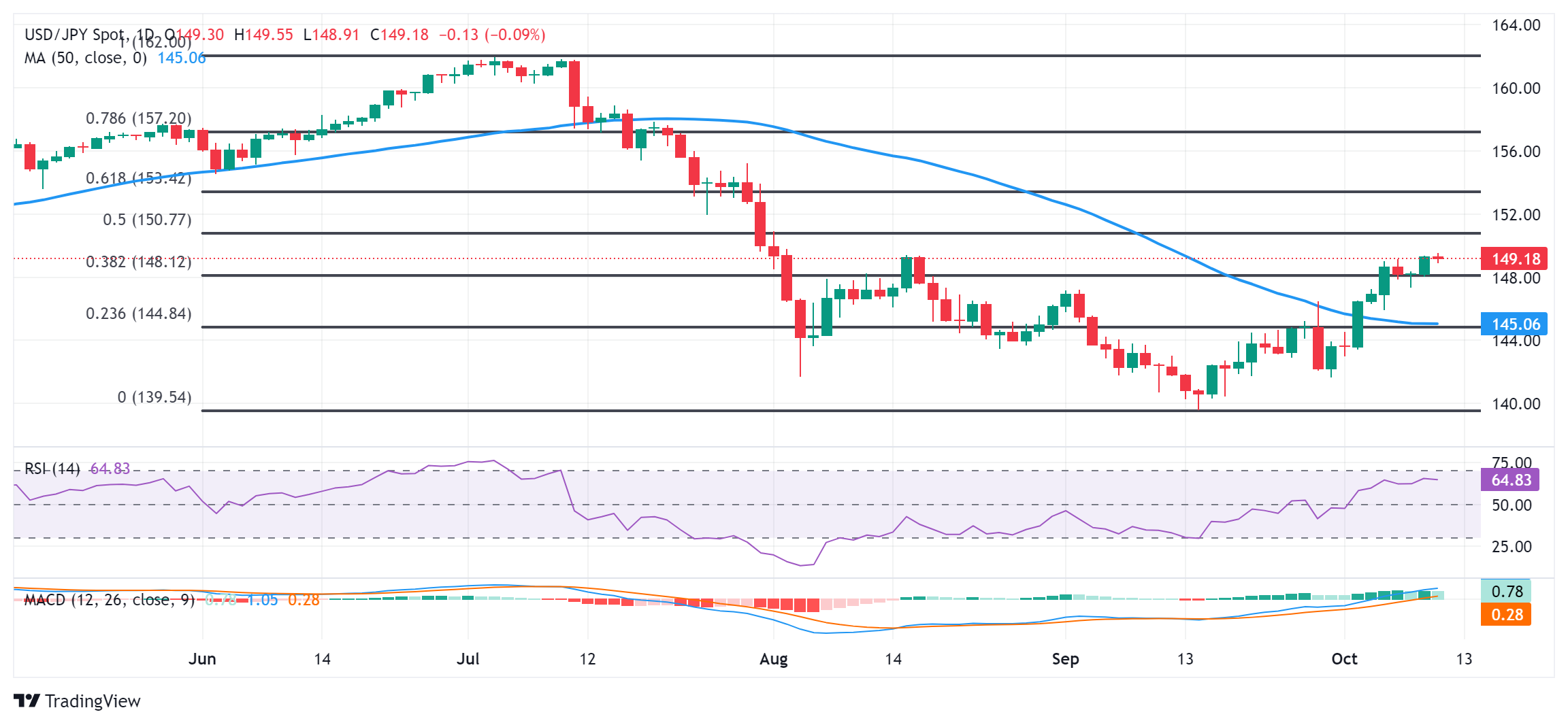
From a technical perspective, last week's move beyond the 50-day Simple Moving Average (SMA) for the first time since mid-July and the overnight close above the 38.2% Fibonacci retracement level of the July-September downfall favors bulls. Moreover, oscillators on the daily chart have been gaining positive traction and are away from being in the overbought territory, suggesting that the path of least resistance for the USD/JPY pair is to the upside.
Hence, any meaningful slide might still be seen as a buying opportunity near the 148.70-148.65 region. This, in turn, should help limit the downside for the USD/JPY pair near the 148.00 round figure. The latter should act as a key pivotal point, which if broken might prompt some technical selling and drag spot prices to the 147.35 intermediate support en route to the 147.00 mark and the 146.50 area. On the flip side, momentum beyond the Asian session peak, around the 149.35 area, should allow the USD/JPY pair to aim to reclaim the 150.00 psychological mark and climb further towards the 50% Fibo. level, around the 150.75-150.80 region.
USD/JPY daily chart
Author

Haresh Menghani
FXStreet
Haresh Menghani is a detail-oriented professional with 10+ years of extensive experience in analysing the global financial markets.