USD/JPY Price Forecast: Bulls look to regain control as trade war fears revive USD demand
- USD/JPY attracts strong buyers on Tuesday amid a solid USD recovery from over a one-month low.
- Trader war fears revive inflationary concerns, lifting the US bond yields and underpinning the buck.
- The divergent BoJ-Fed policy expectations might keep a lid on any further gains for the currency pair.

The USD/JPY pair builds on the overnight modest bounce from the 153.70 area, or its lowest level since December 18 and gains strong positive traction on Tuesday. The momentum lifts spot prices to the 156.00 neighborhood and is sponsored by resurgent US Dollar (USD) demand, bolstered by US President Donald Trump's tariff plans.
In fact, Trump said he would soon impose tariffs on producers of pharmaceuticals, computer chips and metals in the near future. Moreover, the Financial Times reported on Monday that Scott Bessent, who was confirmed as the US Treasury Secretary, is pushing for tariffs on all imports to start at 2.5% and to increase it gradually by the same amount every month. This, in turn, revives trade war fears, which could impact global growth. Furthermore, Trump's protectionist policies could reignite inflationary pressures in the US, triggering a modest bounce in the US Treasury bond yields and assisting the USD to stage a solid recovery from over a one-month low touched on Monday.
Meanwhile, the markets have been pricing in the possibility that the Federal Reserve (Fed) will lower borrowing costs twice by the end of this year. The bets were lifted by Trump's comments last week, saying that he would demand a cut in interest rates immediately. This keeps a lid on the US bond yields and might hold back the USD bulls from placing aggressive bets. Apart from this, expectations that the Bank of Japan (BoJ) will hike interest rates further, amid hopes that spring wage negotiations will result in strong hikes again this year, should limit any meaningful JPY depreciation. This, in turn, warrants some caution before positioning for an extension of the USD/JPY pair's strong move up.
Traders now look forward to the US economic docket – featuring the release of Durable Goods Orders, the Conference Board's Consumer Confidence Index and the Richmond Manufacturing Index – for some impetus later during the US session. The focus, however, will remain glued to the outcome of a two-day FOMC meeting, scheduled to be announced on Wednesday. The Fed's policy outlook will play a key role in influencing the USD price dynamics and determining the near-term trajectory for the USD/JPY pair. Nevertheless, the fundamental backdrop makes it prudent to wait for strong follow-through buying to confirm that the corrective pullback from a multi-month top has run its course.
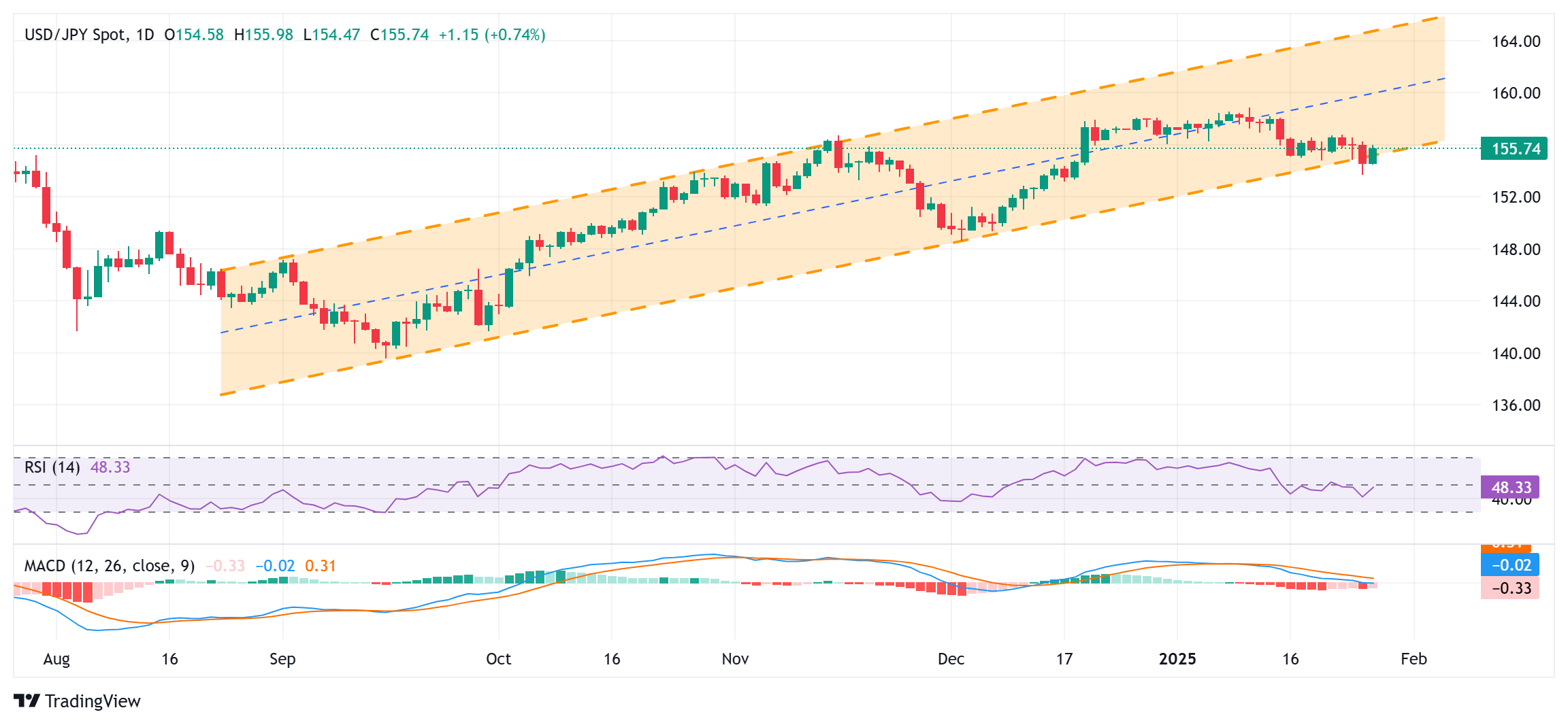
USD/JPY daily chart
Technical Outlook
From a technical perspective, the overnight sustained breakdown below a multi-month-old ascending trend-channel support was seen as a key trigger for bearish traders. Moreover, oscillators on the daily chart have just started gaining negative traction, suggesting that the path of least resistance for the USD/JPY pair is to the downside. Hence, any subsequent move up beyond the 156.00 mark could be seen as a selling opportunity and remain capped near the 156.60-156.70 supply zone.
Some follow-through buying, however, might negate the near-term negative outlook and trigger a short-covering rally. The USD/JPY pair might then surpass the 157.00 round figure and climb further towards the 157.45 intermediate hurdle en route to the 158.00 mark before climbing further towards the 158.85-158.90 region, or a multi-month top touched on January 10.
On the flip side, the 155.00 psychological mark now seems to protect the immediate downside ahead of the 154.55-154.50 horizontal zone, the 154.00 round figure. This is closely followed by the overnight swing low, around the 153.70 region, below which the USD/JPY pair could accelerate the fall further towards the 153.30 support en route to the 153.00 mark.
Author

Haresh Menghani
FXStreet
Haresh Menghani is a detail-oriented professional with 10+ years of extensive experience in analysing the global financial markets.