|

USD/INR: Indian rupee below Rs70 per dollar on oil

Last month, on the 19th March, the Indian rupee hit a major resistance area against the US dollar, prompting us to write an aptly-titled article: “USD/INR: Indian Rupee hits major hurdle, could reignite EM currency concerns.”

As it turned out, that happened to be the rupee’s high of the year so far.

As the rupee weakened, The USD/INR has pushed higher over the past few weeks and is now threatening to break its corrective bearish trend line, potentially resuming its long-term rally.

Today, the Indian Rupee has weakened below the Rs70 per dollar mark, hit in part by the rallying crude prices, with the nation being a large oil importer.

Both major oil contracts have hit new highs on the year this week, with Brent touching $75.50 a barrel today for the first time since 31st October. It comes after the US decided to end sanction waivers for countries that import Iranian oil, which includes India - a nation that is heavily dependent on imports of the black stuff.

Also hurting the Indian Rupee is the fact that the nation’s central bank has adopted a dovish monetary policy stance, cutting interest rates twice this year.

Externally, additional pressure is being exerted on the rupee by a rallying US dollar, with the DXY breaking out of its prior range this week.

Other emerging market currencies (EM FX) are also coming under pressure, with the likes of the Turkish lira, Polish zloty and Argentina peso looking particularly vulnerable.

If the EM FX continues to weaken, then this could have ramifications for the wider markets, which could halt the Wall Street rally after some of the major US indices broke to fresh highs this week.

Figure 1:
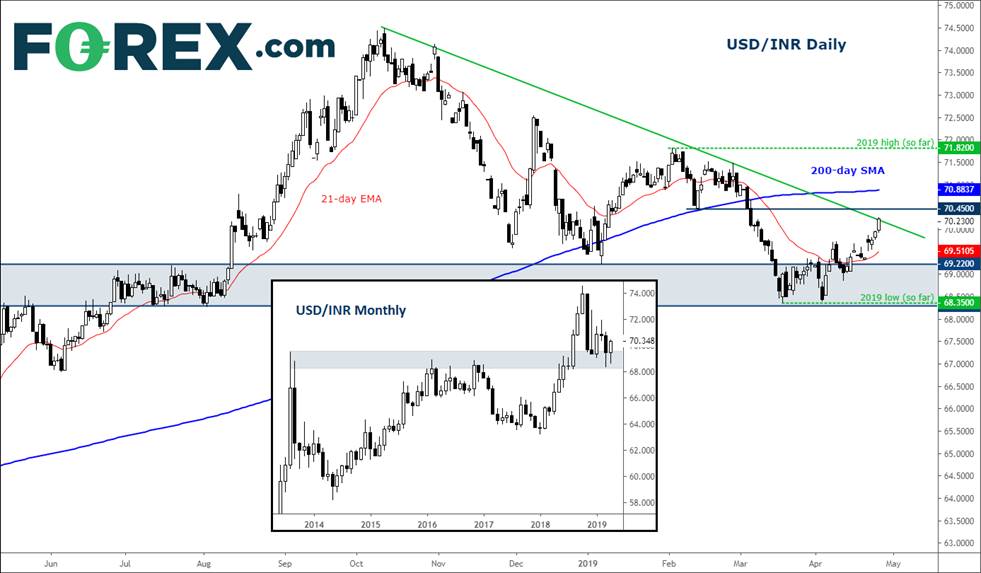
USDINR

Source: TradingView and FOREX.com.

Author

Fawad Razaqzada

Fawad Razaqzada

TradingCandles.com

Experience Fawad is an experienced analyst and economist having been involved in the financial markets since 2010 working for leading global FX, CFD and Spread Betting brokerages, most recently at FOREX.com and City Index.


More from Fawad Razaqzada
Share:

Editor's Picks

EUR/USD flirts with daily highs, retargets 1.1900

EUR/USD regains upside traction, returning to the 1.1880 zone and refocusing its attention to the key 1.1900 barrier. The pair’s slight gains comes against the backdrop of a humble decline in the US Dollar as investors continue to assess the latest US CPI readings and the potential Fed’s rate path.

GBP/USD remains well bid around 1.3650

GBP/USD maintains its upside momentum in place, hovering around daily highs near 1.3650 and setting aside part of the recent three-day drop. Cable’s improved sentiment comes on the back of the Greenback’s  irresolute price action, while recent hawkish comments from the BoE’s Pill also collaborate with the uptick.

Gold clings to gains just above $5,000/oz

Gold is reclaiming part of the ground lost on Wednesday’s marked decline, as bargain-hunters keep piling up and lifting prices past the key $5,000 per troy ounce. The precious metal’s move higher is also underpinned by the slight pullback in the US Dollar and declining US Treasury yields across the curve.

Crypto Today: Bitcoin, Ethereum, XRP in choppy price action, weighed down by falling institutional interest 

Bitcoin's upside remains largely constrained amid weak technicals and declining institutional interest. Ethereum trades sideways above $1,900 support with the upside capped below $2,000 amid ETF outflows.

Week ahead – Data blitz, Fed Minutes and RBNZ decision in the spotlight

US GDP and PCE inflation are main highlights, plus the Fed minutes. UK and Japan have busy calendars too with focus on CPI. Flash PMIs for February will also be doing the rounds. RBNZ meets, is unlikely to follow RBA’s hawkish path.

Ripple Price Forecast: XRP potential bottom could be in sight

Ripple edges up above the intraday low of $1.35 at the time of writing on Friday amid mixed price actions across the crypto market. The remittance token failed to hold support at $1.40 the previous day, reflecting risk-off sentiment amid a decline in retail and institutional sentiment.













