USD/CAD Forecast: Disappointed calm at the bottom
- USD/CAD consolidates near the 2019 low in narrow ranges.
- Canadian ADP employment report shows moderate gains.
- Bank of Canada decision may change outlook of USD/CAD.


The USD/CAD traded in a tight range over the week around the opening level of the last day of 2019 at 1.3062. Liquidity impaired trading that day saw the pair drop to its lowest level in over a year at 1.2951 followed by its lowest close at 1.2963 on January 6th. The subsequent three days returned the USD/CAD to the range where it has played since.
On the week the USD/CAD moved in a very narrow band averaging just 34 daily points with a low of 1.3031 and a high of 1.3081. Trading opened on Monday at 1.3068 and had barely stirred by mid-morning on Friday at 1.3046. Volatility was comparable in other majors. The EUR/USD had a 42 point average range and the USD/JPY 36. Sterling naturally more active and with Brexit politics had a range of 79 points.
The US-China trade deal improved risk appetite and equities were the main beneficiaries with US and Canadian exchanges reaching new records. Credit markets were stationary with the US 10-year Treasury yield unchanged at 1.82% from last Friday.
Currencies await the results of the trade deal which is expected to boost growth in the US and Canada. Though confirmation will take several months any better than forecast statistical result will be interpreted in that light and should support the US dollar.
Canadian and US statistics this week
The lack of movement came despite good American statistics. December retail sales were stronger than expected. Initial jobless claims dropped to 204,000 after an elevated December, elevated only in relation to historically low range in the second half of the year and there was a burst of new construction in housing. The Michigan consumer sentiment was healthy at 99.1 in January. December consumer inflation was a bit higher in the overall 2.3% from 2.1% in November and as expected in the core, 2.3%.
Canadian statistics were particularly light with only the Automatic Data Processing private employment change report for December coming in light at 46,200 on a forecast for 51,200. The prior month was revised down to 27,700 from 30,900. This jobs report did little to counter the recent weakness in the Canadian labor market which though it added 35,200 places in December shed 71,200 workers in November and 1,800 in October for a three month average of -12,600.
In the United States the China trade deal was signed on the 15th and the new North American trade agreement with its long but accurate title, the United States, Mexico, Canada Agreement (USMCA) was passed by the Senate and sent to President Trump for signature. Both agreements had been long anticipated and were largely priced into all markets. It remains to be seen if and when the deals improve the US and Canadian economies.
Canadian and US statistics next week
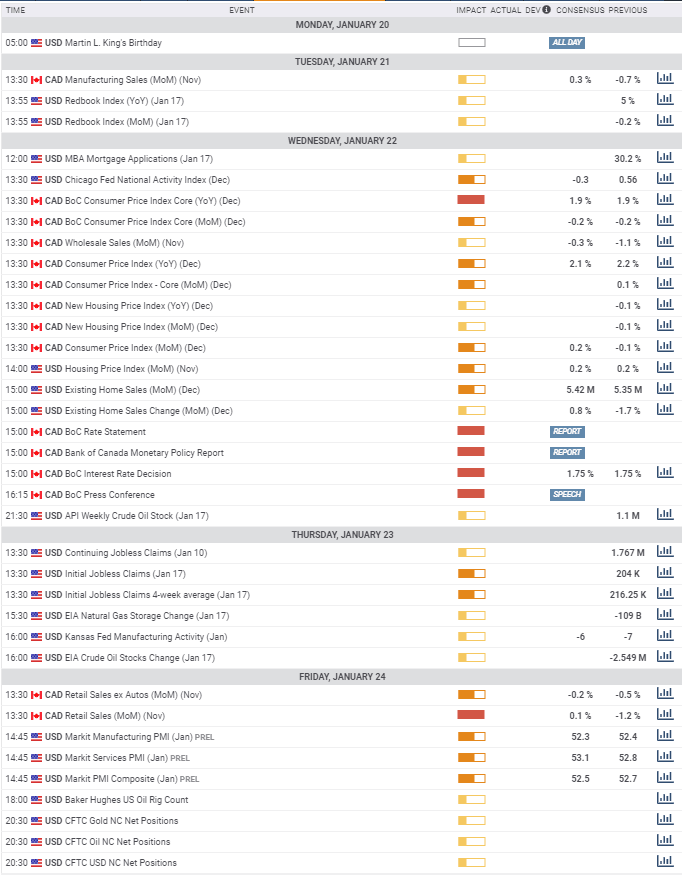
Economic information in the coming week (January 20-24) has a number of potentially market moving items from Ottawa. On Monday Canadian manufacturing sales for November are released with a 0.3% increase forecast following October’s 0.7% drop. Sales were weak in the second half of last year, down in four out of five months through October and averaging -0.56% from June through October. This data is retrograde and unlikely to move markets.
Wednesday brings CPI which is expected to be unchanged at 1.9% for the core rate and 0.1% lower in the overall to 2.1%.
Retail sales for November are out on Friday with a 0.1% gain projected after October's 1.2% loss and a 0.2% decline predicted for the ex-autos number following the October drop of 0.5%.
The main event is the Bank of Canada (BOC) rate decision on Wednesday at 10:00 am EST, 15:00 GMT with no change envisioned in the 1.75% overnight rate and the release of the quarterly Monetary Policy Report.
The recent weakness in the Canadian labor market, the manufacturing sector and retail sales may move the BOC closer to a rate cut and a surprise is not out of the question.
The bank statement on the rate decision and the Monetary Policy Report will be scrutinized for their analysis of the Canadian economy and consideration for future intentions. With the Federal Reserve hold expected to last through the year any signs from the BOC that they are concerned about weakness in the economy could send the USD/CAD higher.
Monday is a holiday in the US honoring Martin Luther King, starting a light week. .
Existing home sales are issued on Wednesday with 5.42 million in annual purchase expected. The housing market has ceased to be a market event though it remains a good if delayed indicator of the overall health of the consumer. Initial jobless claims are out on Thursday and their near record run has no hints of a weakening labor market. The UK firm of Markit Economics releases their PMI surveys on Friday with 52.3 expected in manufacturing, 53.1 in services and 52.5 for the composite.
USD/CAD Technical Outlook
The week’s limited movement has left the technical case largely unaltered.
The 21, 100 and 200 day moving averages have sharpened their descent with the down angle steepest in the shorter terms. The relative strength index (RSI) remains nearly neutral as would be expected with the limited price action.
The sideways movement since the December to mid-January down channel was breached on January 9th leaves open the technical possibility of re-entry if higher levels are not generated. The longer the pair is stationary just above the channel the greater the chance of a test.

There is weak support at 1.3035 just above the lows of this week and last July. The stronger lines at 1.2960 and 1.2900 are intact, as is the weak support at 1.2800 the low in October 2018. Below that is 1.2735 from the May 2018 bottom. The next two lines at 1.2650 and 1.2550 are more markers than actual support. Distant support also exists at 1.2460 and 1.2375 from February and January 2018.
Above the current level of 1.3073 there is initial weak resistance at 1.3100 and a band of moderate strength from 1.3125 to 1.3150 from late December price action. Strong resistance rests at 1.3200 and 1.3275 with the area between subject to traverse from early August to mid-December. Above there we have the November top at 1.3325 and the 1.3350 high in August and October. Above that at long range are 1.3450 and 1.3525.
USD/CAD sentiment poll

The one quarter outlook retains bullish but softer preponderance, 44% bullish vs 55% and 31% bearish vs 24%. Neutral is essentially unchanged at 25% from 21%.
Disappointment is the tale of the USD/CAD this week and absent a fundamentally based move higher the pair is likely to generate a technical test lower.
Author
Joseph Trevisani
FXStreet
Joseph Trevisani began his thirty-year career in the financial markets at Credit Suisse in New York and Singapore where he worked for 12 years as an interbank currency trader and trading desk manager.

















