US Michigan Consumer Sentiment April Preview: Setting a dismal standard
- Sentiment predicted to fall to 75, a more than six year low, estimates range from 60 to 89.
- One and two month declines would be the largest in the 68 year series.
- Employment is the largest component of sentiment.
- Weak consumer sentiment will support risk averse US dollar.


American workers and consumers are enduring the greatest shock in the history of modern economic measurement.
The March collapse in employment, 9.931 million workers filing for unemployment insurance in the last two weeks of the month, even though it largely took place after the polling for the Michigan survey was completed, produced an 11.9 point drop in sentiment, the fourth largest individual decline in the 68 year history of the series.
Consumer sentiment in history
If the forecast for April is correct the plunge from March will be 14.1 the largest on record and the two month decline of 26 would have no rivals for the swiftest and deepest collapse in attitudes since the University of Michigan began asking Americans how they felt in November 1952.
In comparison the two month plummet in sentiment at the height of the financial crisis from September to November 2008 was 15 (70.3-55.3) and the summer drop in 2011 from June to August was 15.7 (71.5-55.8).
Other notable declines were 13.9 in 1991 (September, 83 to November, 69.1) and 15.4 in 1990 (July 88.2 to September, 72.8). The 1980 drop that produced the lowest reading in the series 51.7 in May was 15.3 and it took five months from 67 in January.
Consumer spending
The impact of such a profound change in sentiment, prompted not by an external event like the partial government shutdown in December and January 2019 which caused a 7.1 point drop (98.3-91.2) or the September 2001 terrorist attacks which caused a 9.7 point fall August to September (91.5-81.8), but by an enormous substantive alteration in the economic well-being of a large portion of the population, on consumer spending is simply unknown. Nothing like this have ever happened before.
Consumption is the lifeblood of the US economy. It is taken as granted by economists that consumer spending dropped from a cliff in March as the firings rolled through the economy. While the assumption that the jobless curtailed spending as much as possible is evident, the effect on the remaining majority of workers and households is unknown.
The restrictions and business closures that affect about half of the US will exact their own demand destruction. If a car dealership or retail shop is not open obviously it has no receipts. On-line stores led by Amazon have seen a huge increase in sales so much so that some are warning that deliveries may be delayed due to volume. But these increases are not expected to equal more than a percentage of the traffic lost to the shutdowns.
Consumer sentiment and recovery
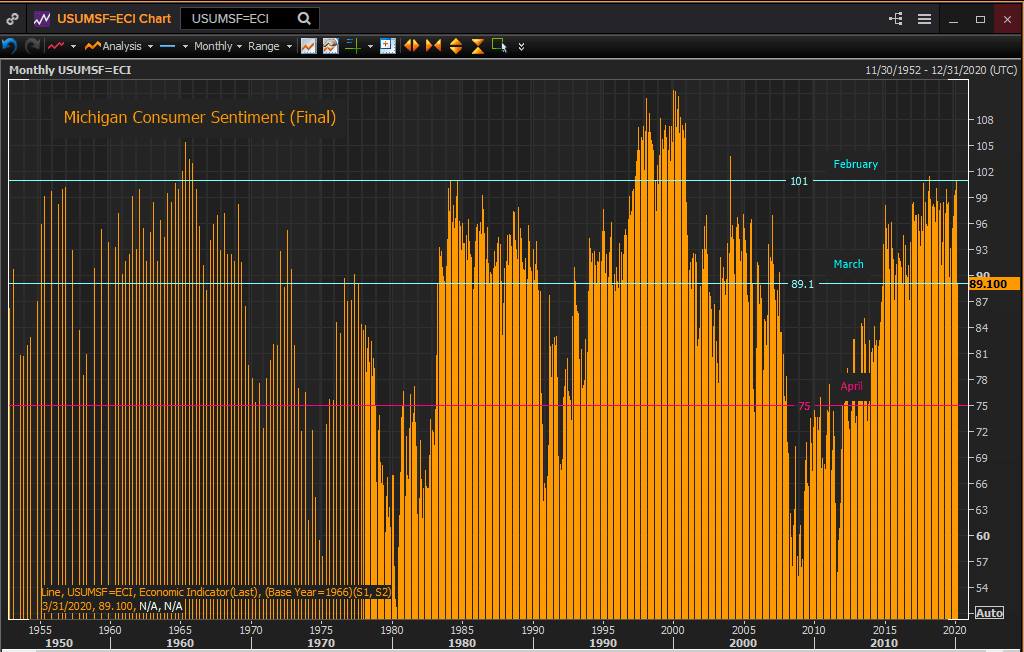
Of the five large sentiment declines mentioned above, 2008, 2011, 1991, 1990 and 1980, three saw rapid recoveries to the level prior to the drop, one took just over a year and the final one needed more than two years. .
In 2011 the recovery to 71.5 from 55.8 took five months until January 2012 at 75. The return from the May 1980 low at 51.7 to 67 was the fastest, in just three months in August it was at 67.3.
The 2008 financial crash and recession also saw a relatively swift recover in sentiment from its 55.3 November low. By June 2009 seven months later it was at 70.8.
In 1991 the return to September’s 83 from 69.1 in November took 14 months to November 1992 and 85.3. After the September 1990 low of 72.8 it was 29 months until the July score of 88.2 was equaled in December 1992, though sentiment had come close with 87.7 eight months later in March 1991.
The three fastest recoveries averaged five months the two longest 21.5 and the overall average was 12.2 months.
In contrast the recoveries in the two externally caused plunges in sentiment, in 2001 and 2019 took four and two months respectively.
US dollar
The dollar remains wedded by market fears to the safety trade. It is too early to be considering which currencies will be most damaged by the whirlwind that has swept through the world’s economies. The greater the fear, the worse the statistic the better for USD.
Conclusion: Which model for sentiment?
The question for economists is which model will consumer sentiment follow this year?
This collapse in employment and the prospective fall in GDP is an externally caused event. If a cure for the Coronavirus were discovered tomorrow the return to normality would be almost as swift as its desertion.
But without that reversal the economic pain from the loss, even if temporary, of millions of livelihoods and the security and spending that accompanies them is a shock at least as powerful as the deepest recession even if the hope for return is more immediate.
Which path consumer sentiment follows in the months ahead depends on the speed and finality with which the virus threat dissipates. The ability to resume normal life is, for most people, inherent in their worldview. It will not take a great deal for that resiliency to triumph but it is by no means assured.
Author
Joseph Trevisani
FXStreet
Joseph Trevisani began his thirty-year career in the financial markets at Credit Suisse in New York and Singapore where he worked for 12 years as an interbank currency trader and trading desk manager.