US Jobless Claims Preview: Facts that retain the ability to move markets
- Initial unemployment claims expected to be 5.1 million.
- Four week total would be over 21 million, 13% of the workforce.
- Continuing claims projected to almost double to 14 million.

The American labor market debacle is slated to moderate slightly when initial jobless claims for the week of April 10 are released. Expectations have been dashed for three weeks running as job losses have continued to outstrip forecasts and this latest figure should bring the total filings to more than 21 million.
Since the shutdown layoffs began in the third week of March 10.2% of the 164.6 million US workforce have been fired. If the 5.1 million figure is correct that will rise to 13.3%.
With most of the population affected to one degree or another by business closure orders and mandatory or voluntary movement restrictions layoffs are predicted to continue at high levels until commercial activity is permitted to reopen. Projections for the unemployment rate which was 4.4% in March range as high as 30% in the months ahead. The Federal government’s closure advice extends to the end of April.
Continuing claims
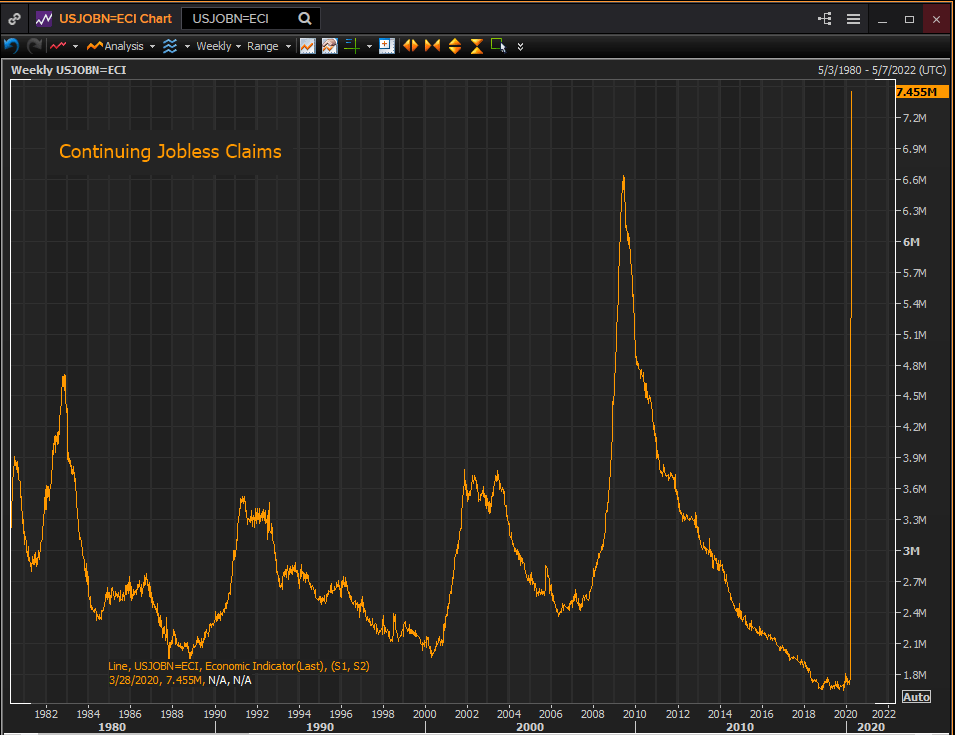
Continuing claims are projected to nearly double from 7.455 million to 14 million far beyond the previous peak of 6.635 million in the final week of May 2009. That apex took 20 months to develop and even the steepest part of the ascent from 3.206 million in July 2008 to 6.546 million in May 2009 required 10 months.
Unemployment insurance is a joint federal and state government program with 26 weeks of benefits available in most localities. During the financial crisis and recession eligibility was extended to 52 weeks for many recipients.
Reuters
Demand destruction
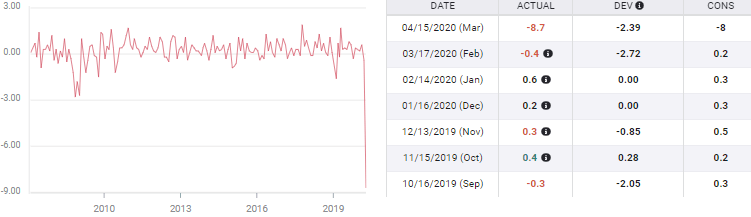
The cost to the consumer based US economy of the effort to fight the coronavirus pandemic was evident in the 8.7% plunge in the March retail sales figures, the largest on record, even though the job losses did not begin in earnest until the third week of the month.
A 3.1% rise in internet purchases and large gains in food and household goods receipts were insufficient to counter the huge declines from the shuttering of much of the nation’s traditional retail establishment.
Retail sales
FXStreet
US dollar
The safety and funding rush to the dollar and Treasury yields that ran through several waves in March has eased in the past week as Federal Reserve moves to provide liquidity to the global financial system have calmed demand and as initial signs have emerged that the pandemic may be moderating.
The dollar remains higher in four of the five major pairs since the beginning of March, keeping small gains against the euro and the aussie, a moderate improvement versus the sterling and a large benefit over the loonie. The greenback is flat on the month against the yen.
Conclusion
Initial claims have provided a great shock to the markets and a boost to the dollar over the past three weeks, chronicling job losses far greater than anyone had anticipated. The impact of the virus on the US and the global economy is an evolving proposition. Markets that were responding to fears and conjecture in the early weeks of March now have some measure of the catastrophe. These new facts retain the ability to move markets despite the already great dislocations.
Even though the safety trade has diminished somewhat the potential, as evidenced by the modest dollar gains after the retail sales numbers, for a recurrence remains strong.
Jobless claims have become the economic epicenter for the US economy and the currency market will likely respond to any substantial variation from the forecast.
Author

Joseph Trevisani
FXStreet
Joseph Trevisani began his thirty-year career in the financial markets at Credit Suisse in New York and Singapore where he worked for 12 years as an interbank currency trader and trading desk manager.