US Initial Jobless Claims Preview: The action moves to continuing claims
- Initial claims expected to drop to 2.1 million from 2.438 million.
- Total jobless filings would be almost 41 million in 10 weeks.
- Continuing claims forecast to add 677,000 to 25.75 million.
- Markets looking for signs that rehiring is starting to cut into unemployment.
- Dollar risk-premium continues to ebb.


The massive layoffs that began in the US a little over two months ago have slowed but the hoped for recovery in employment has yet to mark the accumulated economic devastation.
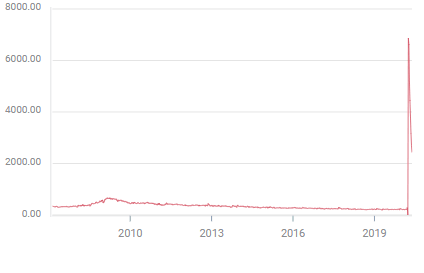
Initial jobless claims are forecast to rise 2.1 million in the May 22 week bringing the total to 40.715 million, 24.7% of the American work force since the pandemic crashed into the US economy in the middle of March.
Initial jobless claims
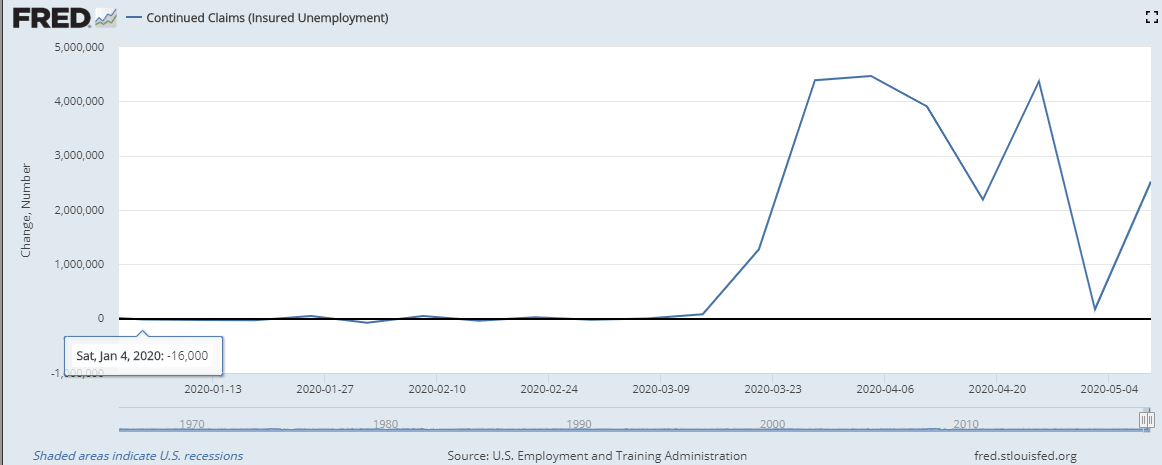
Continuing claims are predicted to rise to 25.75 million in the May 15 week from 25.073 million. If correct the 0.677 million increase would be the second gain of less than 1 million in the last three weeks. In the May 2 week continuing claims rose just 171,000, though the following week May 9 they added 2.525 million.
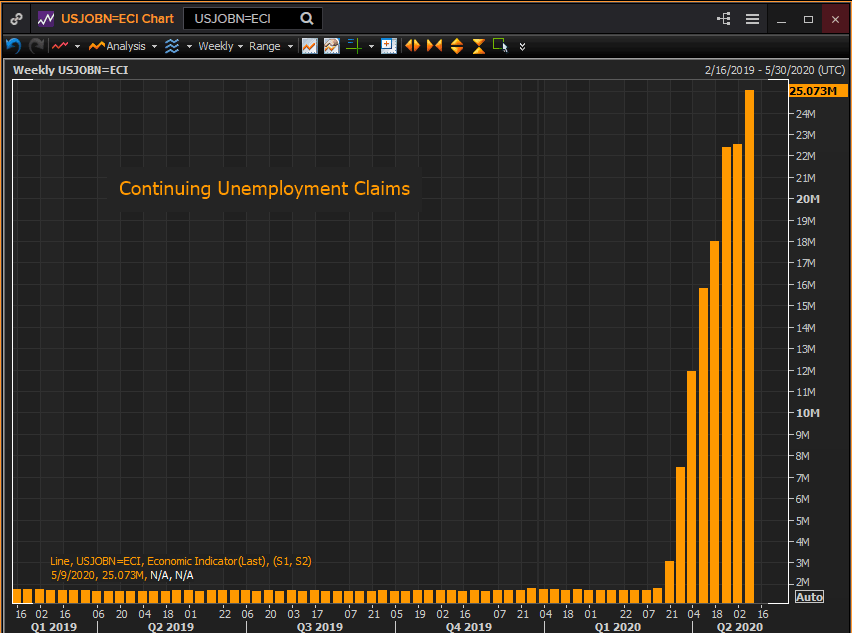
Reuters
Continuing claims weekly change
Market reactions the pandemic economy
The shock dealt to markets by the first three unemployment claims numbers on March 20, 27 and April 3 and reinforced by the April non-farm payrolls loss of 20 million jobs in early May have largely inured traders to the dismal statistics that have followed.
Retail sales set new all-time records for declines in April as did industrial production. The ISM purchasing managers indexes dropped deep into contraction for the month. Durable goods orders for April are expected to fall 19% and 10% in the business spending proxy when released on May 28 their historical depths as well.
The astonishing initial statistical introduction to the pandemic has permitted markets to focus on the future, certain that whatever data comes after may add detail without changing the overall picture.
Equities have been on a steady if uneven rise since early April. The Dow closed at 25,548.27 on Wednesday up 2.21% and finishing above 25,000 for the first time since March. The dollar has lost the majority though not all of its risk-premium advantage against its major counterparts as the funding and safety trade have lost impetus with the retreat of the pandemic and the loosening of economic restriction in most of the globe.
Only the US credit market, with bond prices supported by the Federal Reserve quantitative easing purchases has retained almost all of its post-virus yield range.
Conclusion and continuing claims
Continuing claims run one week behind the initial figures and if people are returning to work in large numbers this number is expected to reverse as rehires outpace further layoffs.
Every state that had imposed business or social restrictions has loosened at least some of their strictures and more are removed daily and week by week. The reopening of the economy is expected to bring millions of unemployed back to work, though to last week there has been no indication of that in the claims statistics.
Georgia began to restart its economy over one month ago and Florida and Texas soon after but three states, even if two are among the largest in population and economic size, are probably not enough to reverse the tide that has rolled over the US economy.
Still, for the markets that are eagerly anticipating recovery, a small indication will suffice. It will not take much good news to send the equities higher and cause the dollar to surrender the balance of its risk advantage.
Author
Joseph Trevisani
FXStreet
Joseph Trevisani began his thirty-year career in the financial markets at Credit Suisse in New York and Singapore where he worked for 12 years as an interbank currency trader and trading desk manager.