US Initial Jobless Claims Preview: On the verge of an explosive recovery?
- Initial Claims expected to climb to 750,000 from 730,000.
- Claims fell more than 100,000 for the second time this year last week.
- Continuing claims at 4.419 million were lowest of the pandemic.
- Texas and Mississippi announce full economic reopening.
- Markets and the dollar keying on US data.

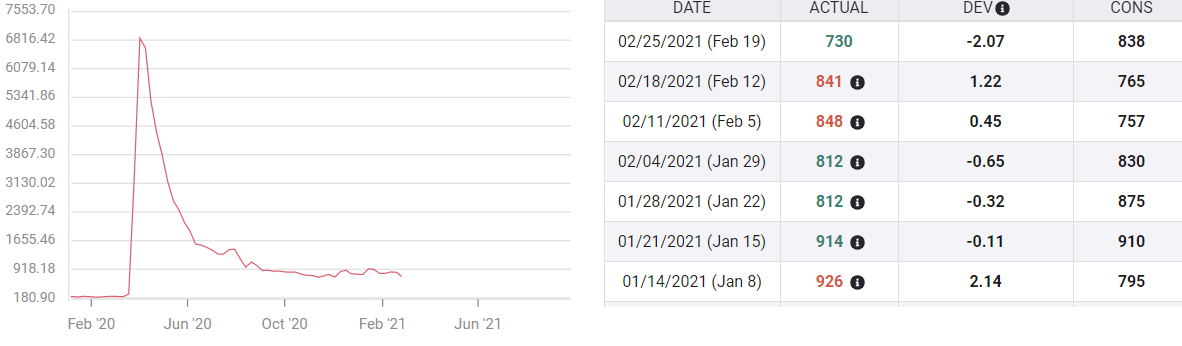
Initial claims for unemployment insurance have exhibited a notable increase in volatility since the beginning of December compared with the prior three months of steady decline.
Requests for jobless benefits are forecast to rise to 750,000 in the February 26 week from 730,000. Continuing claims were 4.419 million in the February 19 week.
Initial Jobless Claims
FXStreet
Initial Jobless Claims
From November 27 to February 19 claims rose or fell more than 100,000 four times, twice each way, in 12 weeks. The average weekly shift was 57,800. Claims started at 716,000 in the November 27 week and ended at 730,000 on February 19.
The previous 12 weeks had held a steady decline from 893,000 on September 4 to 716,000 by November 27. There was no rise or fall greater than 71,000 and the weekly shift was 28,600.
This three month interregnum was due to California's reapplied lockdown in December and lesser revived restrictions in a few other states. New York City again closed indoor dining in December. The job losses hit the areas that had been allowed partial reopening, restaurants and similar in-person retail venues.
Beginning of the end
Texas and Mississippi announced on Tuesday that all remaining restrictions on their economies, socialization and schooling will be removed.
It will shortly be difficult for other states to justify the rules that have limited business life and kept layoffs high, hiring low and children out of the classroom. The momentum toward reopening will build and with it the return to an active employment recovery.
Nonfarm Payrolls and Initial Claims
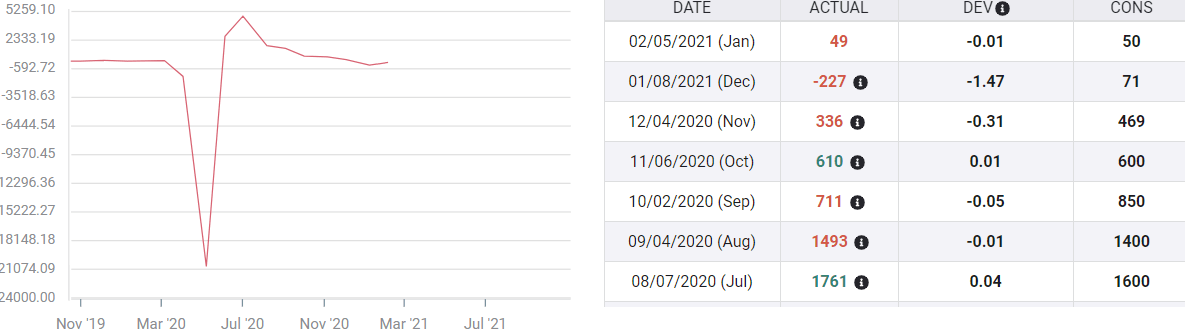
Nonfarm Payrolls are forecast to add only 180,000 jobs in February. Though hiring was completed before the opening announcements, the fast improving pandemic situation that led to the policy changes had to have been evident to employers. Hiring was likely stronger than the current estimate last month.
Nonfarm Payrolls
The impact on jobless claims should be equally swift and positive. Businesses that are on the edge of failing now have every reason to wait out the remaining weeks until they can reopen.
Conclusion
The economy is widely expected to see an explosive recovery as the pandemic, consumer and business pictures rapidly improve. The promised stimulus bill in Congress combined with the psychological relief from the end of the pandemic is a powerful emotional and financial package.
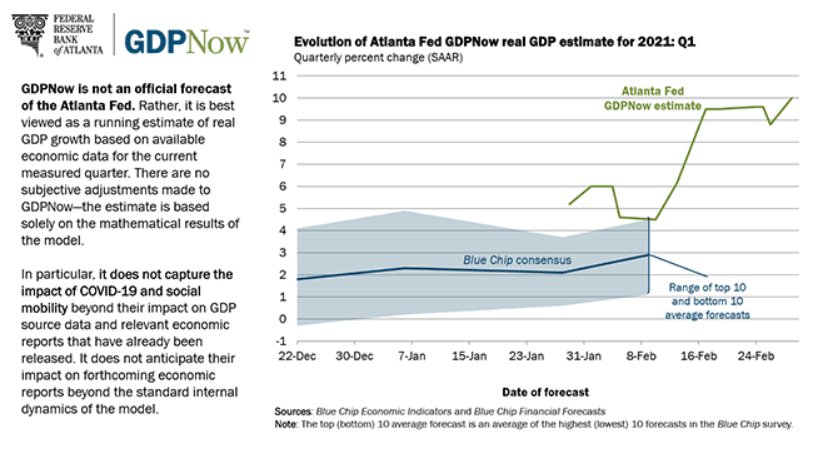
The Atlanta Fed GDPNow model's current estimate for the first quarter is 10% annualized growth.
Credit, equity, commodity and currency markets have paused for the last two weeks, waiting for US data to catch up to their speculative positions.
When the statistics begin to reflect that reality expect the advances to resume.
Author

Joseph Trevisani
FXStreet
Joseph Trevisani began his thirty-year career in the financial markets at Credit Suisse in New York and Singapore where he worked for 12 years as an interbank currency trader and trading desk manager.