|

US Initial Jobless Claims Preview: Can they help the dollar?

  • Claims expected to slip to 765,000 from 793,000.
  • Continuing claims forecast to a pandemic low 4.413 million.
  • Retail Sales surprise seconds credit market based dollar strength.

The Retail Sales January roman candle is clear evidence that the US consumer will spend free money. But the long-term health of the US economy depends on employment and here the prospects are far more equivocal.

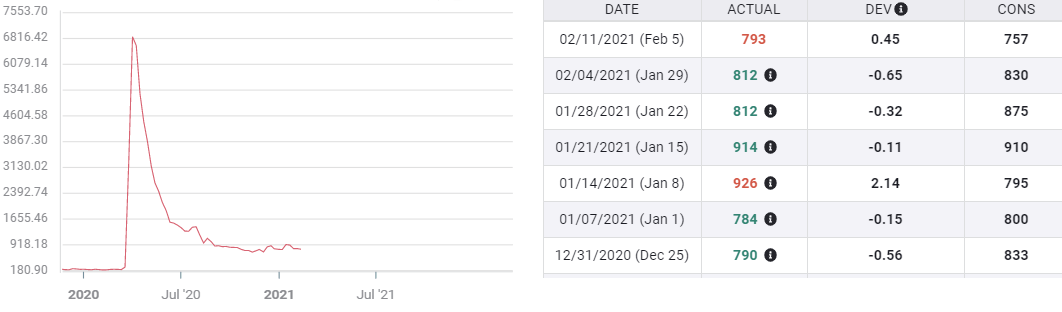
Initial Jobless Claims are expected to continue their slow descent in the February 12 week, slipping to 765,000 from 793,000. Continuing Claims, which chronicle the total number of people receiving payments from this combined federal and state program, is forecast to fall to 4.413 million, the lowest of the pandemic era, from 4.545 million.

Initial Jobless Claims
FXStreet

Since the explosion of jobless claims late last March heralded the economic catastrophe brought on by the pandemic lockdowns, more people have requested benefits every week than at any time in past US history.

Claims and NFP

The end of California's lockdown in January and the loosening of restrictions elsewhere, has reversed the increase in claims which drove the four-week moving average from 740,500 in November to 837,500 in December and 856,500 in January. After claims peaked at 926,000 in the first week of January they have fallen 14% in a month. The pandemic low remains 711,000 in the week of November 6. 

Rising claims foretold the payroll loss in December of 227,000 positions and January's weak addition of 49,000 workers.

Conclusion

Retail Sales may have primed the markets for better US economic news.

Treasury yields have climbed sharply in the last two week, with the 10-year bond reaching 1.3% on Tuesday its highest since before the Federal Reserve intervention in early March. Rising rates have in turn given the dollar a decided January edge.

If jobless claims can improve on forecasts, markets will add them to the suddenly buoyant US economic picture.

Author

Joseph Trevisani

Joseph Trevisani began his thirty-year career in the financial markets at Credit Suisse in New York and Singapore where he worked for 12 years as an interbank currency trader and trading desk manager.


More from Joseph Trevisani
Share:

Editor's Picks

GBP/USD flirts with weekly highs in the Fed's aftermath

GBP/USD reversed early losses following the Federal Reserve decision to keep rates on hold and neared the 1.3360 level before shedding some ground. Focus shifts to Governor Kevin Warsh's speech, while the Bank of England will announce its monetary policy decision on Thursday.

EUR/USD extends rally pass 1.1450 on Fed's Warsh

EUR/USD trades at fresh weekly highs above 1.1450, following the Federal Reserve monetary policy decision to keep interest rates on hold. The statement showed policymakers remain confident in economic progress while blaming inflation on energy prices. The divided vote among officials put in doubt a September hike, leading to sharp US Dollar losses.

Gold  hovers around $4,100 as Fed decision hits the USD

Gold surged following the Federal Reserve's decision to keep the benchmark interest rate unchanged at 3.50%-3.75%. Policymakers noted that inflation remains elevated and that economic activity is expanding at a solid pace despite elevated uncertainty, spurring doubts about a rate hike in September. XAU/USD peaked above $4,100, now battling to retain the level.

No soft target: Warsh vows to return inflation to 2%
The Fed left interest rates unchanged at 3.50%-3.75%, but the decision carried a distinctly hawkish edge as three officials voted for an immediate 25-basis-point increase. Chair Kevin Warsh reinforced that message, insisting there was no tolerance for a softer inflation target and warning that the Fed would not hesitate to act.
How the CLARITY Act unlocks Wall Street’s tokenization pipeline
The United States (US) Digital Asset Market Clarity Act (CLARITY Act), awaiting a full Senate floor vote, promises to unlock Wall Street’s potential to tokenize financial assets, including equities, US Treasuries, private credit, real estate and commodities at a scale that could supercharge the real-world asset (RWA) market from the current $17 billion level to $5.5 trillion by 2030, according to
US Dollar mid-year outlook: Exceptional currency, exceptional risks?
The US Dollar enters the second half of 2026 in a markedly different position from a year ago. The King currency has recovered, reflecting persistent US inflation, changing expectations for Fed policy, geopolitical tensions and renewed demand for defensive assets.