US dollar rules in currency market funding frenzy
- Equities fall hard as markets convert to cash.
- Dollar is the overwhelming choice for the worried global economy.
- Demand for the US dollar drives currency trading.
- Sterling falls to 35 year low before recovering.

As corporations, investors and governments around the world rush to protect themselves from a global recession the asset of choice is cash and the currency is the US dollar.
Seeking the security of the world’s most liquid currency, deepest credit markets and largest economy, traders drove the dollar index to a three year high, currency pair after pair to multi-year lows and the pound sterling close to the nadir of the modern era.
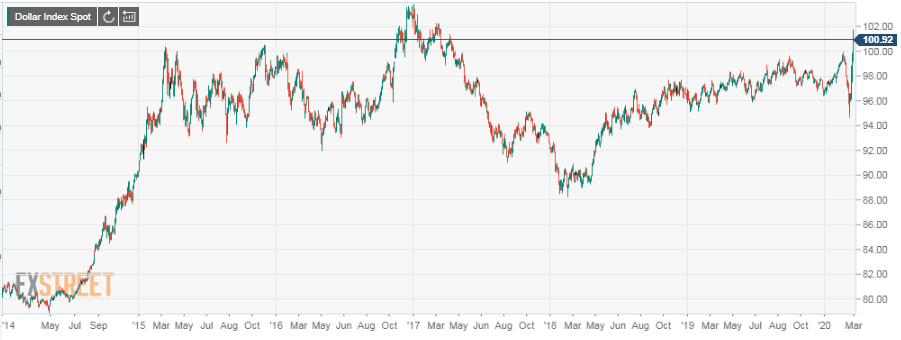
US dollar advances
The flow driven nature of Wednesday’s move was evident in the closing rates, the most active pairs ended well off their worst levels of the day. Once the buying pressure generated by market and stop orders slackened most pairs managed a modest recovery.
The pound fell 3.6% against the dollar closing at 1.1622 from an open at 1.2015 but intra-day it touched 1.1450, its lowest since 1985. The euro saw relatively modest losses, shedding less than 1% to close at 1.0911, having opened at 1.0997 and dropped down to 1.0801.
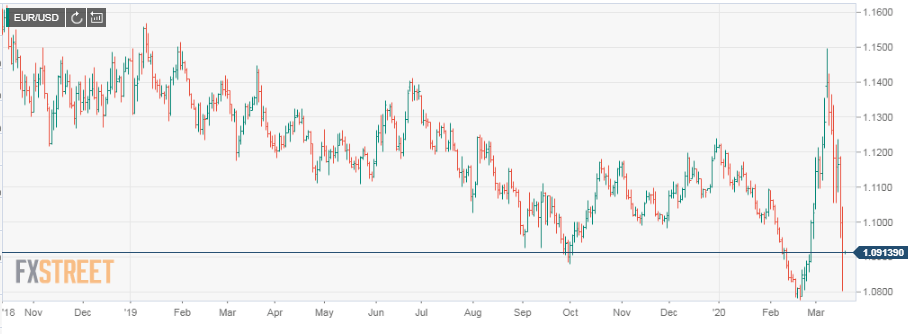 Commodity currencies
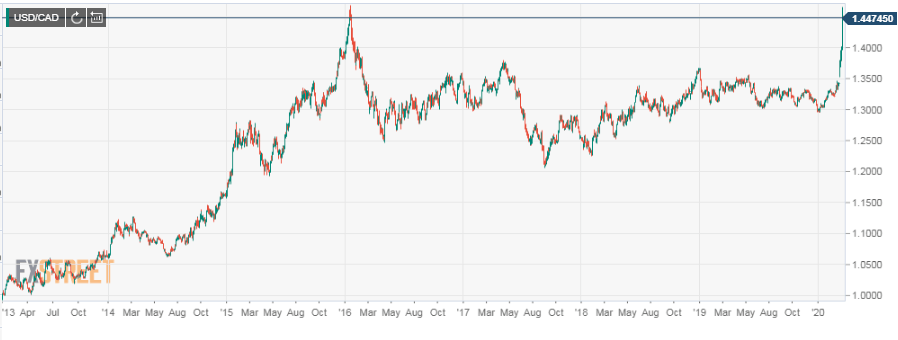
Commodity currencies fared the worst with markets forecasting far lower demand for resources in the months ahead.
The Canadian dollar dropped to 1.4651 its weakest in over three years before closing at 1.4512 down 2.19% and a three year low.
Only the partial safe-haven currencies of the Swiss franc and Japanese yen were somewhat insulated from the strengthening US dollar. The franc lost less than 1% closing at 0.9679 after starting at 0.9612 and the yen was essentially unchanged opening at 107.69 and ending at 107.93.

Equities suffered another in a lengthening string of collapses. In Europe the FTSE in London lost 4.05% and the German DAX 5.56%. In the US the Dow tumbled 6.30%, 1338.46 points closing at 19898.92.
US Treasuries
The US 10-year Treasury, which on March 9th had hit an all-time record low yield at 0.498% as investors piled into safety, has reversed adding 70 points of return to finish at 1.205% on Wednesday.
In addition to the desire of bond owners to hold large cash balances as the economic outlook worsens, credit market anticipate large new supplies of Treasuries as Washington finalizes plans for a nearly $1 trillion stimulus and support package.
Prices on bonds with fixed coupon rates move inversely to yields. Credit traders anticipate that large new government offerings will drive bond prices down and rates up.
Markets around the world have crashed this month as investors, hedge funds and corporations have liquidated holding for cash trying to stockpile the asset most useful in adversity, the US dollar, sending its value soaring as they add to their currency balances.
Author

Joseph Trevisani
FXStreet
Joseph Trevisani began his thirty-year career in the financial markets at Credit Suisse in New York and Singapore where he worked for 12 years as an interbank currency trader and trading desk manager.