US Dollar battles to regain its crown: Does it all depend on the Fed?
- The US Dollar Index has been confined to a well-limited range since the year started.
- The Federal Reserve has the power to direct the USD’s direction but will not use it just yet.
- The case of a steeper USD decline remains out of the picture regardless of Fed’s decisions.

The world’s leading currency has been struggling to regain its crow throughout the first half of the year, as optimism about the Federal Reserve (Fed) delivering three rate cuts and leading the way on monetary loosening diluted as time passed.
In fact, the second half of the year started with Canada and several European central banks, including the European Central Bank (ECB), having already delivered interest rate cuts, while the Fed sat on its hands and gave no signs of abandoning the tight monetary path.
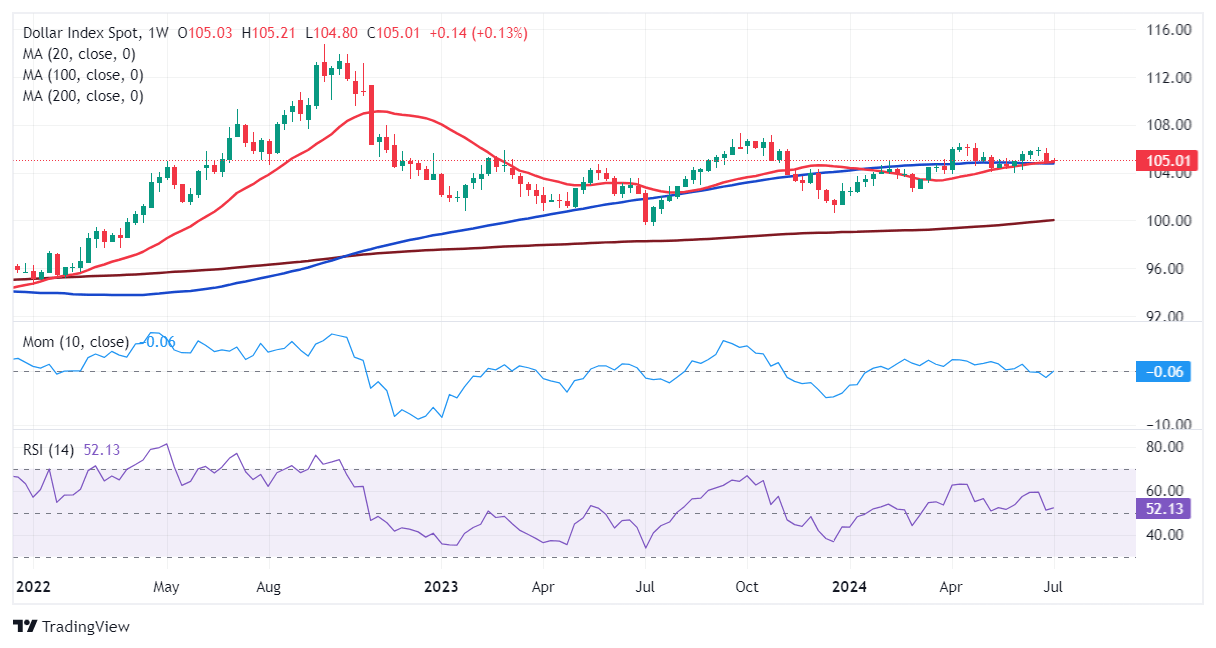
The US Dollar Index, a measure of the value of the US Dollar relative to a basket of foreign currencies, has traded between 102.00 and 106.00 since early January. It came down from a peak at 112.17 posted in September 2022 and fell towards the 99.00 level in July 2023, when the market began foreseeing the end of the tightening cycle.
But is it all about the Fed?
According to the US Bureau of Labour Statistics, the United States (US) real Gross Domestic Product (GDP) increased at an annual rate of 1.4% in the first quarter of 2024.
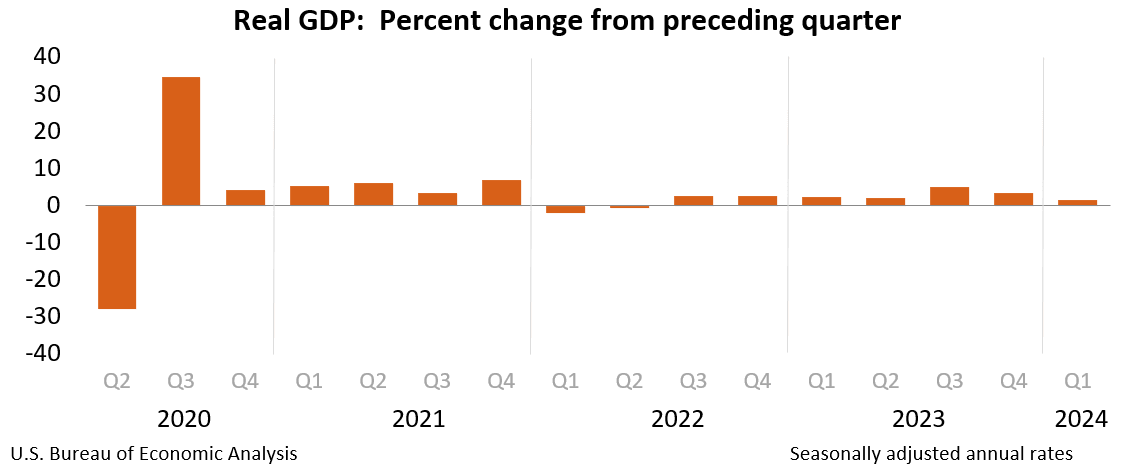
The figure indicated a deceleration in economic growth, primarily attributed to “decelerations in consumer spending, exports, and state and local government spending, and a downturn in federal government spending,” according to the official report. However, the economic expansion continues regardless of the pace, and the recession’s ghost has been long spooked away.
Meanwhile, inflation, as measured by the Personal Consumption Expenditures (PCE) Price Index, edged lower to 2.6% YoY in May from 2.7% in the previous month. The core annual reading printed at 2.6%, easing from the 2.8% recorded in April. While it remains above the Fed’s 2% goal, inflation has resumed its decline after some unfriendly readings in the first quarter of the year.
Finally, a healthy labor market seems to have found its balance. Job creation continues while the unemployment rate stands at 4.1%, and wage inflation is also receding.
It is worth remembering that the Federal Reserve has the dual mandate of promoting maximum employment and stable prices. It has never been closer to such goals since before the coronavirus pandemic.
Then, what is holding the Fed from moving forward with rate cuts?
Fed policymakers started the year anticipating three potential rate cuts in 2024, but the uptick in inflation in the first quarter of the year cooled down such expectations. A stubbornly tight labor market added to the negative outcome of the equation. By May, financial markets reduced hopes to just one cut in 2024, with the focus currently on November as a potential date for the first 25 basis points (bps) reduction.
The economy is moving in the right direction but has not yet reached the finish line. In such a scenario, policymakers refuse to move forward and risk inflation resuming its upward trend. Yet, at the same time, market players refuse to drop hopes of easing interest rates. As a result, the US Dollar keeps trading in limbo.
US Dollar’s destiny explained
Generally speaking, solid economic developments are reflected by a stronger currency. Rate cuts, however, have the opposite result, with the currency depreciating as rates drop. But would that be the case?
The best example may come from the Euro, which barely shed ground vs the USD when the ECB announced the first interest rate trim. The world is in a different scenario, and whatever happened in the past won’t grant a similar outcome in the future. The USD may actually appreciate after the initial reaction, as the overall economic performance will prevail.
One word of warning: not one nor two rate cuts will be enough to ease the burden on US consumers. Record mortgage rates were one of the main factors before the economic slowdown. The Fed can easily deliver up to three rate cuts without actually accelerating the economy to the point it may start generating inflation.
The US Dollar Index shows no signs of leaving the 102.00 - 106.00 range, which most likely will depend on what the market believes on rate cuts. A bullish breakout should expose the 107.35, the September 2023 monthly high, which, at this point, seems the most likely scenario. A side below 102.00 seems too far away at this point. Interim support is found at 104.00 and 103.15, while hell should break loose for the US Dollar Index to pierce the 102.00 level, a scenario not supported by the US economic situation.
Premium
You have reached your limit of 3 free articles for this month.
Start your subscription and get access to all our original articles.
Author
Valeria Bednarik
FXStreet
Valeria Bednarik was born and lives in Buenos Aires, Argentina. Her passion for math and numbers pushed her into studying economics in her younger years.

















