The Fed halts rate cuts seeing improvements in global risk

Federal Reserve Chairman Jerome Powell confirmed in person what had been implied in the bank’s statement announcing its third 0.25% rate reduction in as many meetings.
The central bank is finished cutting rates and will wait for new data on the economy, though it would take a “material change” for the governors to again alter policy.
The FOMC statement at the September 18th meeting noted that the “Committee…will act as appropriate to sustain the expansion…” At the October meeting the FOMC said that the “Committee will continue to monitor the implications of incoming information…” For the Fed the shift from action to monitoring is indeed a material change.
In his news conference Mr. Powell observed that of the three risks facing the US economy over the past year, the slowdown in global growth, trade and Brexit, two, trade and Brexit, have moved closer to solution.
“The principal risks we have been monitoring have been slowing global growth and trade. We now have a potential trade agreement with China...which could bode well for business activity over time. ..It appears as well, that the risk of a no deal Brexit has...subsided,” he said.
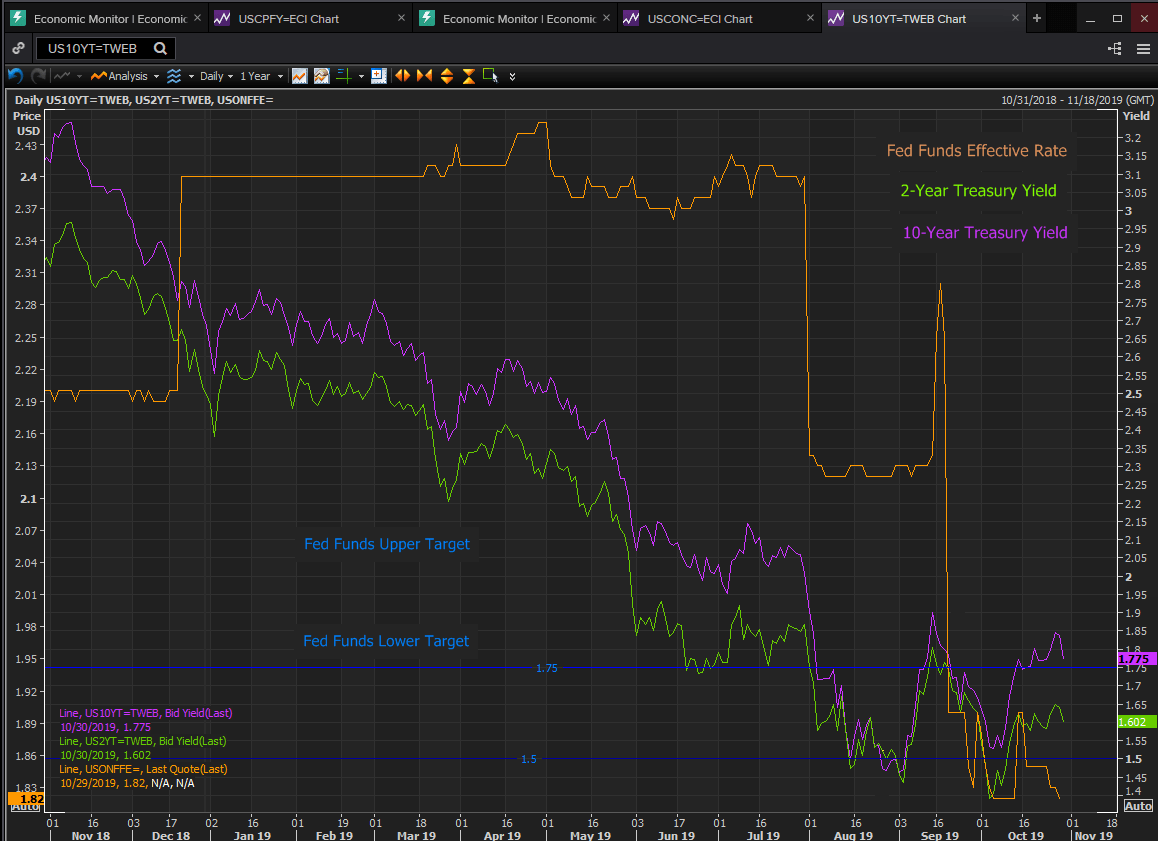
The Treasury yield curve has also indicated diminishing risks to the US economy.
Rates have moved sharply higher over the past two months. The yield on the 2-year Treasury has gained 24 basis points to 1.60% and the 10-year has added 34 points to 1.77%.
After inverting briefly in late August with yields on the 10-year falling as much as five points below the 2-year and exciting much recession talk, the spread has reversed back to normal dimensions and was 17 points wide on Wednesday afternoon well with the standard range of the past several years.
Reuters
Mr. Powell said that while he expected the trade deal with China would have positive effects on business sentiment and investment it would take time for those effects to materialize.
Higher inflation is not one of the Fed main concerns. “There are significant disinflationary pressures around the world. We do not think we are exempt from them,” he observed.
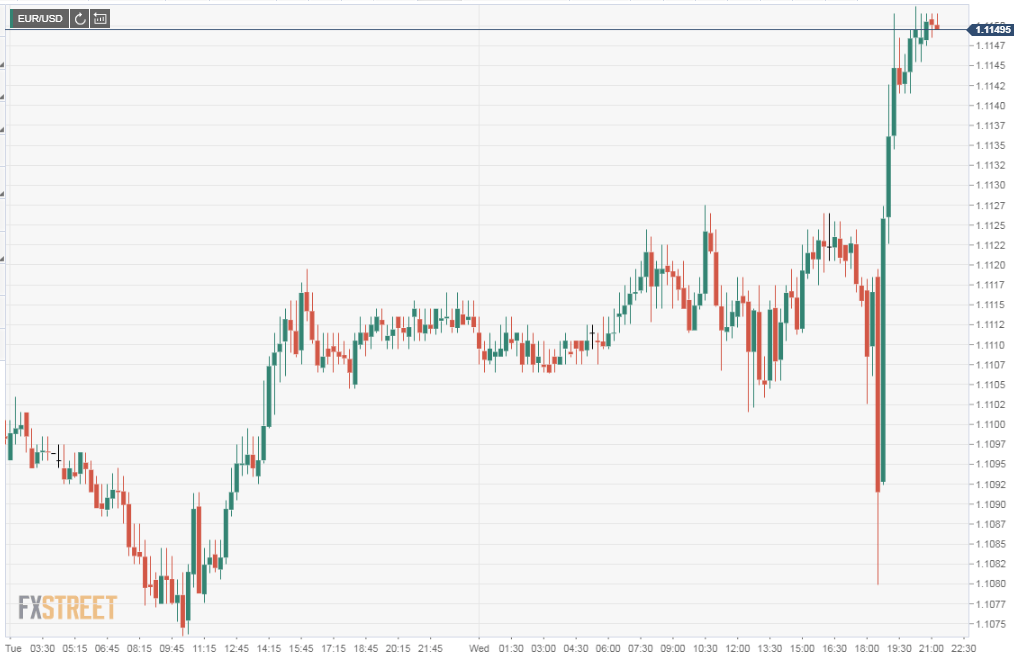
The dollar initially moved higher on the FOMC statement and Chairman’s Powell’s confirmation that the bank has reverted to a neutral stance. His later comment that there would be no rate hikes unless there was a “significant move up in inflation,” sent the greenback tumbling to levels below where it had been before the Fed announcement.
Equities retained most of their post-FOMC gains with the clear indications of a stronger economy and the reduction in global risks outweighing the end of lower rates. The S&P 500 closed at a record and the Dow finished about 200 points below its own all-time high.
Author

Joseph Trevisani
FXStreet
Joseph Trevisani began his thirty-year career in the financial markets at Credit Suisse in New York and Singapore where he worked for 12 years as an interbank currency trader and trading desk manager.
















