|

The Bank of Japan is the main counterparty in the Fed’s FRRP facility

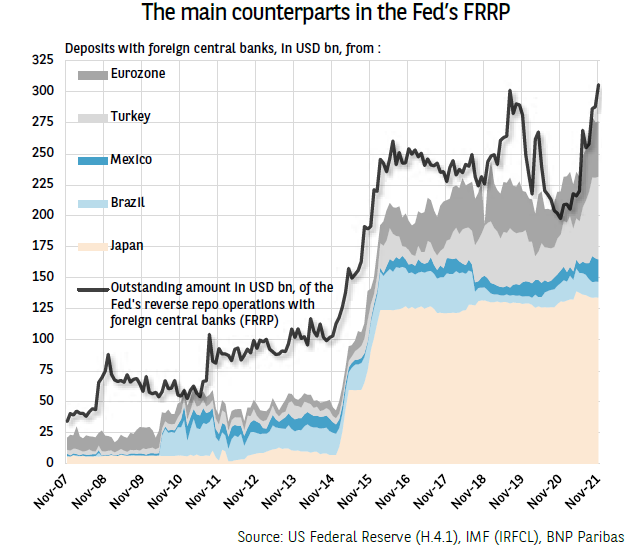
Since November 2020, there has been a significant increase in repurchase agreements1 by the US Federal Reserve (the Fed) with foreign central banks as part of the Foreign Repo Pool (FRRP). Two statistical series can be used to identify the Fed’s main counterparts.

The structure of official foreign reserves2 indicates the amount of deposits (in the broad sense of the term, including repurchase agreements) made by each economy with “foreign central banks, the Bank of International Settlements, and the International Monetary Fund”. Given the weight of the USD, EUR, JPY and GBP in global foreign reserves, the Fed, the European Central Bank (ECB), the Bank of Japan (BoJ) and the Bank of England are probably the main beneficiaries.

The US Department of the Treasury3 also reports the value of US financial institutions’ liabilities (excluding certificates of deposit and shortterm debt securities) to MFIs of each foreign country, presented as a whole (commercial and central banks). Yet these statistics are not granular enough to identify the claims of each foreign central bank alone with the US financial sector (at the aggregate level, these claims are mainly comprised of repurchase agreements with the Fed since 2008). For the period 2014-16, the very comparable trajectory of Japanese deposits with foreign central banks, the US financial sector’ liabilities to Japanese MFIs, and the outstanding amount of the Foreign Repo Pool (FRRP) nonetheless suggests that the BoJ largely contributed to the growing importance of the FRRP facility. More recently, however, the Central Bank of the Republic of Turkey, and to a lesser extent, the ECB seem to be more interested in the FRRP.
Chart

Download The Full EcoFlash

Author

BNP Paribas Team

BNP Paribas Team

BNP Paribas

BNP Paribas Economic Research Department is a worldwide function, part of Corporate and Investment Banking, at the service of both the Bank and its customers.


More from BNP Paribas Team
Share:

Markets move fast. We move first.

Orange Juice Newsletter brings you expert driven insights - not headlines. Every day on your inbox.

By subscribing you agree to our Terms and conditions.

Editor's Picks

EUR/USD posts modest gains near 1.1650 amid Fed rate cut bets

The EUR/USD pair posts modest gains around 1.1645 during the early Asian session on Monday. The prospect of a US Federal Reserve rate cut at its December meeting on Wednesday could weigh on the US Dollar against the Euro. Later on Monday, the German Industrial Production and Eurozone Sentix Investor Confidence reports will be published. 

GBP/USD consolidates around 1.3330 as traders await Fed rate decision

The GBP/USD pair kicks off the new week on a subdued note and oscillates in a narrow trading band, around the 1.3320-1.3325 region, during the Asian session. Spot prices, however, remain close to the highest level since October 22, touched last Thursday, with bulls awaiting a sustained strength and acceptance above the 100-day Simple Moving Average before placing fresh bets.

Gold continues its struggles with $4,200 as the Fed week kicks in

Gold treads water around $4,200 early Monday, while within the previous week’s trading range. US Dollar holds lower ground amid looming Fed rate cut call and a cautious mood. Gold’s daily technical setup suggests that buyers are not ready to give up yet.

Bitcoin and Ethereum aim for breakouts as Ripple holds at $2

Bitcoin, Ethereum, and Ripple record a minor recovery on Monday, starting the week on a positive note. The retail demand for major cryptocurrencies remains strong despite outflows from Bitcoin and Ethereum Exchange Traded Funds.

The Silver disconnection is real

Silver just hit a new all-time high. Neither did gold, nor mining stocks. They all reversed on an intraday basis, but silver’s move to new highs makes it still bullish overall, while the almost complete reversals in gold and miners make the latter technically bearish.

Ripple faces persistent bear risks, shrugging off ETF inflows

Ripple is extending its decline for the second consecutive day, trading at $2.06 at the time of writing on Friday. Sentiment surrounding the cross-border remittance token continues to lag despite steady inflows into XRP spot ETFs.