Soaring inflation and the strong dollar leave investors unsure about gold


Investors seem unsure about what to do with gold amid high levels of uncertainty in the market. The Federal Reserve has finally admitted that the high-level inflation we've been seeing is not transitory, but investors are left to try to guess what the central bank will do next.
Meanwhile, signals from within the gold market are mixed, as exchange-traded funds recorded inflows for the first month since July, despite the roughly flat gold price in November. The yellow metal has been unable to pick up momentum this month, staggering around amid weak economic data, a fluctuating dollar, and the type of uncertainty that usually drives its price higher.
Net inflows for gold ETFs
According to the World Gold Council, gold-backed exchange-traded funds recorded net inflows of 13.6 tons in November, marking the first month of inflows since July. North America and Europe led the way, as inflows in those regions more than offset outflows in Asia, marking the first month of outflows for the region since May.
November's inflows for gold ETFs are particularly interesting in light of the very slight increase in gold prices during the month. In fact, flows to gold ETFs are still in the red year to date, down US$8.8 billion or 167 tons. The yellow metal ended November up 2% month over month at $1,804 an ounce, according to the World Gold Council.
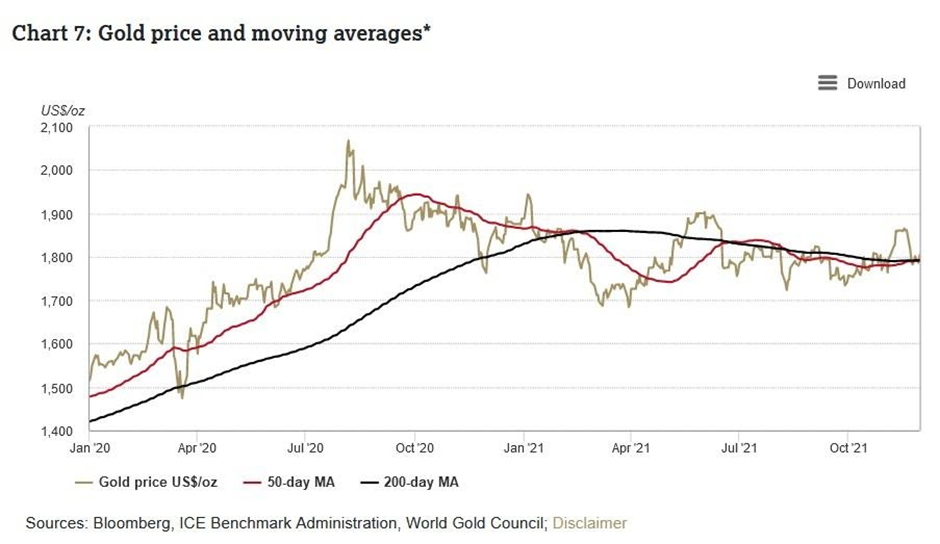
Gold rallied in early November but then gave up most of those gains in the following weeks. Meanwhile, equities and commodities weakened while yields fell and the U.S. dollar strengthened. The yellow metal found support at around $1,780 per ounce toward the end of November, close to its 50- and 200-day moving averages.
Inflation is driving gold prices
The World Gold Council attributed the lion's share of the drive for gold prices to the rising 10-year breakeven inflation rate, as it pushed real yields lower for much of the month.
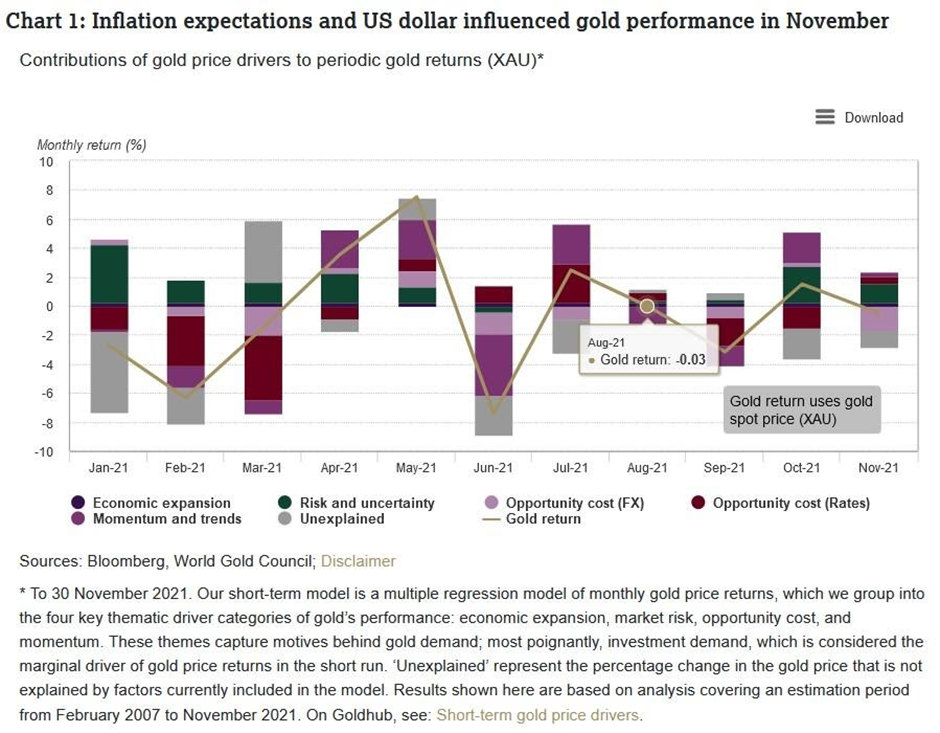
Breakeven inflation climbed 2.7% intra-month in November, the highest level since 2005. The World Gold council added that investors remain focused on inflation and central banks' possible reactions to it, which remain a strong influence on the price of gold.
The organization expects investors to remain preoccupied with inflation and regulators' potential responses to it for the rest of the year. Last week, Fed Chairman Jerome Powell stated that the word "transitory" is no longer applicable to the current inflation rate and suggested that the central bank could start tapering its asset-buying program sooner than previously expected. As a result, investors will also be watching the pace of expected interest rate hikes.

Gold struck by the strong dollar
The problem for gold right now is that it can't seem to find the momentum to keep rising with all that's going on. The yellow metal appears range-bound between $1,775 and $1,790. Ole Hansen of Saxo Bank noted earlier this week that sentiment took another hit after Powell's signal that the Fed is moving from its focus on job creation to fighting inflation.
The focus is now on tomorrow's inflation reading, although the gold market has been struggling to respond to rising inflation. The big problem for gold right now is the strong dollar, which is holding the yellow metal back toward the lower boundaries of this week's trading range.
"Gold could have a make-or-break moment following the U.S. inflation report, which could seal the fate for an accelerated tapering of asset purchases by the Fed," Edward Moya of OANDA said in an email. "If tomorrow's inflation report delivers a 7-handle, the Fed will likely double its tapering pace, which could suggest a first rate hike will fully be priced in for the May 4th policy meeting."
He added that gold traders are waiting for a big move and probably will hold back until the metal is clearly free from its trading range. However, Moya believes the long-term bullish outlook for gold is still intact, especially now that some market watchers are expecting a recession in 2023 due to accelerated tightening by the Fed.
Author
Jacob Wolinsky
ValueWalk
Jacob Wolinsky is the founder of ValueWalk, a popular investment site. Prior to founding ValueWalk, Jacob worked as an equity analyst for value research firm and as a freelance writer. He lives in Passaic New Jersey with his wife and four children.