Gold Weekly Forecast: XAU/USD poised to extend slide after breaking key supports
- Gold lost more than 5% on a weekly basis for the first time in a year.
- Unabated USD strength on FOMC’s hawkish shift dominated financial markets.
- The next target on the downside is located at $1,756.

After closing the previous week in the negative territory, gold remained under modest bearish pressure during the first half of the week and registered losses on Monday and Tuesday. With the USD gathering strength during the American trading hours on Wednesday, XAU/USD extended its slide and lost nearly 5% in a two-day span to touch its lowest level in six weeks at $1,767 on Thursday. Although the pair staged a correction ahead of the weekend, it struggled to preserve its recovery momentum and closed a little above $1,770 with a weekly loss of 5.5%.
What happened last week
The data published by the US Bureau of Labor Statistics revealed on Tuesday that the Producer Price Index (PPI) for final demand rose 6.6% on a yearly basis in May, compared to the market expectation of 6.3%. Other data from the US showed that Retail Sales contracted by 1.3% on a monthly basis following April’s expansion of 0.9% (revised from 0%). Nevertheless, market participants largely ignored these readings ahead of Wednesday’s highly-anticipated FOMC event.
Following its June meeting, the US Federal Reserve announced that it left the benchmark interest rate, the target range for federal funds, unchanged at 0%-0.25% as widely expected. In its updated Summary of Economic Projections, the FOMC revealed that seven policymakers saw a lift-off in the fed funds rate from zero in 2022, compared to four policymakers in March's publication. More importantly, the number of policymakers who expect a lift-off in the policy rate from zero in 2023 rose to 13 from seven in March.
In its policy statement, the Fed reiterated that it will maintain the accommodative policy until inflation runs moderately above 2% for some time, so that inflation averages 2% over time and longer-term inflation expectations remain well-anchored at 2%.
During the press conference, FOMC Chairman Jerome Powell acknowledged that they are not dismissing the possibility of inflation staying high for longer than expected. Powell further noted that it will be appropriate to consider a plan for taper in the upcoming minutes if the economy continues to progress.
The hawkish shift witnessed in the Fed’s dot plot and Chairman Powell’s cautious comments with regards to the inflation outlook triggered a USD rally. Reflecting the broad-based USD strength, the US Dollar Index (DXY) climbed to its highest level in two months at 92.07 on Friday and gained more than 1.5% in the second half of the week.
On Thursday, the US Department of Labor said that the Initial Jobless Claims rose to 412,000 in the week ending June 12. This print came in worse than analysts’ estimate of 359,000 but failed to trigger a noticeable market reaction as the greenback’s performance continued to dominate the financial markets.
In the absence of high-tier macroeconomic data releases on Friday, St. Louis Fed President James Bullard’s comments provided an additional boost to the USD and the DXY stretched its weekly rally, making it difficult for XAU/USD to erase its losses. Bullard acknowledged the Fed’s June meeting represented a “somewhat hawkish move” and added that inflation was more intense than expected.
Next week
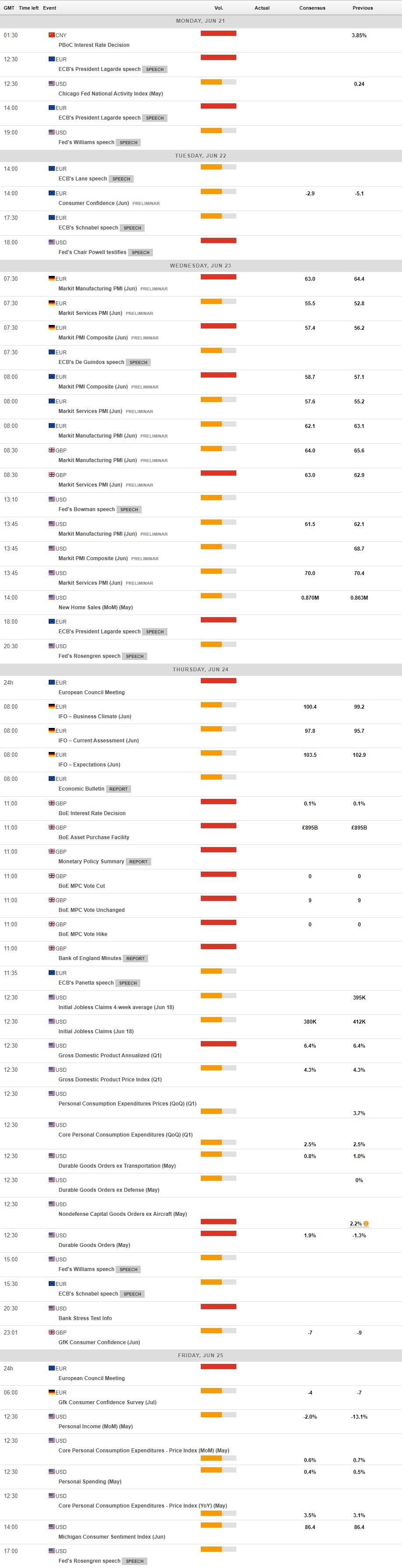
On Tuesday, Powell will be testifying before the House Select Committee on the Coronavirus Crisis at 1800 GMT in a hearing entitled "Lessons Learned: The Federal Reserve’s Response To The Coronavirus Pandemic." The chairman is unlikely to change his tone only a few days after the FOMC meeting and his remarks are unlikely to have a significant impact on the USD’s valuation.
On Wednesday, the IHS Markit will publish the preliminary Manufacturing and Services PMI reports for June. The headline figures are expected to confirm the ongoing expansion at a robust pace both in the service and the manufacturing sectors. Investors, however, will keep a close eye on the underlying details with regards to input price pressures. In case these reports reaffirm the view that inflation will continue to rise, the USD could gather additional strength and weigh on XAU/USD.
On Thursday, the Bank of England (BoE) will announce its policy decision. There will not be a press conference and the BoE could refrain from changing its forward guidance. Nevertheless, a hawkish outlook could trigger a sharp increase in the GBP/USD pair and help XAU/USD turn north. Meanwhile, the US Bureau of Economic (BEA) will release the final version of the annualized first-quarter GDP growth on Monday, which is expected to match the previous estimate of 6.4%.
Finally, the BEA will publish the Core Personal Consumption Expenditures (PCE) Price Index, the Fed’s preferred gauge of inflation, on Friday. The Core PCE Price Index is forecast to edge lower to 2.9% in May from 3.1% in April. A stronger-than-expected PCE inflation is likely to allow the greenback to continue to outperform its rivals and vice versa.
Gold technical outlook
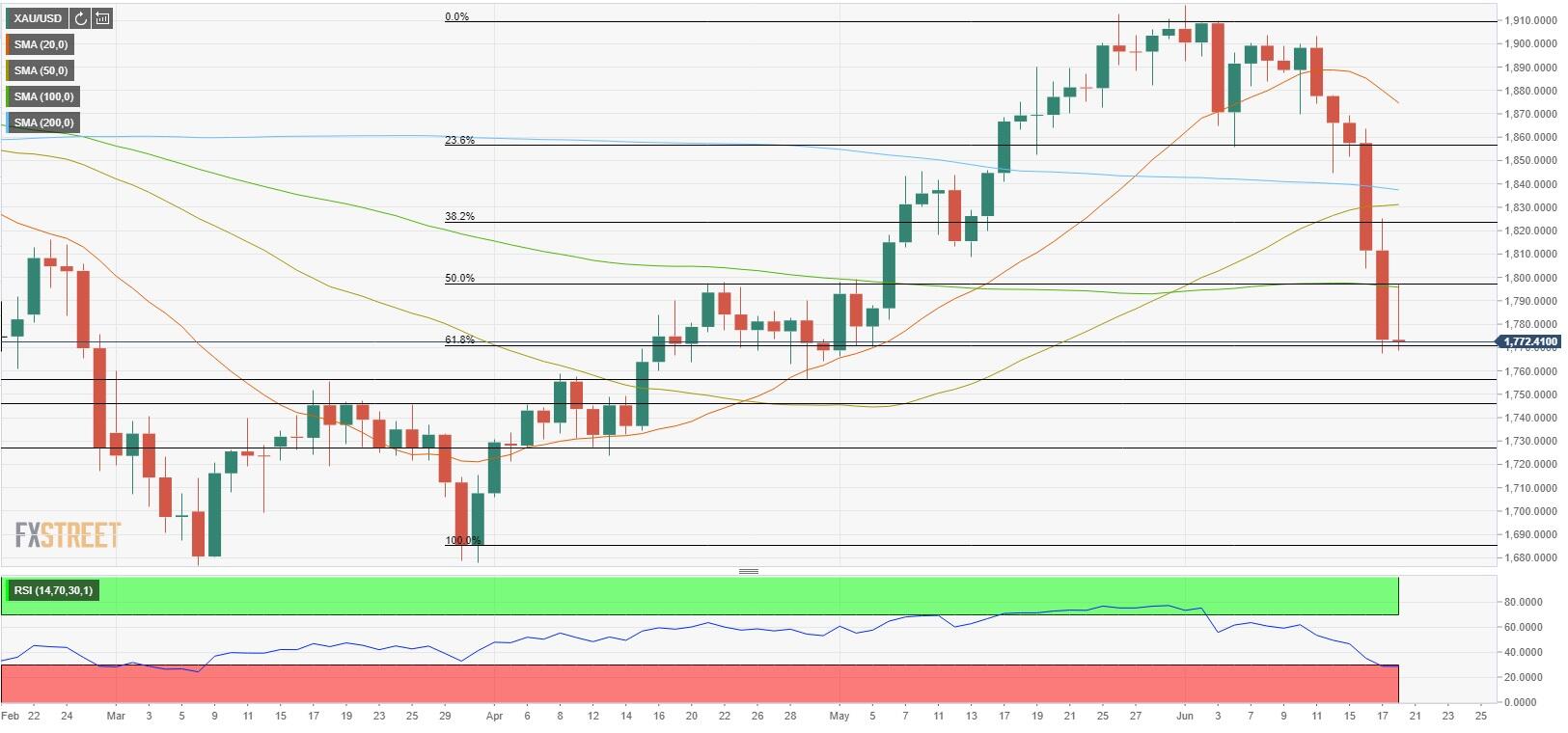
On the daily chart, the Relative Strength Index (RSI) indicator dropped below 30 for the first time since early March, suggesting that the pair could stage a technical correction before the next leg down. However, XAU/USD broke below the 200-day and the 100-day SMAs in a two-day span, reflecting the dominance of the sellers in the current environment.
Unless gold makes daily close above $1,800 (100-day SMA, psychological level, Fibonacci 50% retracement of April-June uptrend), the bearish pressure is likely to remain intact in the near term. Above that level, the next critical resistance is located at $1,825 (Fibonacci 38.2% retracement) ahead of $1,835 (200-day SMA).
On the downside, strong support seems to have formed at $1,770 (Fibonacci 61.8% retracement) before $1,756 (April 29 low, static level) and $1,745 (static level).
Gold sentiment poll
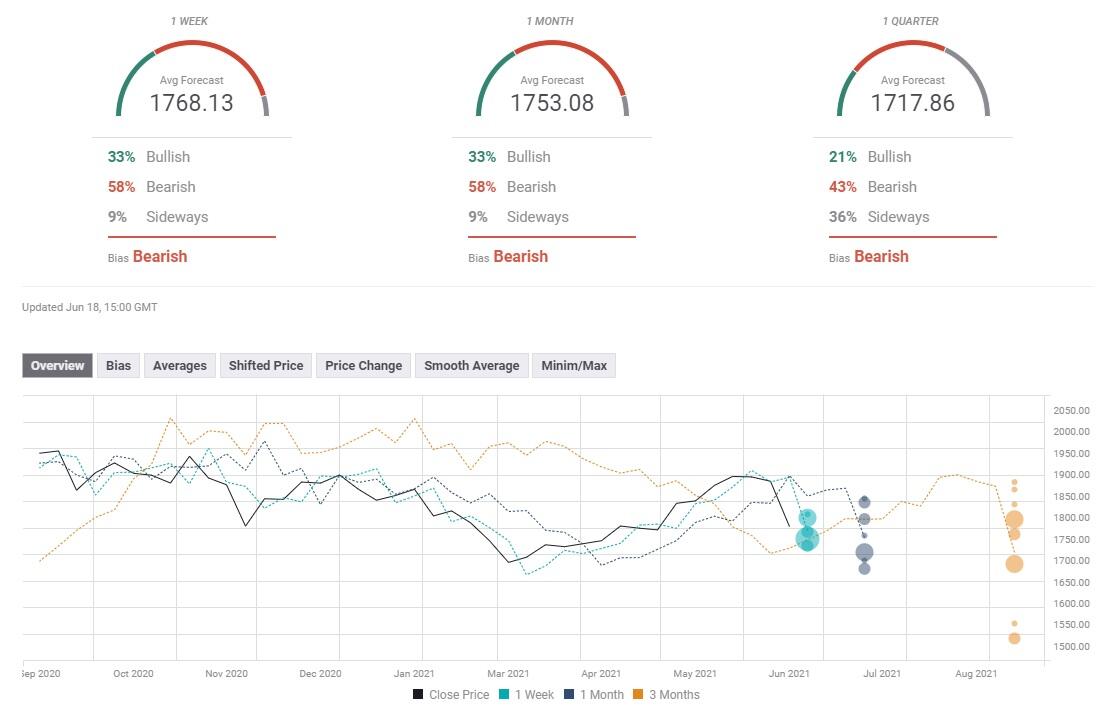
The FXStreet Forecast Poll shows a clear bearish change in gold’s outlook. Although the one-week viewpoints to a near-term consolidation with an average target of $1,768, additional losses are expected on one-month and one-quarter views. Moreover, some experts are seeing gold dropping below $1,600 in the next three months.
Author

Eren Sengezer
FXStreet
As an economist at heart, Eren Sengezer specializes in the assessment of the short-term and long-term impacts of macroeconomic data, central bank policies and political developments on financial assets.