Gold Weekly Forecast: Volatility to continue as investors stay on edge
- Gold fell sharply after surging above $1,970 and ended the week in negative territory.
- The near-term technical outlook remains bullish as long as $1,870 support holds.
- A prolonged Russia-Ukraine war could help the yellow metal gain traction.

Gold fluctuated wildly throughout the week as it remained the most sensitive asset to shifts in risk perception. Following an impressive rally to its highest level since September 2020 at $1,974 on Thursday, the yellow metal declined below $1,900 in the early American session on Friday and ended up snapping a three-week winning streak.
What happened last week
The improving market mood at the beginning of the week on renewed hopes of a diplomatic solution to the Russia-Ukraine crisis made it difficult for gold to build on the previous week’s gains. The White House announced late Sunday that US President Biden agreed to meet his Russian counterpart Vladimir Putin later in the week, allowing markets to breathe a sigh of relief.
Markets stayed relatively quiet on Tuesday and gold edged lower in the second half of the day as US Treasury bond yields gained traction with American investors returning from the long weekend. Additionally, the data from the US revealed that the economic activity in the private sector continued to expand at a robust pace in February with Markit Composite PMI improving sharply to 56.6 from 51 in January.
Gold managed to hold above $1,900 on Wednesday and sellers remained on the sidelines as reports of Russia piling up troops near the Ukrainian border caused risk flows to cool off.
During the Asian trading hours on Thursday, Russia announced that it had launched a "special military operation" against Ukraine and Russian President Vladimir Putin said that the aim was to demilitarize Ukraine. Ukrainian President Volodymyr Zelenskyy announced martial law and Ukrainian news outlets reported that Russia was shelling targets across the country. The knee-jerk market reaction triggered an intense flight to safety and provided a boost to gold, lifting XAU/USD to the $1,950 area. When European markets opened, gold extended its rally and touched its strongest level in 17-months at $1,974 with European stocks suffering heavy losses.
The west’s response to Russian aggression against Ukraine, however, eased fears over the negative implications of a prolonged Russia-Ukraine war on the global economy. The UK, the EU and the US announced a series of sanctions on Thursday but refrained from cutting Russia off from the SWIFT system while reiterating that it was an option that could be exercised. Furthermore, the Russian energy sector was largely untouched. The slight positive tilt witnessed in risk sentiment and profit-taking forced XAU/USD to erase its daily gains late Thursday.
Meanwhile, the US Bureau of Economic Analysis announced on Thursday that it had revised the annualized real Gross Domestic Product growth in the fourth quarter higher to 7% in its second estimate from 6.9%. This reading came in line with the market expectation and it was largely ignored by investors.
On Friday, reports of Russian forces moving toward the Ukrainian capital of Kyiv with the intention of overthrowing the government forced markets to adopt a cautious stance. The yellow metal spent the first half of the day in a relatively tight range above $1,900. In the early American session, reports of Russia willing to send a delegation to Minsk for talks with Ukraine revived optimism for a diplomatic end to war. XAU/USD came under bearish pressure on this development and continued to push lower.
Next week
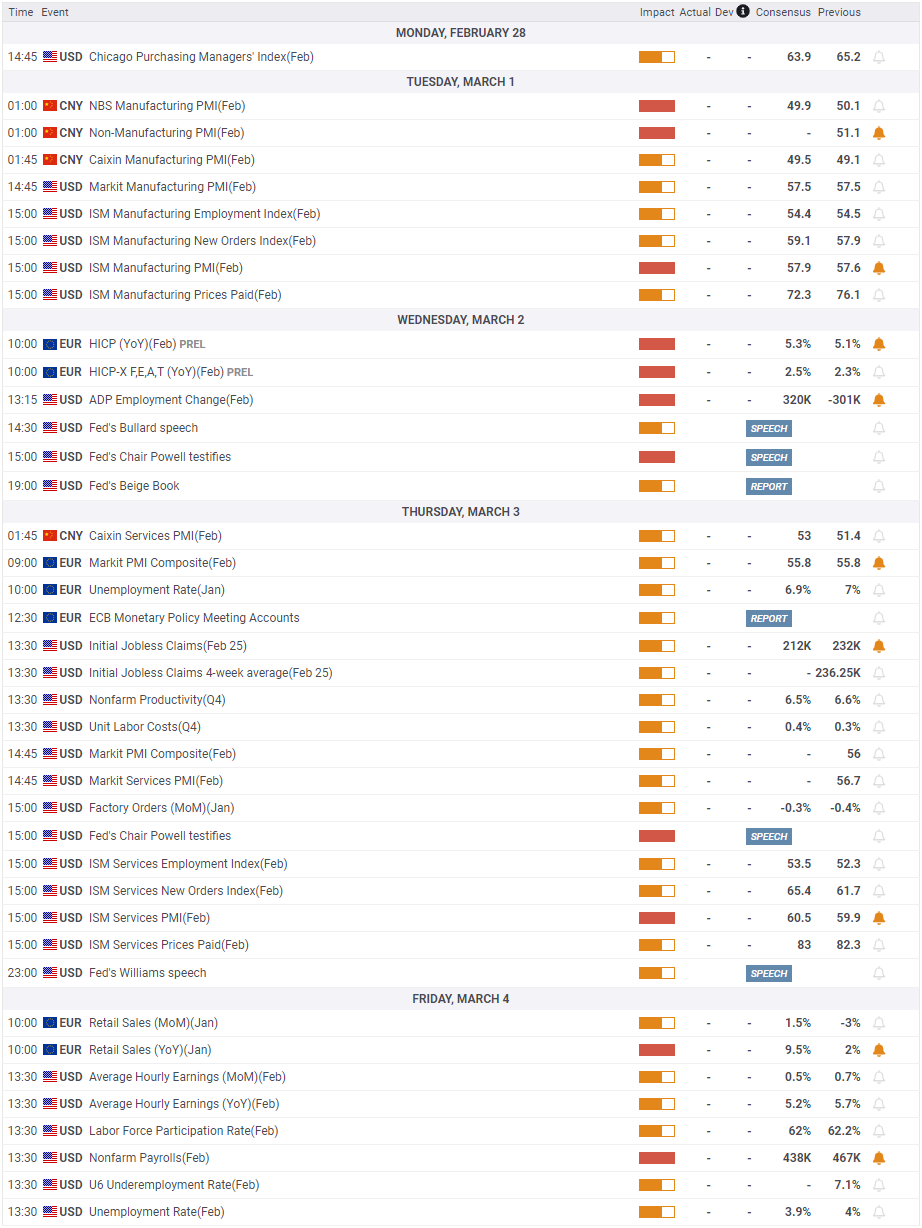
There will be several high-tier data releases featured in the economic calendar next week but investors are likely to stay focused on geopolitical headlines. This week's market action showed that gold is the go-to safe-haven asset but it's also the one that's being sold first when the mood improves.
In case Russia reaffirms its intention to look for a diplomatic solution and refrains from advancing its troops early next week, gold is likely to face additional selling pressure. On the flip side, a prolonged military conflict with Russia's intention to take over Kyiv and additional sanctions from the west could support the precious metal.
On Tuesday, the ISM will release the Manufacturing PMI for February. On Wednesday, the ADP's private sector employment report and the Federal Reserve's Beige Book will be looked upon for fresh impetus.
In the second half of the week, the US economic docket will offer ISM Services PMI on Thursday and Nonfarm Payrolls on Friday. More importantly, FOMC Chairman Jerome Powell will testify before the US Senate Banking Committee and it will be interesting to see how Powell responds to questions on the potential impact of the Russia-Ukraine war on the policy outlook. Powell is likely to reiterate that their priority is controlling inflation. If the chairman hints at the possibility of a 50 basis points rate hike in March, gold could start pushing lower. On the flip side, markets are currently pricing a very small chance of a double-dose hike in March and a dollar selloff should be limited in case Powell goes against it.
FOMC policymakers said numerous times that they are not concerned about the labour market but market participants will pay close attention to wage inflation nonetheless. Average Hourly Earnings on a yearly basis are expected to edge lower to 5.2% in February from 5.7% in January. A stronger-than-expected reading could help the greenback find demand and weigh on XAU/USD but the market reaction is likely to remain short-lived as long as geopolitics remain the primary market driver.
Gold technical outlook
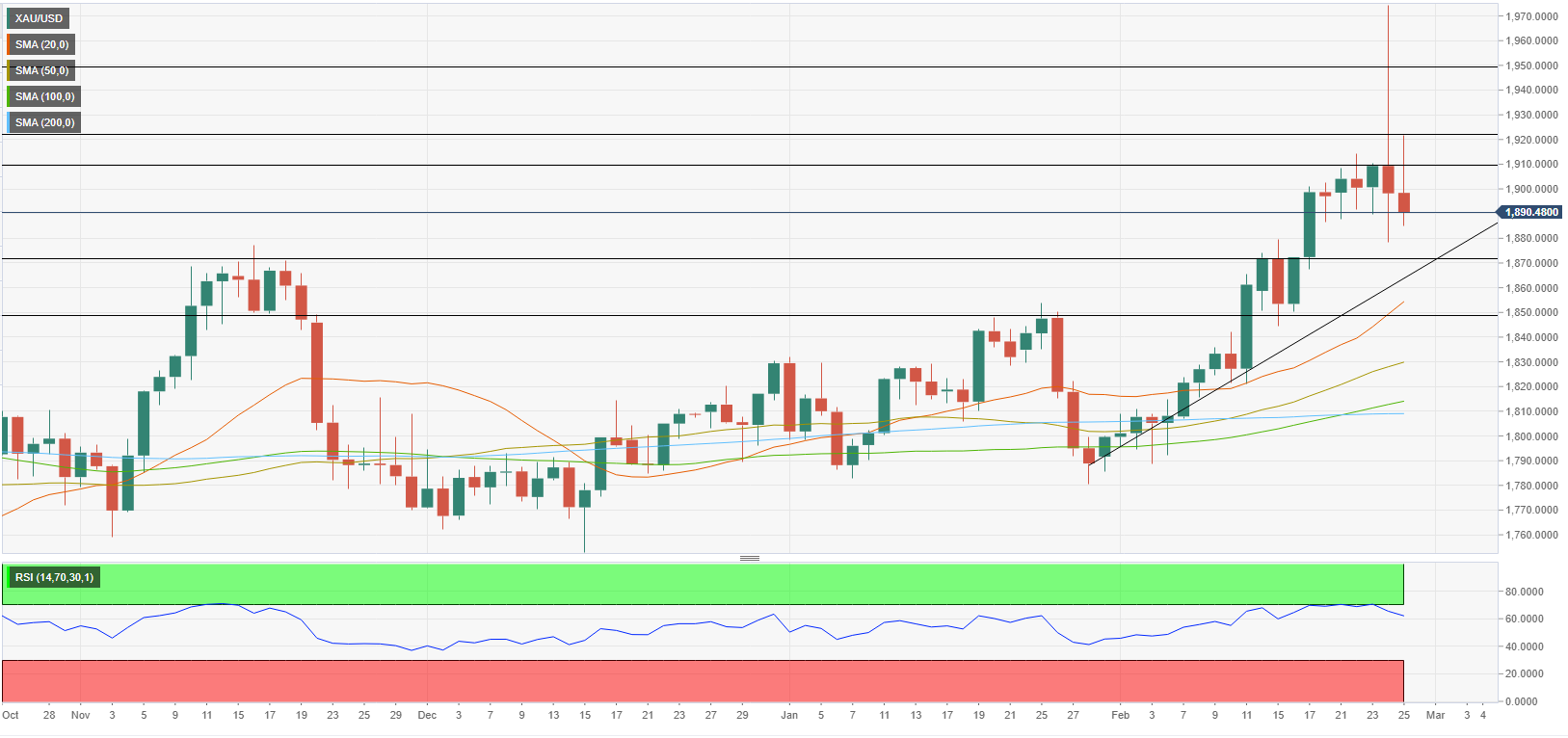
Despite the sharp correction witnessed toward the end of the week, gold's near-term outlook doesn't yet point to a bearish shift. The ascending trend line coming from early February stays intact, the Relative Strength Index (RSI) indicator on the daily chart sits above 50 and the price holds way above the 20-day, 50-day, 100-day and 200-day SMAs.
The initial support is located at $1,870 (static level, ascending trend line). In case XAU/USD makes a daily close below that level it could extend its slide toward $1,850 (static level, 20-day SMA).
On the upside, $1,900 (psychological level) aligns as first resistance. If buyers managed to flip that level into support, $1,910 (static level) could be seen as the next hurdle before $1,920 (static level).
Gold sentiment poll
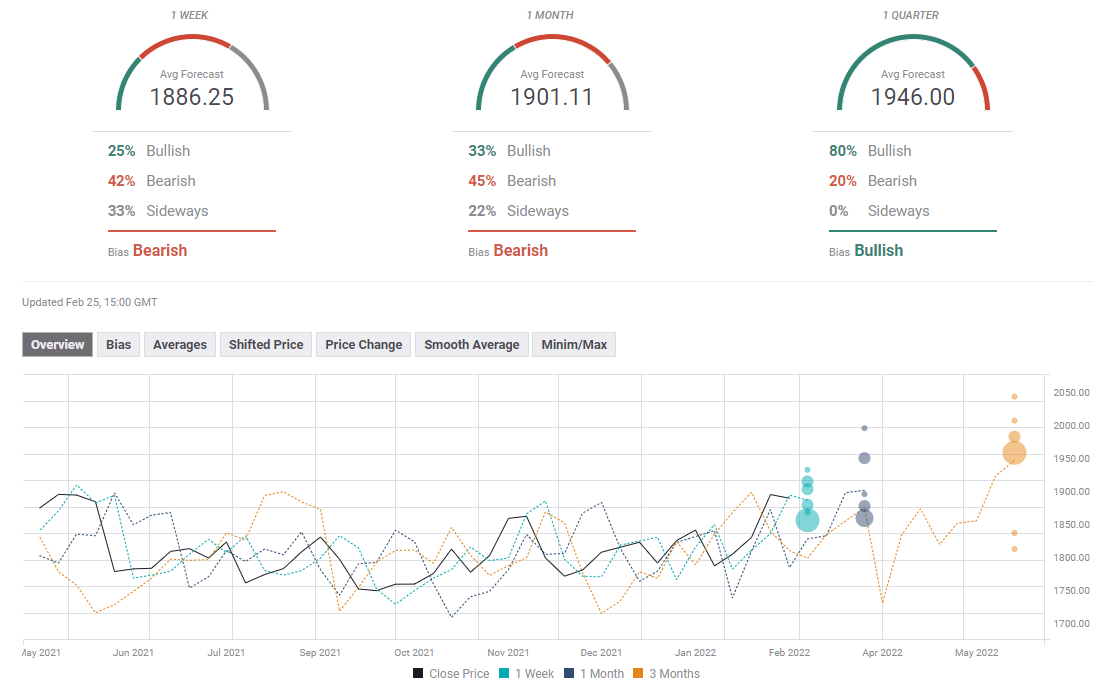
The FXStreet forecast poll points to a slightly bearish bias in the near term with the one-week average target sitting at $1,886. The one-month outlook paints a mixed picture.
Author

Eren Sengezer
FXStreet
As an economist at heart, Eren Sengezer specializes in the assessment of the short-term and long-term impacts of macroeconomic data, central bank policies and political developments on financial assets.