Gold Weekly Forecast: Sellers stay on the sidelines as focus shifts to US data
- Gold registered gains for the second straight week as US T-bond yields continued to fall.
- The technical outlook suggests XAU/USD remains slightly bullish.
- US yields' reaction to next week's key US data could impact gold's action.


Falling US Treasury bond yields and the unabated selling pressure surrounding the dollar helped gold close the second straight week in positive territory. As focus shifts to the US May jobs report, the technical outlook suggests that XAUUSD is likely to continue to push higher as long as $1,840 holds as support.
What happened last week?
Gold started the new week in a calm manner but managed to register daily gains on Monday with the greenback continuing to weaken against its major rivals. The negative tilt to risk sentiment amid disappointing macroeconomic data from the US caused US Treasury bond yields to push lower on Tuesday, allowing XAUUSD to climb to its highest level in nearly two weeks at $1,870.
The S&P Global Composite PMI in the US dropped to 53.8 in May from 56 in April, revealing a loss of growth momentum in the private sector’s business activity. The print also fell short of the market expectation of 55.5. Commenting on the PMI survey, “companies report that demand is coming under pressure from concerns over the cost of living, higher interest rates and a broader economic slowdown,” said Chris Williamson, Chief Business Economist at S&P Global Market Intelligence. Additionally, the US Census Bureau reported that New Home Sales contracted by 16.6% on a monthly basis in April, reflecting the negative impact of the current financing conditions on the housing market.
Meanwhile, European Central Bank (ECB) President Christine Lagarde said on Tuesday that the policy rate was likely to be positive at the end of the third quarter, triggering capital outflows from the dollar to the euro.
On Wednesday, the FOMC’s May meeting minutes revealed that most policymakers agreed two more 50 basis points rate hikes will be appropriate in the next two meetings and noted inflation risks were skewed to the upside. Regarding the Fed’s balance sheet reduction plan, the publication showed that a number of participants thought they needed to consider sales of mortgage-backed securities once the runoff is well underway. The Fed’s hawkish tone helped the dollar find demand and caused XAUUSD to pull a retreat in the second half of the week.
With the benchmark 10-year US Treasury bond yield edging lower toward 2.7% on Friday, gold regained its traction and climbed to the $1,860 area. Moreover, the 200-day SMA stayed intact following the downward correction, allowing buyers to retain control of XAUUSD’s price action.
Ahead of the weekend, The US Bureau of Economic Analysis reported that the Personal Consumption Expenditures (PCE) Price Index declined to 6.3% on a yearly basis in April from 6.6% in March. The annual Core PCE Price Index, the Fed’s preferred gauge of inflation, edged lower to 4.9% as expected…
Next week
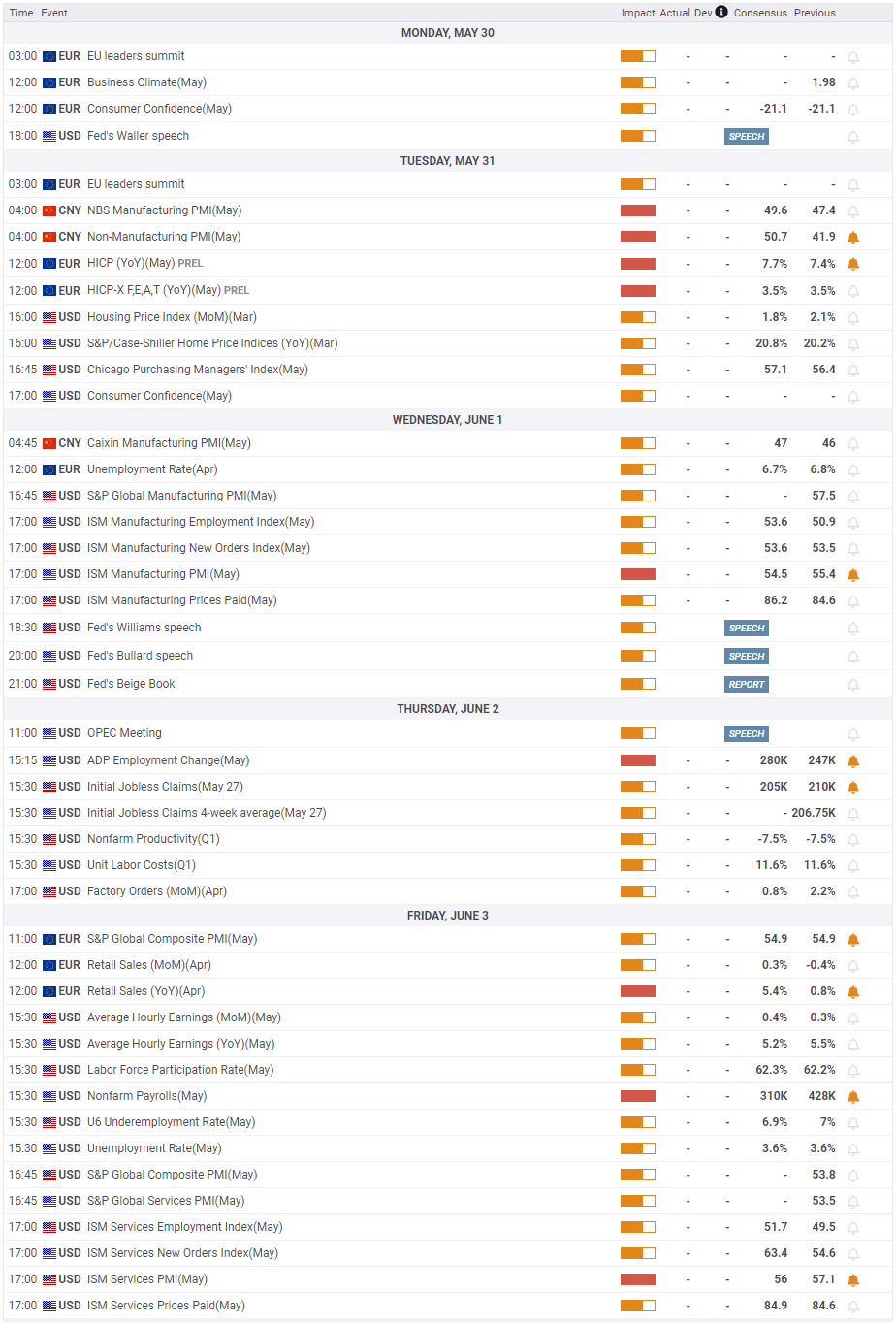
The NBS Manufacturing PMI and Non-Manufacturing PMI data will be featured in the Chinese economic docket on Tuesday. Both of these readings are forecast to rebound in May following April’s significant decline. In case the PMI data fall short of market expectations and remind investors of the negative impact of coronavirus-related restrictions in China, gold is likely to lose interest and vice versa.
Additionally, Eurostat will release the HICP inflation data for the euro area. Several ECB policymakers said last week that a 50 basis points rate hike was not going to be on the table at the July policy meeting. If investors start pricing a double-dose ECB rate increase on hot inflation data, the dollar should continue to weaken.
On Wednesday, the ISM Manufacturing PMI from the US will be watched closely by market participants, who are growing increasingly concerned over a possible recession in the US. If this data suggests that the business activity in the manufacturing sector continued to expand at a robust pace in May, the greenback could stage a rebound and limit XAUUSD’s upside.
The US Bureau of Labor Statistics will publish the May jobs report on Friday. Nonfarm Payrolls (NFP) are expected to rise by 310,000 following April’s increase of 428,000. Unless the NFP print offers a big surprise in either direction, the wage inflation component of the report should impact the market action. The Average Hourly Earnings are forecast to rise by 5.6% on a yearly basis in May. Strong wage inflation could be seen as a factor that can cause consumer inflation to remain high for longer-than-expected and remind investors of the Fed’s willingness to tighten its policy aggressively. In that scenario, gold could turn south amid a rebound in US T-bond yields.
Speaking of yields, 2.7%, which is the Fibonacci 23.6% retracement of the uptrend that started in December, aligns as a key technical level for the 10-year US T-bond yield. If that support fails, a steep decline in US yields could open the door for a gold rally.
Gold technical outlook
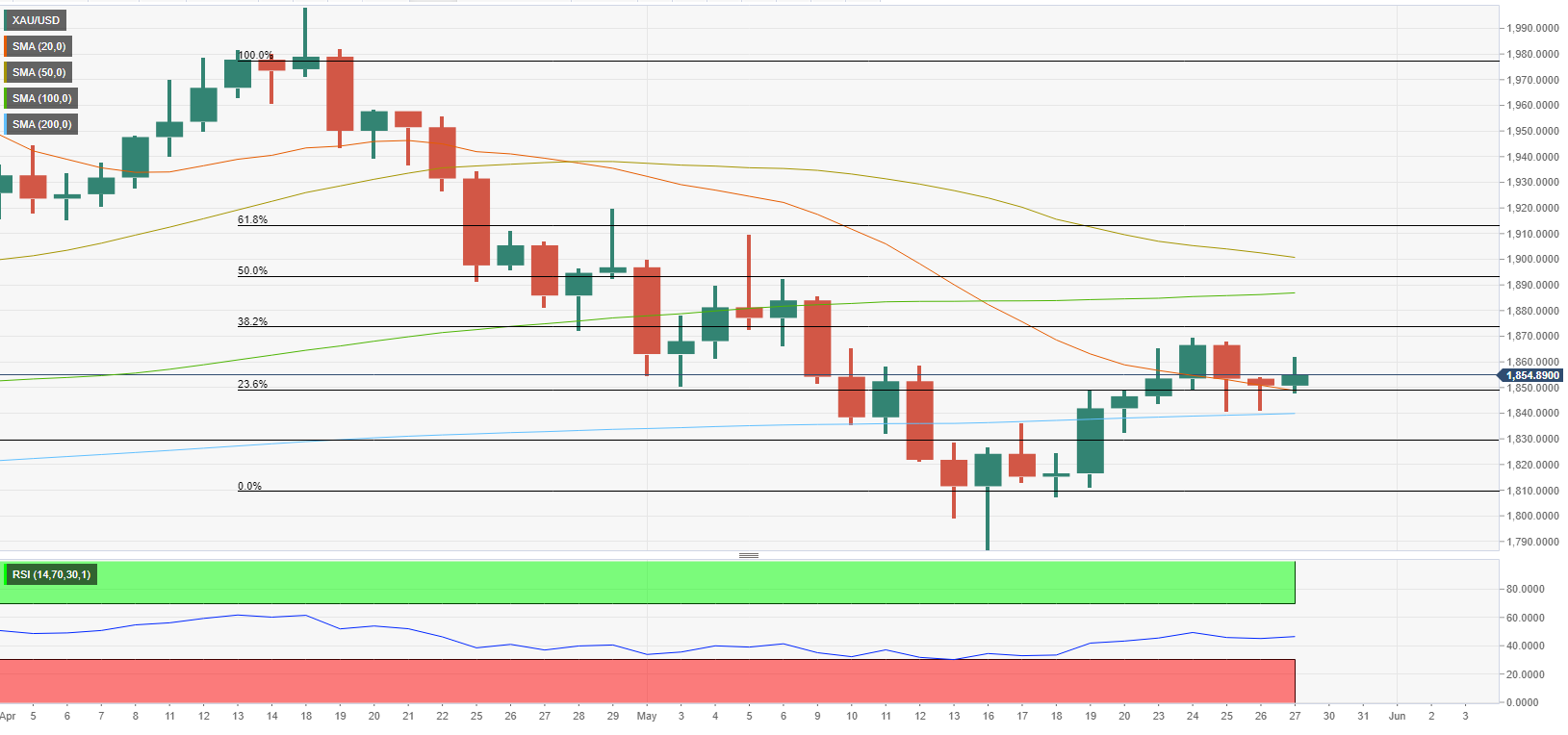
Gold closed the week above the 200-day SMA and the Fibonacci 23.6% retracement of the latest downtrend, suggesting that sellers remain on the sidelines. On the upside, $1,870 (Fibonacci 38.2% retracement) aligns as next resistance. In case XAUUSD rises above that level and starts using it as support, it could target $1,890 (100-day SMA and Fibonacci 50% retracement) and $1,900 (psychological level, 50-day SMA) afterwards.
On the other hand, $1,850 (Fibonacci 23.6% retracement) forms first support ahead of $1,840 (200-day SMA). Only a daily close above the latter could attract sellers and cause the near-term technical outlook to turn bearish. In such a scenario, $1,830 (static level) could act as the next line of defence.
Gold sentiment poll
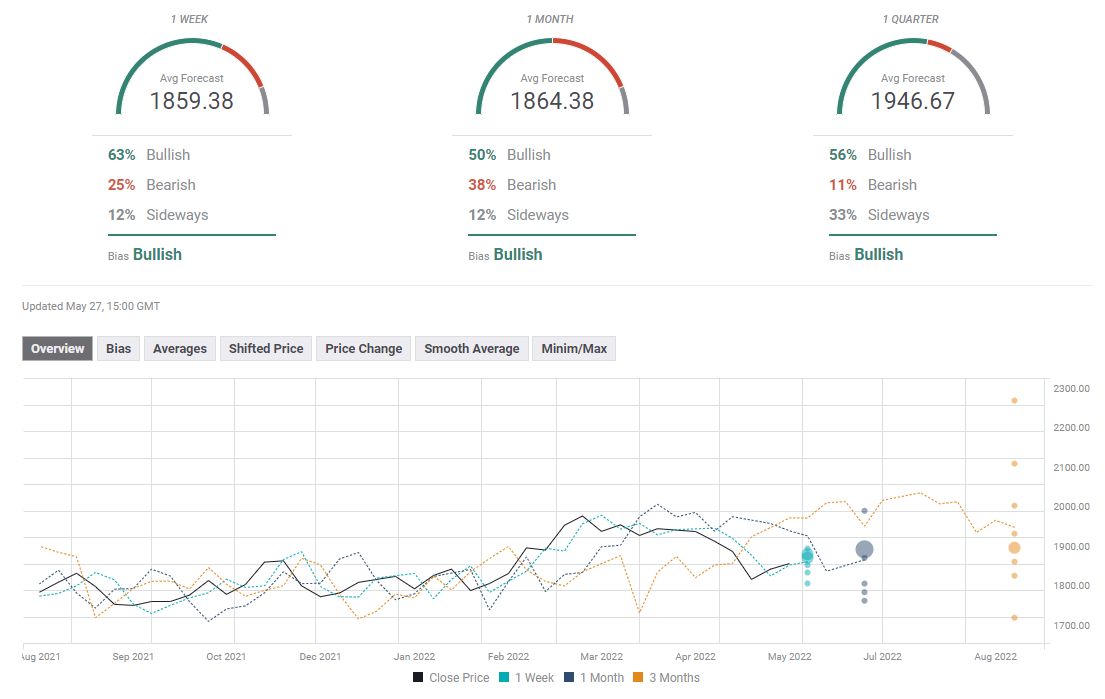
FXStreet Forecast Poll shows that the majority of experts see gold continuing to edge higher next week. The one-month outlook paints a mixed picture and the average target of $1,864 highlights the lack of consensus among analysts.
Premium
You have reached your limit of 3 free articles for this month.
Start your subscription and get access to all our original articles.
Author
Eren Sengezer
FXStreet
As an economist at heart, Eren Sengezer specializes in the assessment of the short-term and long-term impacts of macroeconomic data, central bank policies and political developments on financial assets.