Gold Weekly Forecast: Fed rate decision, key US data to drive near-term action
- Gold stretched lower after breaking below $2,400 this week.
- The Fed’s policy announcements, US labor market data could trigger the next big action in Gold.
- The near-term technical outlook highlights a lack of buyer interest.

After ending the previous week marginally lower, Gold (XAU/USD) extended its slide and touched a two-week low near $2,350, pressured by growing signs of a worsening demand outlook for the precious metal. The Federal Reserve (Fed) will announce monetary policy decisions next week and the US economic docket will feature high-tier data releases, which could trigger the next directional move in XAU/USD.
Gold struggles to gain traction on gloomy demand outlook
Following the sharp decline seen on Friday, Gold continued to edge lower at the beginning of the week. The People's Bank of China (PBoC) announced early Monday that it cut the one-year Loan Prime Rate (LPR) by 10 basis points (bps) from 3.45% to 3.35% and lowered the five-year LPR from 3.95% to 3.85%. Additionally, the PBoC lowered the interest rate for the 7-day reverse report to 1.7% from 1.8%. These unexpected policy-easing measures from China, the world’s biggest consumer of Gold, made it difficult for XAU/USD to gain traction.
In the absence of high-tier data releases, Gold managed to stage a technical correction and stabilized near $2,400 on Tuesday. XAU/USD continued to stretch higher on Wednesday after the mixed preliminary S&P Global Purchasing Managers Index (PMI) data for July from the US caused the US Dollar (USD) to lose interest. S&P Global Manufacturing PMI fell below 50 for the first time since December in July’s flash estimate and showed a contraction in the manufacturing sector’s business activity. On a positive note, S&P Global Services PMI improved to 56 from 55.3 in June.
During the Asian trading hours on Thursday, the PBoC said that it lowered the one-year Medium-term Lending Facility (MLF) rate from 2.50% to 2.30%. This decision, combined with the rate cuts announced earlier in the week, caused investors to grow increasingly concerned over the Chinese economic outlook. In turn, Gold came under renewed bearish pressure and dropped below $2,400. Later in the day, the US Bureau of Economic Analysis reported that the US Gross Domestic Product (GDP) expanded at an annual rate of 2.8% (first estimate) in the second quarter. This reading followed the 1.4% growth recorded in the first quarter and surpassed the market expectation of 2% by a wide margin. Other data from the US showed that the weekly Initial Jobless Claims declined to 235,000 in the week ending on July 20 from 243,000 in the previous week. XAU/USD extended its daily slide following the upbeat US data and touched its weakest level in two weeks below $2,360 in the American trading hours.
Inflation in the US, as measured by the change in the Personal Consumption Expenditures (PCE) Price Index, edged lower to 2.5% on a yearly basis in June from 2.6% in May, the US BEA announced on Friday. The core PCE Price Index, which excludes volatile food and energy prices, rose 2.6% in the same period, matching May's increase but coming in above the market expectation of 2.5%. The core PCE Price Index rose 0.2%, up from 0.1% in May. The benchmark 10-year US Treasury bond yield edged lower after these data and allowed XAU/USD to cling to daily gains.
Gold investors shift attention to Fed, high-tier US data
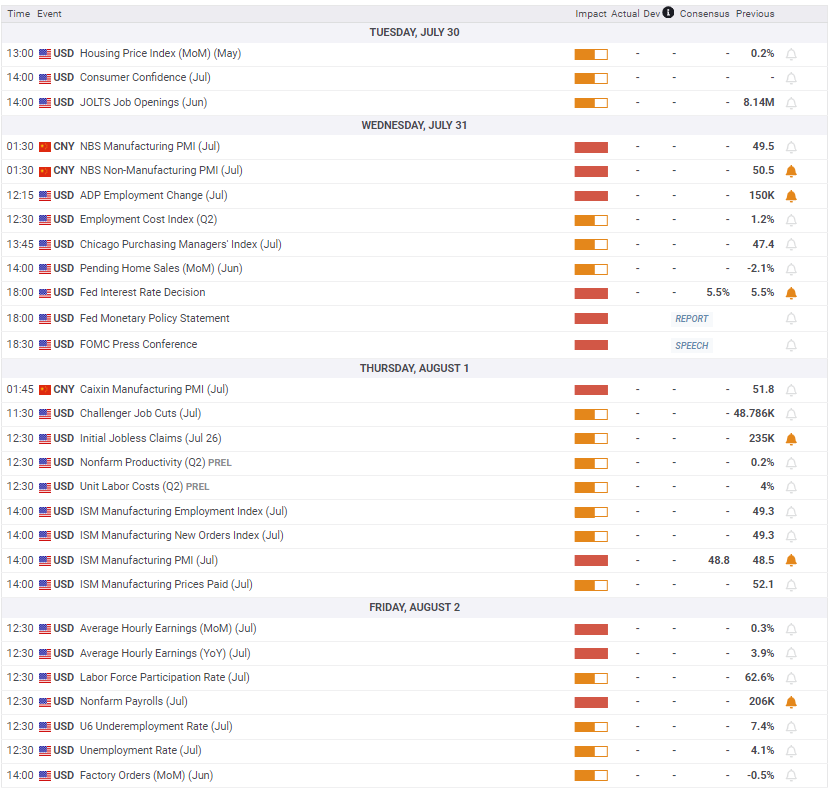
In the Asian session on Wednesday, the July NBS Manufacturing PMI and the NBS Non-Manufacturing PMI data from China will be watched closely by market participants, especially following this week’s developments. In case both PMIs come in below 50, Gold could come under renewed selling pressure with the immediate reaction.
The ADP Employment Change data will be featured in the US economic docket on Wednesday. Investors, however, are likely to ignore this data and wait for the Federal Reserve to announce its monetary policy decisions later in the day.
The Fed is widely expected to leave its policy rate unchanged following the July 30-31 meeting. According to the CME FedWatch Tool, a 25 basis points (bps) Fed rate cut is fully priced in at the September meeting, suggesting that the USD doesn’t have a lot of room on the downside even if the Fed policy statement, or Fed Chairman Jerome Powell, confirms a rate reduction in September.
In the post-meeting press conference, Powell’s remarks on the policy outlook could influence the USD’s valuation and impact Gold’s movements. The CME FedWatch Tool shows that there is nearly a 70% chance that the Fed will lower the policy rate by a total of 75 bps by the end of this year. In case Powell draws attention to robust growth readings and argues that they can take their time when the policy easing starts, markets could reassess the number of Fed rate cuts in 2024. In this scenario, the USD is likely to gather strength and weigh on XAU/USD. On the other hand, markets could remain optimistic about several Fed rate reductions this year and pave the way for a leg higher in Gold if Powell voices confidence over further progress in disinflation while acknowledging loosening conditions in the labor market.
On Thursday, the ISM Manufacturing PMI report for July will be released. The headline PMI is expected to edge slightly higher to 48.8 from 48.5 in June. In case the data arrives above 50 and shows that business activity expanded unexpectedly in July, the USD could find demand. Ahead of Friday’s jobs report, however, the market reaction is likely to remain short-lived.
Nonfarm Payrolls (NFP) rose by 206,000 in June. This reading came in above analysts’ estimate of 190,000. The USD, however, failed to benefit from this data as the jobs report also showed that May’s increase of 272,000 was revised lower to 218,000. Unless there is a significant revision to June’s print, a disappointing NFP growth in July could adversely impact the USD’s valuation. If the NFP arrives near market consensus, the wage inflation component of the report could drive the USD’s action. On a yearly basis, Average Hourly Earnings increased 3.9% in June. A noticeable increase in this data could support the USD heading into the weekend.
Gold technical outlook
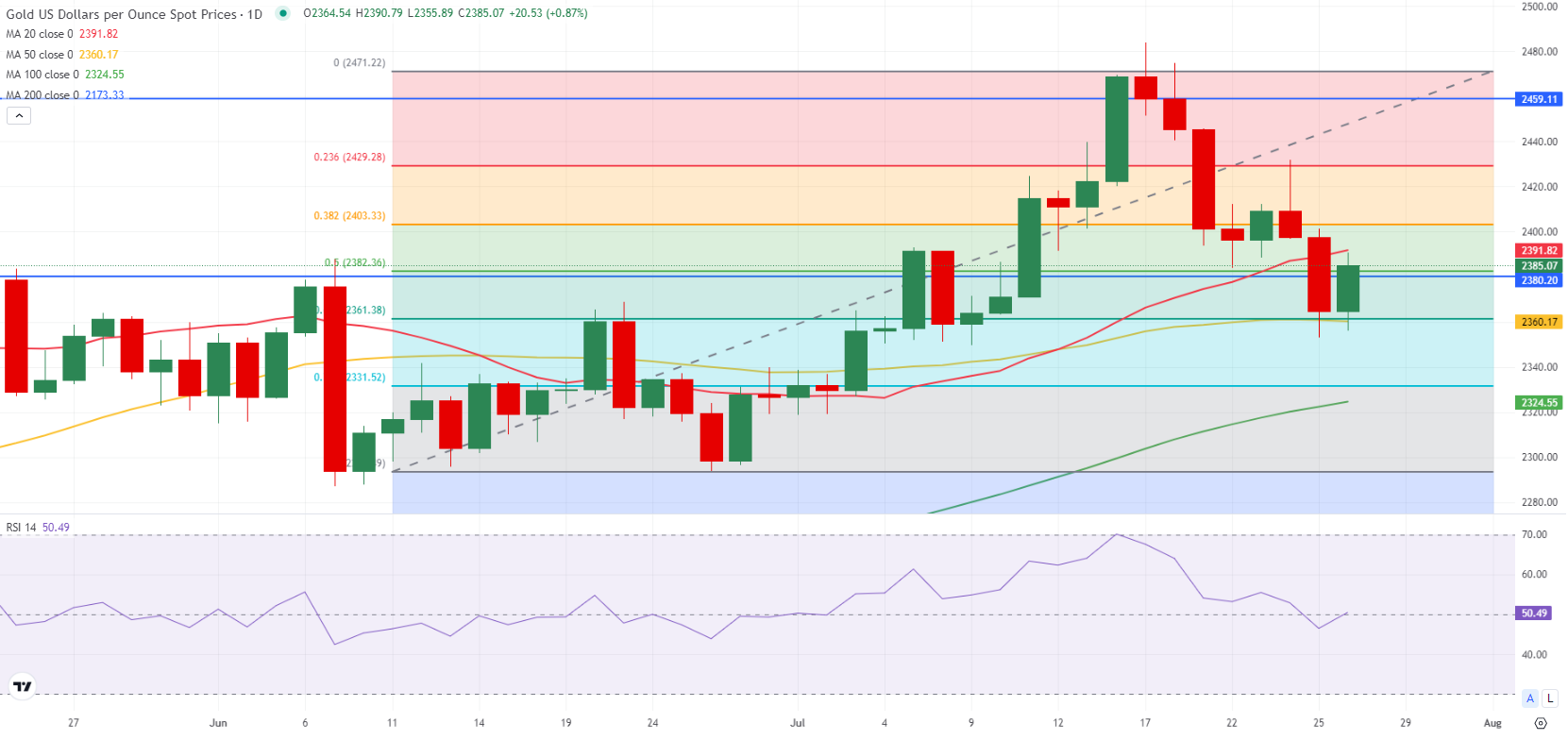
The Relative Strength Index (RSI) indicator on the daily chart recovered toward 50, despite Gold’s sharp drop on Thursday, suggesting that sellers remain hesitant to commit to an extended downtrend for the time being.
Gold faces key support area at $2,360, where the Fibonacci 61.8% retracement of the July uptrend meets the 50-day Simple Moving Average (SMA). In case Gold falls below that level and starts using it as resistance, technical sellers could take action. In this scenario, $2,330-$2,325 (Fibonacci 78.6% retracement, 100-day SMA) could be set as the next bearish target.
On the upside, a strong resistance area seems to have formed at $2,390-$2,400 (20-day SMA, Fibonacci 38.2% retracement, psychological level). If XAU/USD stabilizes above this region, $2,430 (Fibonacci 23.6% retracement) could be seen as the next hurdle before $2,460 (static level).
Gold FAQs
Gold has played a key role in human’s history as it has been widely used as a store of value and medium of exchange. Currently, apart from its shine and usage for jewelry, the precious metal is widely seen as a safe-haven asset, meaning that it is considered a good investment during turbulent times. Gold is also widely seen as a hedge against inflation and against depreciating currencies as it doesn’t rely on any specific issuer or government.
Central banks are the biggest Gold holders. In their aim to support their currencies in turbulent times, central banks tend to diversify their reserves and buy Gold to improve the perceived strength of the economy and the currency. High Gold reserves can be a source of trust for a country’s solvency. Central banks added 1,136 tonnes of Gold worth around $70 billion to their reserves in 2022, according to data from the World Gold Council. This is the highest yearly purchase since records began. Central banks from emerging economies such as China, India and Turkey are quickly increasing their Gold reserves.
Gold has an inverse correlation with the US Dollar and US Treasuries, which are both major reserve and safe-haven assets. When the Dollar depreciates, Gold tends to rise, enabling investors and central banks to diversify their assets in turbulent times. Gold is also inversely correlated with risk assets. A rally in the stock market tends to weaken Gold price, while sell-offs in riskier markets tend to favor the precious metal.
The price can move due to a wide range of factors. Geopolitical instability or fears of a deep recession can quickly make Gold price escalate due to its safe-haven status. As a yield-less asset, Gold tends to rise with lower interest rates, while higher cost of money usually weighs down on the yellow metal. Still, most moves depend on how the US Dollar (USD) behaves as the asset is priced in dollars (XAU/USD). A strong Dollar tends to keep the price of Gold controlled, whereas a weaker Dollar is likely to push Gold prices up.
Author

Eren Sengezer
FXStreet
As an economist at heart, Eren Sengezer specializes in the assessment of the short-term and long-term impacts of macroeconomic data, central bank policies and political developments on financial assets.