Gold Weekly Forecast: Extended recovery depends on Fed's tone
- Gold recovered from multi-month lows, snapped a three-week losing streak.
- The FOMC is widely expected to hike its policy rate by 75 bps next week.
- The technical outlook shows bearish bias stays intact as long as gold remains below $1,780.


Gold price fell to its lowest level in nearly a year at $1,680 on Wednesday but managed to stage a decisive rebound in the second half of the week. XAUUSD capitalized on the sharp decline witnessed in the US Treasury bond yields and ended up snapping a three-week losing streak. Ahead of the Federal Reserve’s policy announcements and the US Gross Domestic Product data, gold could find it difficult to make a convincing move in either direction.
What happened last week?
Although the dollar struggled to find demand at the beginning of the week, gold struggled to gain traction and fluctuated in a tight range above $1,700. Growing fears over China imposing additional coronavirus-related restrictions weighed on gold’s demand outlook. The country reported 699 coronavirus cases on Monday, the highest daily tally since May 22, having reported over 1,000 infections over the weekend. The city of Lanzhou ordered a city-wide lockdown from Wednesday, and Shanghai widened the mass testing to 12 of the city's 16 districts. Meanwhile, the data from the US showed that Housing Starts declined by 2% on a monthly basis in June, dragging the probability of a 100 basis points Fed rate hike in July lower.
In the absence of high-tier macroeconomic data releases on Tuesday, gold price extended its sideways grind above $1,700. On Wednesday, the negative shift witnessed in risk sentiment helped the USD outperform its rivals and forced the price to fall toward $1,700. Additionally, reports suggesting that the European Central Bank (ECB) could hike its policy rate by 50 bps rather than 25 bps triggered a sharp decline in XAUEUR in the first half of the week, causing XAUUSD to push lower.
On Thursday, the ECB announced a 50 bps rate hike. With the initial market reaction, the dollar came under heavy selling pressure, and gold reversed its course. Although the US Dollar Index erased a large portion of its daily losses during ECB President Christine Lagarde’s press conference, gold preserved its bullish momentum. The 5% decline seen in the benchmark 10-year US Treasury bond yield fueled XAUUSD’s rally. Lagarde refrained from committing to another 50 bps hike in September and didn’t share any details regarding the bank’s new anti-fragmentation tool.
As US T-bond yields continued to decline on Friday, gold managed to build on Thursday’s gains and climbed above $1,730 for the first time in a week. Ahead of the weekend, the data from the US revealed that the business activity in the service sector contracted in early July, with S&P Global Services PMI dropping to 47 from 52.7 in June. This reading came in much weaker than the market expectation of 52.6 and triggered another decline in US yields, allowing gold bulls to retain control of the price action.
Next week
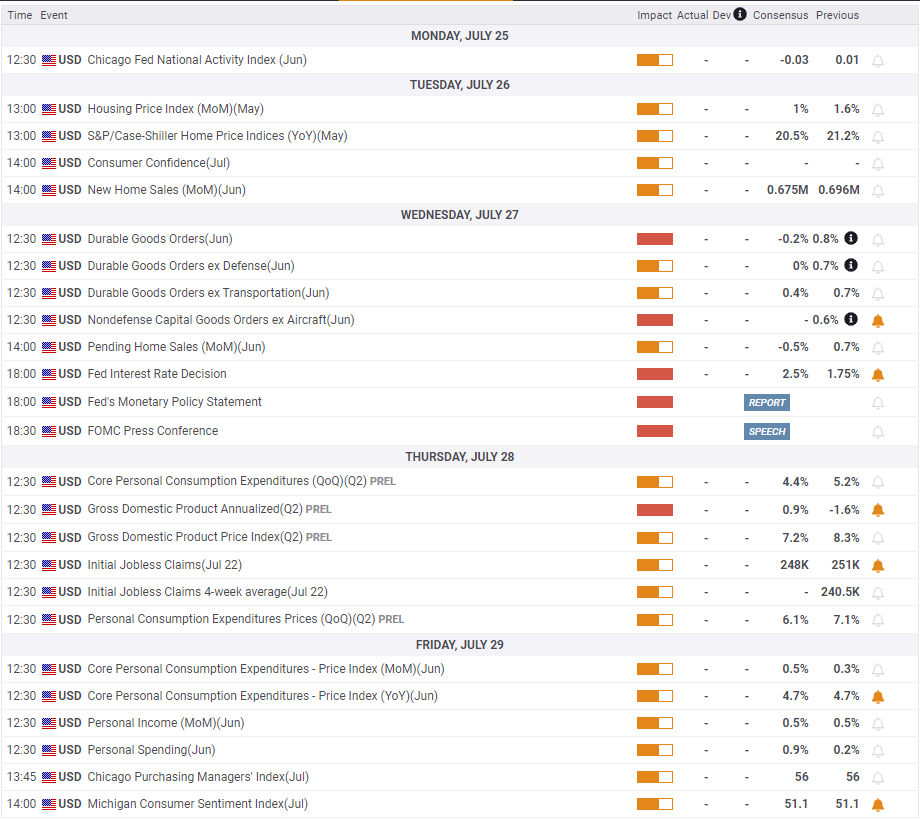
June New Home Sales and the Conference Board’s Consumer Confidence Index data will be featured in the US economic docket on Tuesday. According to the CME Group’s FedWatch Tool, markets are pricing in a 22% probability of a 100 bps rate hike. Even if the housing data show an unexpected increase in sales, investors are unlikely to reassess the FOMC’s upcoming rate decision.
The disappointing macroeconomic data releases of late and the modest decline in the University of Michigan’s long-run inflation expectations caused investors to refrain from betting on a 100 bps hike in July despite hot inflation data.
At this point, a 100 bps hike would be a significant hawkish surprise and trigger a dollar rally. If the Fed opts for a 75 bps increase as expected, market participants will look for fresh clues regarding the September hike and the location of the neutral rate. In case the US central bank commits to at least one more 75 bps hike in September, the dollar could gather strength as the market pricing points to a 44% chance of a total of 150 bps hikes in the next two meetings. In that hawkish scenario, US Treasury bond yields are likely to gain traction and further weigh on XAUUSD.
On the other hand, the USD could weaken against its rivals if the Fed acknowledges an increasing risk of recession and voices its concerns over the worsening conditions in the housing market. The possibility of a 50 bps hike in September would also be seen as a dovish development and open the door for another leg higher in gold.
On Thursday, the US Bureau of Economic Analysis will release its first estimate of the second-quarter GDP growth. Markets expect the US economy to expand by 0.9% following the 1.6% contraction recorded in the first quarter. It’s difficult to predict the market reaction following the Fed event, but it is likely to be straightforward, with a better-than-expected print being USD-positive and vice versa.
It’s worth noting that 2.7% aligns as significant support for the 10-year US T-bond yield. In case this level stays intact, yields could rebound and limit gold’s upside.
Finally, Personal Spending and Personal Income data for June, alongside the Personal Consumption Expenditure (PCE) Price Index will be watched closely by market participants ahead of the weekend.
Gold technical outlook
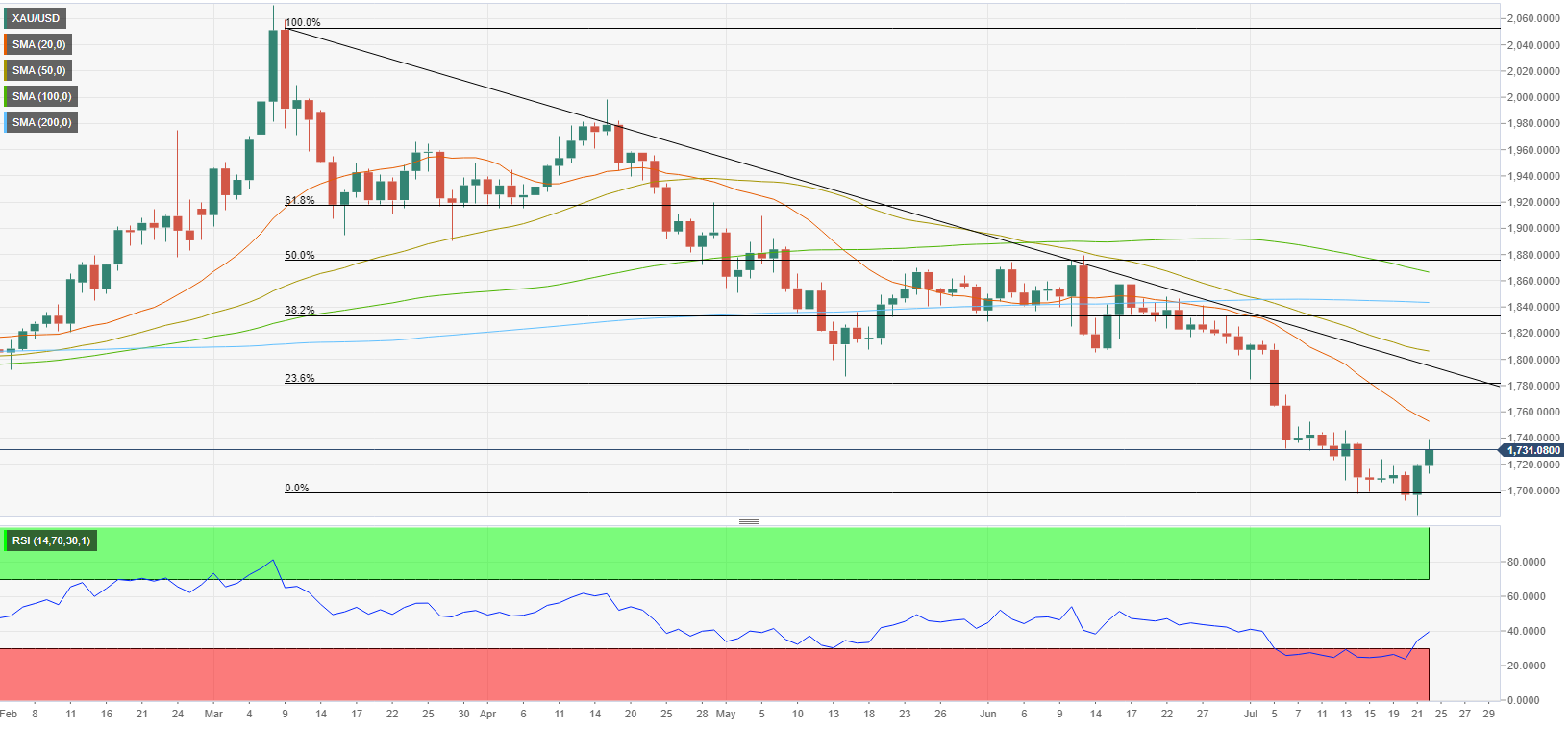
The Relative Strength Index (RSI) indicator on the daily chart climbed above 30 for the first time in two weeks, suggesting that gold has finally corrected its oversold conditions. The technical recovery could continue until the daily RSI reaches 50.
On the upside, $1,750 (20-day SMA) aligns as initial resistance ahead of $1,780, where the Fibonacci 23.6% retracement of the latest downtrend and the descending trend line meet. A daily close above the latter could be seen as a significant bullish development and open the door for additional gains toward $1,800.
On the downside, $1,700 (psychological level) forms key support before $1,680 (July 21 low, static level from March 2021) and $1,670 (static level from May 2020).
Gold forecast poll
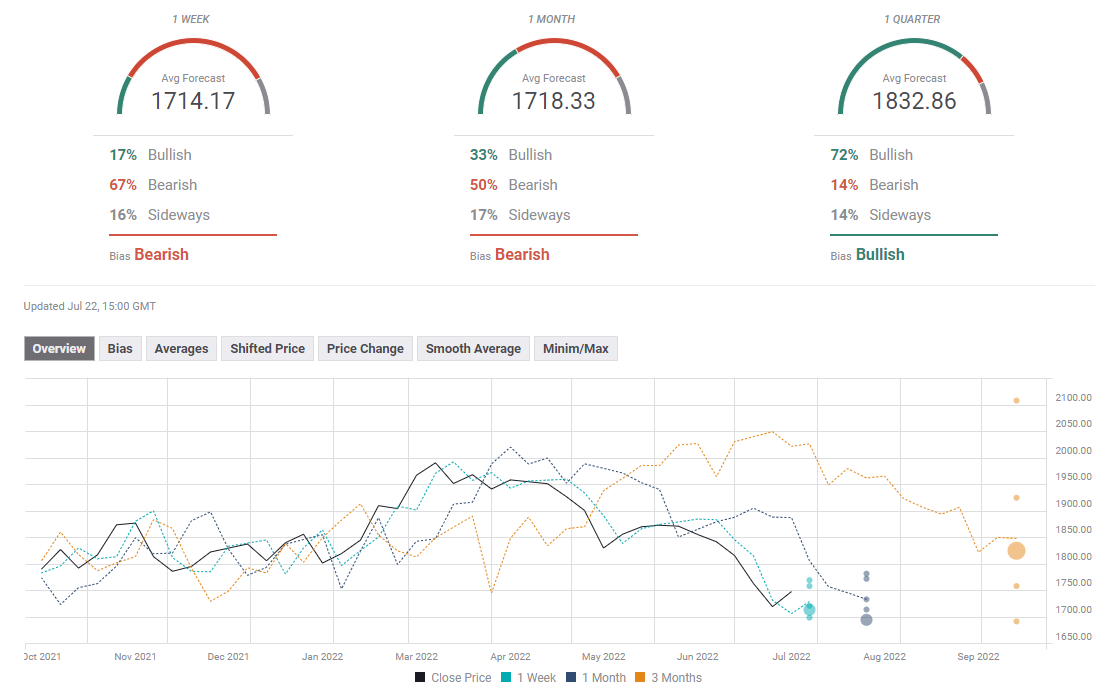
Despite this week's rebound, the near-term outlook for gold remains bearish, according to the FXStreet Forecast Poll. Similarly, half of the polled experts expect gold price to continue to edge lower over the next month.
Premium
You have reached your limit of 3 free articles for this month.
Start your subscription and get access to all our original articles.
Author
Eren Sengezer
FXStreet
As an economist at heart, Eren Sengezer specializes in the assessment of the short-term and long-term impacts of macroeconomic data, central bank policies and political developments on financial assets.