Gold Price Forecast: XAU/USD struggle with key $2,650 level extends ahead of US Retail Sales data
- Gold price clings to the previous rebound above $2,650 ahead of US Retail Sales data.
- The US Dollar stays defensive with Treasury bond yields despite hopes of a hawkish Fed in 2025.
- Gold price looks for a fresh impetus amid neutral daily RSI while below 50-day SMA at $2,671.

Gold price holds the previous rebound above $2,650 early Tuesday as buyers remain in control amid sustained weakness in the US Dollar (USD) and sluggish US Treasury bond yields. The focus now remains on the US Retail Sales data as the US Federal Reserve (Fed) begins its two-day monetary policy meeting later on Tuesday.
Gold price awaits US data ahead of Wednesday’s Fed event risk
Traders continue to adjust their USD positions, closing in on the Fed policy announcements, with US Treasury bond yields witnessing a choppy action, unperturbed by the mixed US S&P Global preliminary Manufacturing and Services PMI data released on Tuesday. Data showed that the US manufacturing sector contraction deepened to 48.3 in December, missing the forecast of 49.4. Meanwhile, the US Services PMI jumped to 58.5 in the same period from November’s 56.1. The market consensus was 55.7.
The CME Group's FedWatch Tool shows that markets continue to fully price in the probability that the Fed will lower the interest rate by 25 basis points on Wednesday. This continues to underpin the sentiment around the non-yielding Gold price alongside looming geopolitical risks.
However, growing expectations that the Fed could opt for fewer rate cuts in 2025 and likely pause its easing cycle in January act as a headwind to the Gold price turnaround. Markets eagerly await the Fed’s quarterly economic projections and Chairman Jerome Powell’s comments to gauge the US central bank’s path forward on interest rates next year, which could significantly impact the Gold price.
On the geopolitical front, the US imposed new sanctions on North Korea and Russia on Monday, targeting Pyongyang's financial activities and military support to Moscow. The political instability in South Korea and Israel-Gaza tensions also support the Gold price.
In the lead-up to the Fed event risks, Gold traders look forward to US November Retail Sales for some fresh trading incentives. The consumer spending data, however, is unlikely to alter the market’s expectations of the Fed’s move this week.
Gold price technical analysis: Daily chart
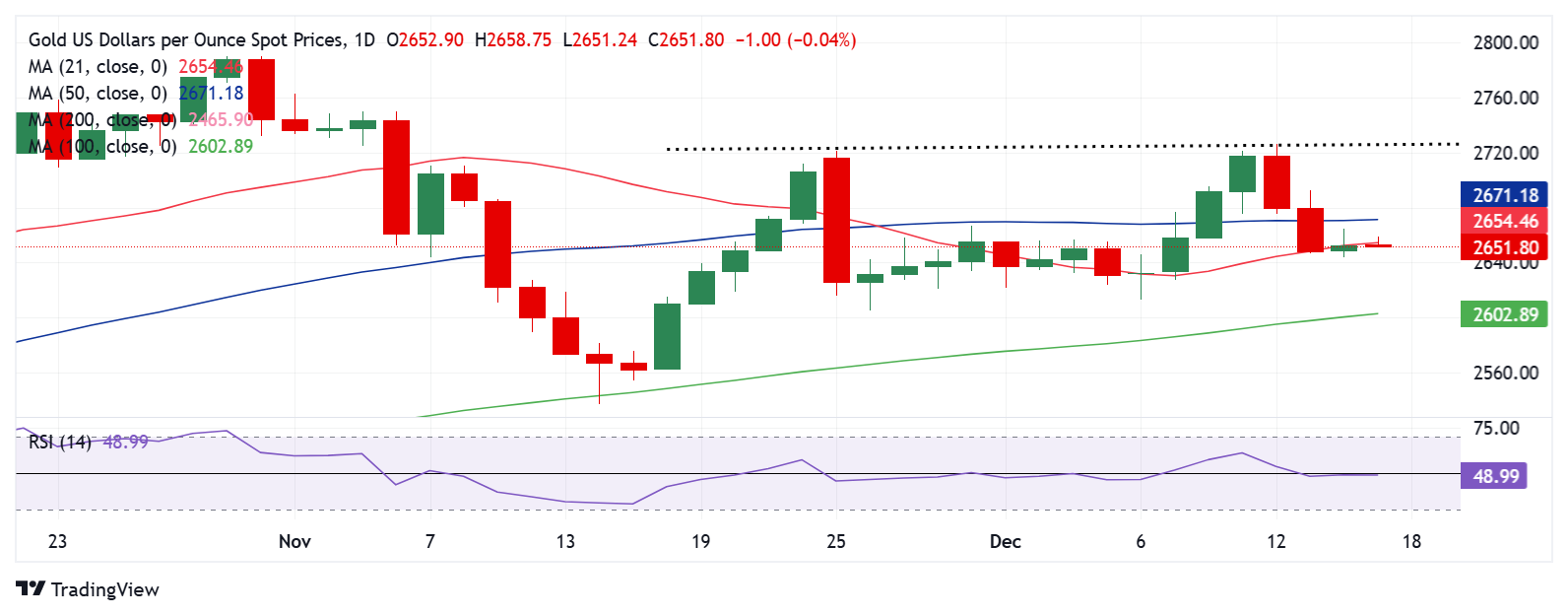
As observed on the daily chart, Gold price extends its struggles with the 21-day Simple Moving Average (SMA) support at $2,655 after having closed above it on Monday.
The 14-day Relative Strength Index (RSI) is trading flat at around the 50 level, suggesting a lack of clear directional bias.
Gold buyers must scale the 50-day SMA at $2,671 to offer extra legs to the recent rebound. The next upside target is at the $2,700 level.
Further up, Gold price could revisit the multi-week high of $2,726.
Conversely, a daily candlestick close below the 21-day SMA at $2,655 could initiate a fresh downtrend toward the December 6 low of $2,613.
The line in the sand for Gold buyers is seen at the $2,600 area, where the 100-day SMA coincides with the November 26 low.
Economic Indicator
Retail Sales (MoM)
The Retail Sales data, released by the US Census Bureau on a monthly basis, measures the value in total receipts of retail and food stores in the United States. Monthly percent changes reflect the rate of changes in such sales. A stratified random sampling method is used to select approximately 4,800 retail and food services firms whose sales are then weighted and benchmarked to represent the complete universe of over three million retail and food services firms across the country. The data is adjusted for seasonal variations as well as holiday and trading-day differences, but not for price changes. Retail Sales data is widely followed as an indicator of consumer spending, which is a major driver of the US economy. Generally, a high reading is seen as bullish for the US Dollar (USD), while a low reading is seen as bearish.
Read more.Next release: Tue Dec 17, 2024 13:30
Frequency: Monthly
Consensus: 0.5%
Previous: 0.4%
Source: US Census Bureau
Retail Sales data published by the US Census Bureau is a leading indicator that gives important information about consumer spending, which has a significant impact on the GDP. Although strong sales figures are likely to boost the USD, external factors, such as weather conditions, could distort the data and paint a misleading picture. In addition to the headline data, changes in the Retail Sales Control Group could trigger a market reaction as it is used to prepare the estimates of Personal Consumption Expenditures for most goods.
Author

Dhwani Mehta
FXStreet
Residing in Mumbai (India), Dhwani is a Senior Analyst and Manager of the Asian session at FXStreet. She has over 10 years of experience in analyzing and covering the global financial markets, with specialization in Forex and commodities markets.